This learning resource is available in interactive and printable formats. The interactive worksheet can be played online and assigned to students. The Printable PDF version can be downloaded and printed for completion by hand.
This passage, aligned to NGSS standard MS-ESS1-3, helps middle school students grasp the immense scale of the solar system. It covers how scientists use models and analogies, such as comparing the Sun to a basketball and planets to different-sized objects, to visualize distances that are otherwise hard to imagine. Students learn why most of the solar system is empty space, how light and radio signals travel between planets, and the technological and communication challenges this creates. The passage connects these concepts to real-world exploration, such as the Voyager 1 mission and the nearest star beyond our solar system. Activities include comprehension questions, writing prompts, and graphic organizers to support understanding. Audio integration supports diverse learning needs. Keywords: solar system, scale, distance, NGSS, science education, light year, AU.
CONTENT PREVIEW
Expand content preview
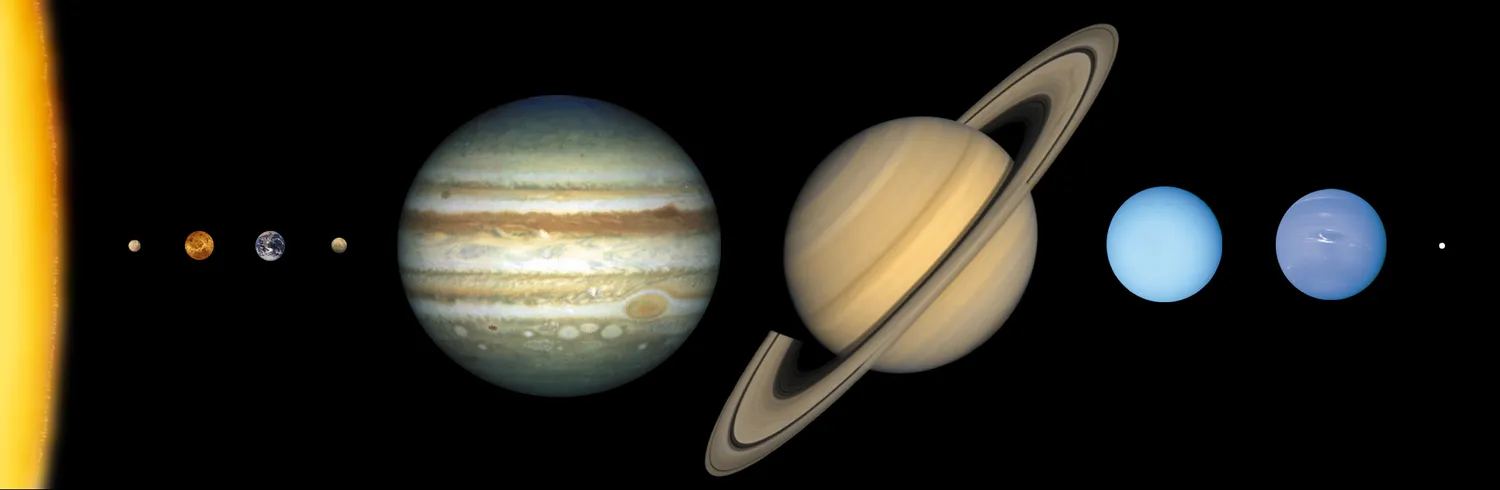
"Solar system scale" by Lunar and Planetary Laboratory / Source: Wikimedia Commons (Public domain).
The solar system is the collection of the Sun, eight planets, their moons, and many smaller objects, all bound together by gravity. Scientists study the solar system to understand why the planets move as they do and how they interact with each other. One major challenge in studying the solar system is grasping its vast scale. Most of the space between planets is empty, and the distances are so large that even light takes minutes or hours to travel from one place to another.
Understanding the Immense Distances
To better understand these distances, astronomers use models and analogies. For example, if the Sun were the size of a basketball, Mercury would be a peppercorn about 15 meters away, Earth would be another peppercorn 38 meters from the Sun, and Jupiter would be a large grapefruit 200 meters away. Neptune, the most distant planet, would be a walnut 1.2 kilometers from the Sun. The distances between planets are often measured in astronomical units (AU), where 1 AU is the distance from Earth to the Sun, about 150 million kilometers. Mercury is only 0.4 AU away, while Neptune is 30 AU from the Sun. This shows that most of the solar system is empty space, with planets orbiting at great distances from each other and from the Sun.
Light, Communication, and Space Exploration
Light travels very fast—about 300,000 kilometers per second—but even at that speed, it takes 8 minutes to reach Earth from the Sun and 4 hours to reach Neptune. When scientists communicate with spacecraft, such as the Mars rover, they must wait 4 to 24 minutes for messages to travel between Earth and Mars, depending on their positions. The Voyager 1 spacecraft, launched in 1977, is now over 23 billion kilometers from Earth, about 156 AU. A radio signal from Earth takes over 21 hours just to reach Voyager 1. Yet, Voyager 1 is still only about 0.002 light-years away. In comparison, the nearest star, Proxima Centauri, is 4.2 light-years, or about 268,000 AU from the Sun. This demonstrates just how tiny our solar system is compared to the galaxy.
Why Scale Models Matter
Because it's impossible to build a model that shows both the size of planets and the distances between them accurately, scientists use scale models to help people picture the solar system. These models help us understand why space exploration is so difficult—spacecraft must travel enormous distances through mostly empty space. Understanding the scale of the solar system also helps scientists plan missions, predict planetary movements, and develop new technology for communication and exploration. The study of the solar system connects to larger scientific principles, such as gravity and the nature of space and time.
Understanding the scale of the solar system reveals the challenges faced by scientists and engineers and highlights our place in the universe. The vastness of space encourages new questions about how we might explore further in the future.
Interesting Fact: If Voyager 1 kept traveling at its current speed, it would still take over 70,000 years to reach the nearest star, Proxima Centauri!
What is one main challenge scientists face when studying the solar system?
Understanding the vast distances between objectsCounting all the moons in the galaxyFinding new elements on EarthMeasuring rainfall on Jupiter
In a scale model where the Sun is a basketball, how far away would Neptune be?
15 meters1.2 kilometers38 meters200 meters
What is an astronomical unit (AU)?
The distance from Earth to the MoonThe average distance from Earth to the SunThe width of JupiterThe speed of light
How long does it take for light to travel from the Sun to Earth?
8 minutes1 hour21 hours4 hours
What does the passage say about Voyager 1?
It is already outside the Milky WayIt is still only a tiny fraction of a light-year from EarthIt takes 8 minutes to send it a messageIt is the closest planet to the Sun
What is the purpose of using scale models in studying the solar system?
To show both planet sizes and distances perfectlyTo help visualize the vast distances and empty spaceTo shrink the real planets for easier studyTo find new moons around Neptune
Why do scientists have to wait for messages when communicating with space probes?
Because signals travel slowly through Earth's airBecause of the huge distances signals must crossBecause planets block all signalsBecause probes only receive messages at night
If the Sun is a basketball in a model, what object represents Earth?
A walnutA peppercornA grapefruitA marble
True or False: The passage says that most of the solar system is filled with empty space.
TrueFalse
True or False: The passage claims that Proxima Centauri is less than 10 AU from the Sun.
TrueFalse
Perfect For:
👩🏫 Teachers
• Reading comprehension practice
• Auto-graded assessments
• Literacy skill development
👨👩👧👦 Parents
• Reading practice at home
• Comprehension improvement
• Educational reading time
🏠 Homeschoolers
• Reading curriculum support
• Independent reading practice
• Progress monitoring
Reading Features:
📖
Reading Passage
Engaging fiction or nonfiction text
❓
Comprehension Quiz
Auto-graded questions
📊
Instant Feedback
Immediate results and scoring
📄
Printable Version
Download for offline reading
🔊
Read Aloud
Voice-over with word highlighting
Reviews & Ratings
No reviews yet. Be the first to share your experience!
Related Content
Sunspots and Solar Flares
This quiz is designed to test your understanding of the fascinating phenomena of sunspots and solar flares, as described...
RI.4.1RI.4.4RI.5.1ESS1.A
The Hottest Planet in the Solar System
This NGSS-aligned middle school reading passage explains why Venus is the hottest planet in our solar system. Students l...
MS-ESS1-3
Mercury: Closest to the Sun
This comprehensive, standards-aligned passage explores Mercury—the smallest and closest planet to the Sun. Students in g...
MS-ESS1-2MS-ESS1-3
Venus: Earth's Twin?
This comprehensive science passage for grades 6-8 examines Venus—often called Earth's twin—by exploring its similarities...
MS-ESS1-2MS-ESS1-3
Mars: The Red Planet
This middle school science passage explores Mars, the Red Planet, providing students in grades 6-8 with a comprehensive ...
MS-ESS1-2MS-ESS1-3
What Is the Solar System?
This passage provides a comprehensive overview of the solar system for grades 6-8, aligned with NGSS standards MS-ESS1-2...
MS-ESS1-2MS-ESS1-3
Structure of the Solar System
This comprehensive science reading passage introduces middle school students (grades 6-8) to the structure of the solar ...
MS-ESS1-2MS-ESS1-3
Exploration of the Solar System
This comprehensive passage for grades 6-8 examines how humans explore the solar system, aligning with NGSS standards MS-...
MS-ESS1-3MS-ETS1-1
Optical Telescopes
This comprehensive passage explores the science of optical telescopes for middle school students, aligning with NGSS sta...
MS-ESS1-3MS-ETS1-1
Future of Alien Search
This informational passage for grades 6-8 explores how scientists are using cutting-edge missions and technology to sear...
MS-ESS1-3MS-ETS1-1
Communicating with Aliens
This middle school science passage, aligned with NGSS standard MS-ESS1-3, examines the scientific and technological chal...
MS-ESS1-3
Measuring Distances in Space
This middle school science passage explores how astronomers measure the vast distances in space, aligning with NGSS stan...
MS-ESS1-3
Astronomy
This comprehensive reading passage introduces middle school students to the science of astronomy, which is the study of ...
MS-ESS1-2MS-ESS1-3MS-PS4-2MS-ETS1-1
The Solar System
This middle school science passage introduces students to the solar system, aligning with NGSS standards MS-ESS1-2 and M...
MS-ESS1-2MS-ESS1-3
The Inner Planets
This comprehensive science passage for grades 6-8 explores the inner (terrestrial) planets of our solar system—Mercury, ...
MS-ESS1-2MS-ESS1-3
The Outer Planets
This engaging science passage for grades 6-8 introduces students to the outer planets—Jupiter, Saturn, Uranus, and Neptu...
MS-ESS1-2MS-ESS1-3
Light-Years and Cosmic Distances
This middle school science passage, aligned to NGSS MS-ESS1-3, explores how astronomers measure the vast distances in sp...
MS-ESS1-3
Space Stations
This informational science reading passage for grades 6-8 explores the complex systems and technology behind space stati...
MS-ESS1-3MS-ETS1-1
Types of Spacecraft
This passage introduces middle school students to the various types of spacecraft used to explore our solar system and b...