Supermassive Black Holes in Galaxies — Reading Comprehension
Rate this
Premium Resource
Present
Present in classroom. No work saved
Assign
Classroom with student accounts, Track progress
Quick Play
No student accounts, assign with a link
Grades
6
PRINT+DIGITAL RESOURCE
This learning resource is available in interactive and printable formats. The interactive worksheet can be played online and assigned to students. The Printable PDF version can be downloaded and printed for completion by hand.
This educational passage, audio integrated for an enhanced learning experience, delves into the fascinating world of supermassive black holes in galaxies. Students will learn how these incredibly dense objects influence the structure and movement of stars within galaxies, connecting to the NGSS standard MS-ESS1-2 by describing the role of gravity. The content covers key concepts like galaxy formation, the characteristics of supermassive black holes, and their relationship with galactic centers, making complex astronomical ideas accessible for a Grade 6 reading level. Important terms such as 'galaxy', 'gravity', and 'event horizon' are clearly defined, ensuring a solid understanding of this core science topic. The passage and activities help students build foundational knowledge about the universe.
CONTENT PREVIEW
Expand content preview
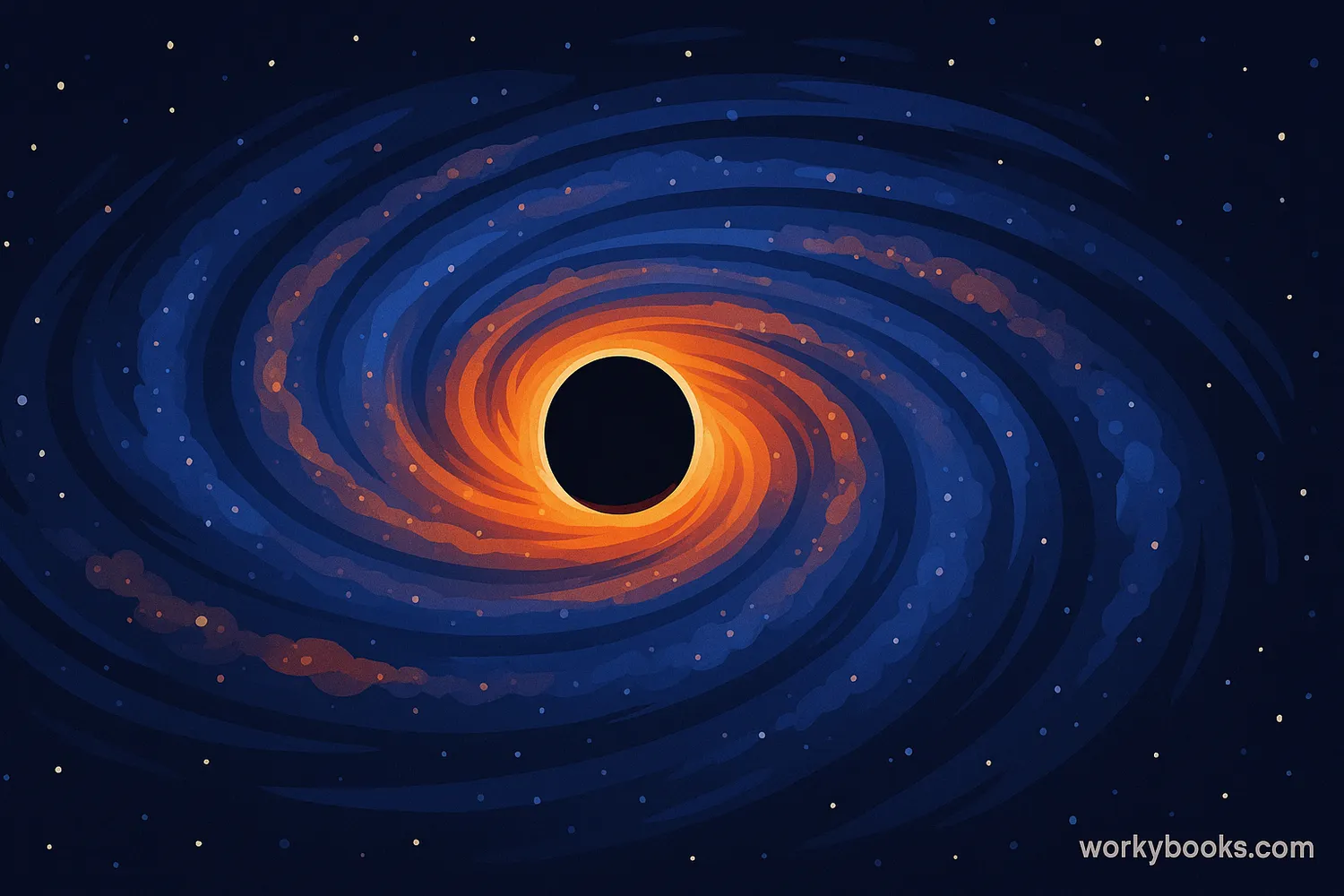
Galaxy swirl around black hole displaying event horizon and gravitational pull.
Imagine something so heavy and dense that not even light can escape its pull! That's a black hole. And there are special, super-sized ones called supermassive black holes. These incredible objects are found at the very center of almost every large galaxy, including our own Milky Way galaxy.
A galaxy is a huge collection of stars, gas, dust, and dark matter, all held together by gravity. Gravity is a force that pulls objects towards each other. The more mass an object has, the stronger its gravity. Supermassive black holes have millions, or even billions, of times the mass of our Sun! Because they are so massive, their gravity is incredibly powerful. This strong gravitational pull plays a big role in how galaxies are formed and how they behave.
These supermassive black holes act like gravitational anchors. Stars, gas, and dust in the galaxy orbit around this central black hole, much like planets orbit the Sun in our solar system. The black hole's gravity helps to keep the entire galaxy organized and spinning. Without its strong gravitational influence, the stars in a galaxy might drift apart or move in a much more chaotic way.
One of the most famous supermassive black holes is named Sagittarius A* (pronounced "Sagittarius A star"). This is the one at the center of our Milky Way galaxy. Scientists study the movement of stars very close to Sagittarius A* to learn more about how black holes work and their effect on galactic structure. While supermassive black holes are incredibly powerful, they are also very far away from Earth, so there's no danger to us.
When matter gets too close to a black hole, it crosses a boundary called the event horizon. Once something crosses this line, it cannot escape the black hole's gravity. This is why black holes are often called "cosmic vacuum cleaners," though they don't actually "suck up" everything. They only pull in things that get too close. Understanding these cosmic giants helps us understand the universe and our place in it.
Interesting Fact: Even though Sagittarius A* is a supermassive black hole, it's actually quite quiet and doesn't consume much matter these days, making it relatively peaceful.
What is found at the center of most large galaxies?
Supermassive black holesSmall planetsBright nebulaeEmpty space
What is the name of our galaxy?
Andromeda GalaxyTriangulum GalaxyMilky Way GalaxyWhirlpool Galaxy
What force holds a galaxy together?
MagnetismGravityAir pressureLight speed
The more mass an object has, the stronger its gravity.
TrueFalse
What is the boundary where nothing escapes?
Orbital pathEvent horizonGravitational fieldStellar core
How do supermassive black holes help organize galaxies?
By emitting bright lightBy creating new starsBy strong gravitational pullBy repelling matter
If Earth's Sun were a black hole, how would this affect Earth's orbit, assuming its mass stayed the same?
Orbit fasterOrbit slowerOrbit the sameLeave orbit
Why are black holes called 'cosmic vacuum cleaners'?
They create suctionThey absorb all lightThey pull in matter close byThey clean space
What might happen to a galaxy without a strong central gravitational influence?
Become brighterStars drift apartShrink in sizeForm new planets
If a new, much larger supermassive black hole suddenly appeared near a galaxy, what would be the most likely immediate effect on the galaxy's stars?
Stars would get hotter.Their orbits would change.Stars would disappear.The galaxy would expand.
Perfect For:
👩🏫 Teachers
• Reading comprehension practice
• Auto-graded assessments
• Literacy skill development
👨👩👧👦 Parents
• Reading practice at home
• Comprehension improvement
• Educational reading time
🏠 Homeschoolers
• Reading curriculum support
• Independent reading practice
• Progress monitoring
Reading Features:
📖
Reading Passage
Engaging fiction or nonfiction text
❓
Comprehension Quiz
Auto-graded questions
📊
Instant Feedback
Immediate results and scoring
📄
Printable Version
Download for offline reading
🔊
Read Aloud
Voice-over with word highlighting
Reviews & Ratings
No reviews yet. Be the first to share your experience!
Related Content
Earth: Our Home in Space
This engaging Grade 4-5 science passage, aligned to NGSS, introduces students to Earth's special place in the solar syst...
Tools and Technology in Earth Science
This middle school science reading passage explores the wide range of tools and technologies used in Earth science, from...
MS-ESS2-2MS-ESS3-2MS-ETS1-1MS-PS4-3
Earth's Place in the Universe
This reading passage explains Earth's place in the universe, supporting NGSS 1-ESS1-1. It describes how Earth is one of ...
1-ESS1-1
Scientific Inquiry in Earth Science
This passage explores scientific inquiry in Earth science for grades 6-8, aligned with NGSS standards MS-ESS1-4, MS-ESS2...
MS-ESS1-4MS-ESS2-1MS-ESS3-5SEP
What Is Space Weather and How Does It Affect the Earth?
This NGSS-aligned science passage for middle school explains what space weather is and how it affects Earth. Students le...
MS-ESS2-2
Escape Velocity and Space Travel
This middle school science passage introduces students to the concept of escape velocity—the minimum speed required to b...
MS-ESS1-2MS-PS2-4
Space Stations
This informational science reading passage for grades 6-8 explores the complex systems and technology behind space stati...
MS-ESS1-3MS-ETS1-1
What Is Earth Science?
This engaging middle school science passage introduces students to the field of Earth science, aligning with NGSS standa...
MS-ESS1MS-ESS2MS-ESS3SEP
The Space Garden
This innovative passage combines plant science with space exploration, aligning with NGSS standards for life sciences an...
RL.3.1RL.2.1RL.4.9
Measuring Distances in Space
This middle school science passage explores how astronomers measure the vast distances in space, aligning with NGSS stan...
MS-ESS1-3
Earth: Our Home Planet
This comprehensive science passage for grades 6-8 explores Earth’s unique characteristics and the interconnected systems...
MS-ESS1-2
Meteorite Impacts on Earth
This engaging science reading passage for Grades 4-5 explores meteorite impacts on Earth, aligning with NGSS standards. ...
Exploring Space: Rockets and Spacecraft
Space exploration has been one of humanity's greatest achievements, made possible by rockets and spacecraft. Rockets act...
RI.4.4RI.4.2
Earth's Rotation
This middle school science passage, aligned with NGSS standard MS-ESS1-1, focuses on Earth's rotation—how Earth spins on...
MS-ESS1-1
Facts About Earth
This engaging science reading passage introduces Grade 4 and 5 students to Earth, our home planet. Aligned with NGSS sta...
Earth's Moon Facts
This engaging science passage, 'The Moon: Earth's Companion,' is designed for Grade 4-5 students and aligns with NGSS ge...
Earth's Seasons
This comprehensive reading passage for grades 6-8 explains why Earth has seasons, revealing the scientific mechanisms be...
MS-ESS1-1
International Space Station
Discover the wonders of the International Space Station with this informative coloring page showcasing the orbiting outpost where astronauts live and work in space. As children color the complex modul...
Venus: Earth's Twin?
This comprehensive science passage for grades 6-8 examines Venus—often called Earth's twin—by exploring its similarities...
MS-ESS1-2MS-ESS1-3
What Makes Earth Perfect for Life?
This Grade 4-5 science passage, aligned with NGSS standards, explores the essential features that make Earth the perfect...