The Aye-Aye's Special Finger for Finding Food — Reading Comprehension
Rate this
Premium Resource
Present
Present in classroom. No work saved
Assign
Classroom with student accounts, Track progress
Quick Play
No student accounts, assign with a link
Grades
6
PRINT+DIGITAL RESOURCE
This learning resource is available in interactive and printable formats. The interactive worksheet can be played online and assigned to students. The Printable PDF version can be downloaded and printed for completion by hand.
This audio-integrated reading passage, 'The Aye-Aye's Special Finger for Finding Food,' introduces students to the fascinating world of the aye-aye, a unique creature from Madagascar. It focuses on how this animal uses its extraordinary long middle finger as a tool to find and eat insects hidden inside trees, aligning with the NGSS Disciplinary Core Idea LS1.A: Structure and Function. Students will learn about animal adaptations, nocturnal habits, and the specific body parts animals use to obtain food. Keywords include aye-aye, special finger, Madagascar, nocturnal, insect eating, and animal adaptations. The passage is designed for a Grade 4 reading level, making complex biological concepts accessible and engaging.
CONTENT PREVIEW
Expand content preview
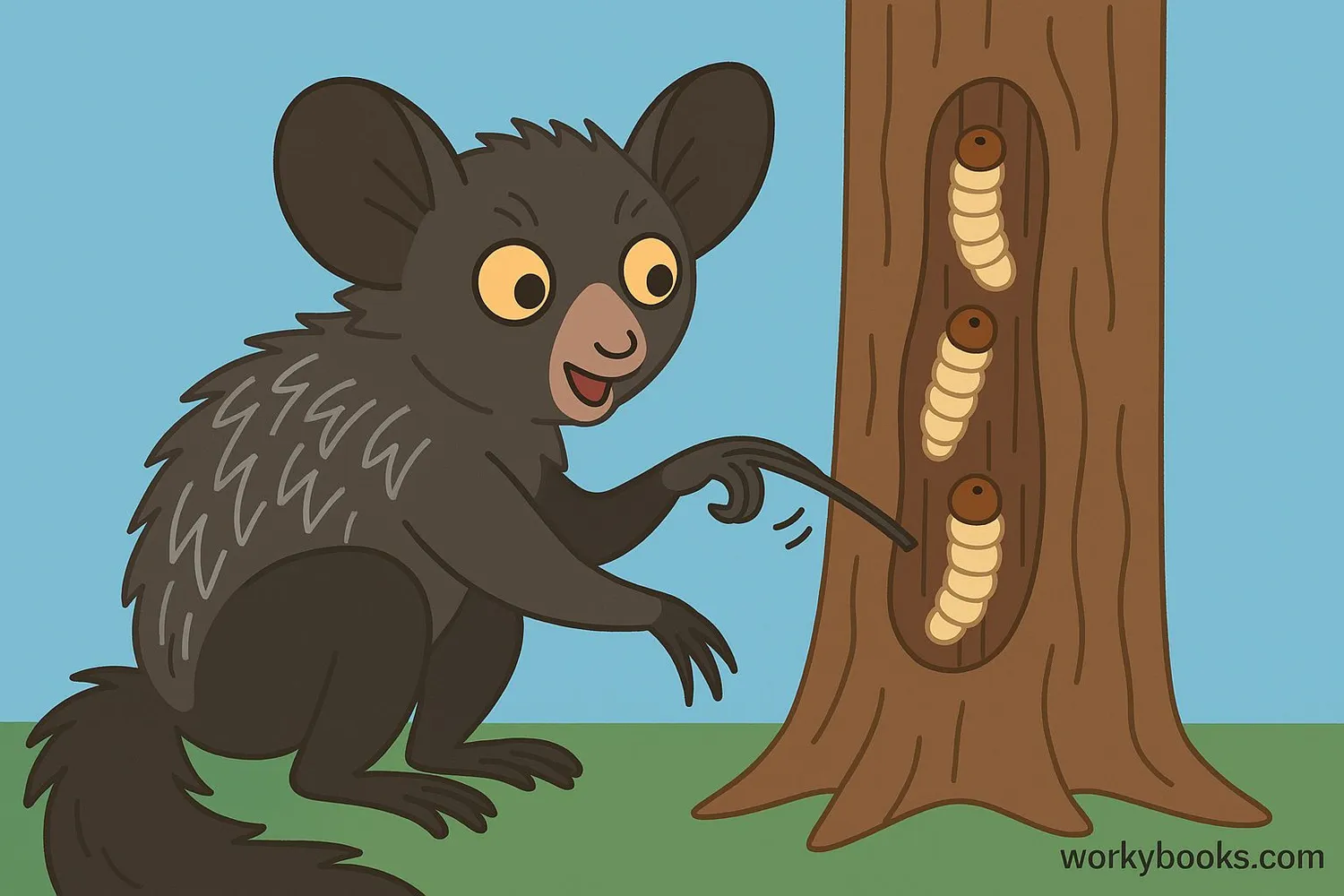
Aye-aye using its specialized super long, skinny middle finger
Aye-Aye Adaptations
The aye-aye is one of the most unusual animals in the world. It lives only in the rainforests of Madagascar, a large island near Africa. The aye-aye is a type of lemur, and it looks very different from most other animals.
To find food, the aye-aye uses a long, skinny middle finger that works like a built-in bug-catching tool! The aye-aye taps on tree branches and listens carefully with its large, sensitive ears. These ears help the aye-aye use a special sense called echolocation. Echolocation means listening for sounds and echoes to find insects hiding inside wood. When the aye-aye hears a hollow spot, it chews a hole with its sharp, rodent-like teeth, which never stop growing. Next, it slides its long middle finger into the hole to hook grubs and insects, pulling them out just like using a fishing hook.
The aye-aye is nocturnal, which means it is active at night. Its large eyes help it see in the dark while it hunts for food. All these special body parts, called adaptations, help the aye-aye survive in its rainforest home.
Sadly, the aye-aye is endangered. Many people are afraid of the aye-aye because of its strange looks and believe it brings bad luck. People also cut down forests in Madagascar, destroying the aye-aye's home. Conservationists are working to protect the aye-aye and its rainforest habitat, so this amazing animal does not disappear forever.
Interesting Fact: The aye-aye’s middle finger is so thin and flexible that it can move almost like a worm to reach deep into tree holes!
Where does the aye-aye live?
MadagascarAsiaSouth AmericaAustralia
What is the aye-aye's special finger used for?
Catching insectsRunning fastMaking soundsSwimming
What sense helps the aye-aye find food?
EcholocationTouchSmellTaste
Why does the aye-aye need big eyes?
To see at nightTo flyTo swimTo smell better
What would happen if the rainforest is destroyed?
Aye-ayes lose their homeAye-ayes get strongerAye-ayes have more foodNothing changes
How does the aye-aye get bugs from trees?
Chews a hole, uses fingerChases them on the groundCalls them outDigs with its feet
The aye-aye is nocturnal. (True or False)
TrueFalse
What does 'endangered' mean?
At risk of disappearingVery colorfulLives in waterVery large
Perfect For:
👩🏫 Teachers
• Reading comprehension practice
• Auto-graded assessments
• Literacy skill development
👨👩👧👦 Parents
• Reading practice at home
• Comprehension improvement
• Educational reading time
🏠 Homeschoolers
• Reading curriculum support
• Independent reading practice
• Progress monitoring
Reading Features:
📖
Reading Passage
Engaging fiction or nonfiction text
❓
Comprehension Quiz
Auto-graded questions
📊
Instant Feedback
Immediate results and scoring
📄
Printable Version
Download for offline reading
🔊
Read Aloud
Voice-over with word highlighting
Reviews & Ratings
No reviews yet. Be the first to share your experience!
Related Content
The Nature of Life Science
This passage, aligned with NGSS MS-LS1-1, introduces students in grades 6-8 to the foundational concepts of life science...
MS-LS1-1
Science Vocabulary
This worksheet on domain-specific words will help students learn some science vocabulary. Students will be asked to matc...
L.3.6L.3.4.A
The Science of Hibernation
This educational module, featuring an audio-integrated reading passage titled 'The Science of Hibernation,' is designed ...
Adaptation
This engaging middle school science passage explores adaptation, focusing on how inherited traits enable organisms to su...
MS-LS4-4MS-LS4-6
Simple Machines Science Report
This science writing task requires students to clearly explain how three simple machines work using precise domain-speci...
W.5.4
Desert Rain Frog Behavioral Adaptations
Dive into the fascinating world of the Desert Rain Frog and discover its incredible unique adaptations for survival in a...
Animal Adaptations Word Sort
This engaging word sort activity helps students understand the difference between physical and behavioral adaptations in...
Herbivore Adaptations
This engaging reading passage, integrated with audio, delves into the fascinating world of herbivore adaptations. Studen...
Ocean Animal Adaptations
Students will read a passage that provides information about various adaptations that marine animals have developed to t...
W.4.9.B
Nocturnal Adaptations of the Strange Aye-Aye
This engaging reading passage, integrated with audio, takes grade 5 students on a journey to discover the fascinating no...
Early Life Forms and Their Adaptations
This educational passage focuses on early life forms and their basic adaptations, supporting NGSS standard 3-LS4-2 for e...
RI.3.3RI.4.3RI.5.33-LS4-2
Binturong Adaptations
This engaging, audio-integrated reading passage, 'Binturong Adaptations,' for Grade 6 students delves into the fascinati...
Barnacle Biology and Adaptations
Dive into the intriguing world of barnacles with this engaging Grade 6 reading passage. Students will learn about these ...
Whale Blubber: Function and Adaptation
This engaging, audio-integrated reading passage, 'Whale Blubber Function and Adaptation,' introduces young learners to t...
Amur Leopard Adaptations
This engaging, audio-integrated reading passage, 'Amur Leopard Adaptations,' is designed for Grade 6 science students. I...
Mountain Animal Adaptations
This reading comprehension worksheet focuses on the topic of animal adaptations for survival in mountainous environments...
W.4.9.B
Climate Zone Adaptations Word Sort
This word sort activity examines how plants and animals adapt to different climate conditions. Students sort 12 differen...
Plant Adaptations for Survival
This NGSS-aligned word sort activity, suitable for kindergarten, focuses on plant survival adaptations, helping students...
K-LS1-1
The Pumpkin Life Cycle
This informational worksheet explores the pumpkin lifecycle, guiding students through procedural steps in a scientific t...
RI.2.3RI.2.10
Blobfish Adaptations to Extreme Pressure
This engaging passage explores the fascinating world of the blobfish and its unique adaptations to the extreme pressure ...