This learning resource is available in interactive and printable formats. The interactive worksheet can be played online and assigned to students. The Printable PDF version can be downloaded and printed for completion by hand.
This engaging 500-word science passage explores the remarkable adaptations of the Yeti Crab, a deep-sea creature discovered near hydrothermal vents. Students in grades 6-8 learn how this unusual organism survives in one of Earth's most extreme environments through specialized structures and behaviors. The passage aligns with NGSS standards MS-LS4-4, focusing on natural selection and adaptation (LS4.B and LS4.C). Students discover how the crab's bristle-covered claws may cultivate bacteria for food, how it navigates without sight using chemical senses, and how its exoskeleton withstands crushing deep-ocean pressure. The content includes comparisons with other deep-sea organisms like vampire squid and vent shrimp, helping students understand different survival strategies in extreme habitats. Audio-integrated features support diverse learners, while differentiated versions ensure accessibility for English Language Learners and struggling readers. Vocabulary terms are clearly defined in context, and comprehension activities reinforce understanding of adaptation, natural selection, and structure-function relationships in living organisms.
CONTENT PREVIEW
Expand content preview
Understanding how Yeti Crabs adapt to extreme conditions helps scientists learn how life can exist in harsh environments on Earth and potentially on other planets.
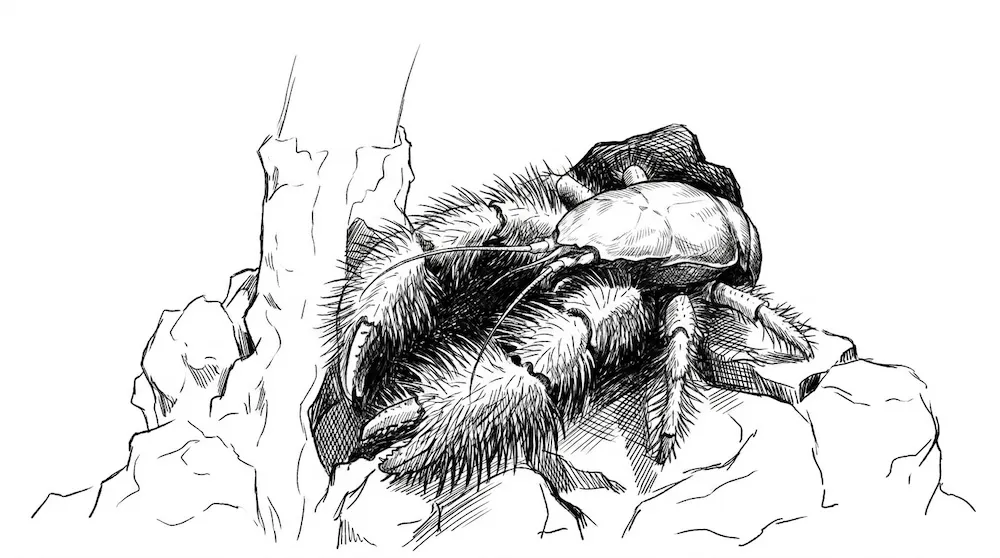
The Yeti Crab is a deep-sea creature that survives in one of Earth's most extreme environments. Named for its hairy, bristle-covered claws that resemble the legendary Bigfoot, this unusual crab lives near hydrothermal vents on the ocean floor, where superheated water shoots up from cracks in Earth's crust. Scientists first discovered the Yeti Crab in 2005 near Easter Island at depths exceeding 7,200 feet. At these depths, there is no sunlight, crushing pressure, and water temperatures that can shift from near freezing to over 750 degrees Fahrenheit within inches.
The Yeti Crab's most striking feature is its hairy claws, covered with fine bristles called setae. Evidence suggests these bristles may serve as tiny gardens where the crab cultivates bacteria. The bacteria use chemicals from the vents to produce energy through chemosynthesis, a process similar to photosynthesis but using chemicals instead of sunlight. Scientists observed Yeti Crabs waving their claws near vent openings, possibly feeding the bacteria or harvesting them for food. The bristles may also help protect the crab from toxic chemicals like hydrogen sulfide that pour from the vents. In complete darkness, the Yeti Crab cannot rely on vision to find food. Instead, it uses highly developed chemical sensors on its antennae and legs to detect food sources and navigate the vent environment.
Research conducted in 2022 near the East Scotia Ridge revealed how Yeti Crabs compete for prime real estate near vents. Scientists documented hundreds of crabs clustered around vent openings, with some individuals positioned just inches from water hot enough to cook them. The crabs actively crawl and forage, moving between cooler and warmer zones to balance feeding opportunities with survival. This active lifestyle contrasts sharply with other deep-sea creatures like vampire squid, which drift passively and wait for food to come to them. The Yeti Crab's tough exoskeleton protects it from extreme pressure that would crush most surface animals. At depths below 7,000 feet, pressure exceeds 3,000 pounds per square inch.
Understanding how Yeti Crabs adapt to extreme conditions helps scientists learn how life can exist in harsh environments on Earth and potentially on other planets. These adaptations demonstrate how natural selection shapes organisms over many generations to match their environment. The Yeti Crab's specialized features show that even in Earth's most challenging habitats, life finds ways to survive and thrive through remarkable biological innovations.
Interesting Fact: The Yeti Crab has no eyes or eye stalks, unlike most crabs, because vision is useless in the complete darkness of the deep ocean where it lives.
Where does the Yeti Crab live?
In shallow coral reefs near the surfaceNear hydrothermal vents on the deep ocean floorIn underwater caves with sunlightIn freshwater lakes and rivers
What are the hair-like bristles on the Yeti Crab's claws called?
AntennaeSetaeExoskeletonsChemosynthesis
What is chemosynthesis?
A process where organisms use sunlight to make foodA process where organisms use chemicals to produce energyA type of deep-sea volcanic eruptionA method crabs use to detect food with their eyes
How does the Yeti Crab find food in complete darkness?
It uses its large eyes to see in the darkIt follows other crabs that can seeIt uses chemical sensors on its antennae and legsIt creates its own light to illuminate the area
Why do scientists think the Yeti Crab waves its claws near vent openings?
To communicate with other crabsTo feed bacteria growing on the bristles or harvest them for foodTo cool down the water temperatureTo scare away predators
How does the Yeti Crab's lifestyle differ from the vampire squid?
The Yeti Crab drifts passively while the vampire squid actively huntsThe Yeti Crab actively crawls and forages while the vampire squid waits passivelyBoth organisms use the same feeding strategyThe Yeti Crab lives in shallow water while the vampire squid lives in deep water
What protects the Yeti Crab from extreme pressure in the deep ocean?
Its hairy clawsIts chemical sensorsIts tough exoskeletonIts ability to produce light
At what depth was the Yeti Crab first discovered?
Below 1,000 feetAround 3,500 feetExceeding 7,200 feetAt the ocean surface
The Yeti Crab has eyes and eye stalks like most other crabs.
TrueFalse
Natural selection helps organisms develop traits that help them survive in their environment over many generations.
TrueFalse
Perfect For:
👩🏫 Teachers
• Reading comprehension practice
• Auto-graded assessments
• Literacy skill development
👨👩👧👦 Parents
• Reading practice at home
• Comprehension improvement
• Educational reading time
🏠 Homeschoolers
• Reading curriculum support
• Independent reading practice
• Progress monitoring
Reading Features:
📖
Reading Passage
Engaging fiction or nonfiction text
❓
Comprehension Quiz
Auto-graded questions
📊
Instant Feedback
Immediate results and scoring
📄
Printable Version
Download for offline reading
🔊
Read Aloud
Voice-over with word highlighting
Reviews & Ratings
No reviews yet. Be the first to share your experience!
Related Content
Vampire Squid Adaptations
This engaging 500-word science passage introduces middle school students to the vampire squid and its remarkable adaptat...
MS-LS4-4LS4.B: NATURAL SELECTIONLS4.C: ADAPTATION
Deep-Sea Shrimp Adaptations
This audio-integrated science reading passage explores the remarkable adaptations of deep-sea vent shrimp that live near...
MS-LS4-4LS4.B: NATURAL SELECTIONLS4.C: ADAPTATION
The Giant Isopod: Biological Evolution
This NGSS passage examines how giant isopods evolved for deep-sea survival, including slow metabolism for food scarcity,...
MS-LS4-4RI.6.3RI.7.3RI.8.8
What Is Biodiversity?
This comprehensive science reading passage for grades 6-8 introduces students to biodiversity and explores its importanc...
MS-LS2-5MS-LS4-4
Vertebrates: Fishes
This middle school science reading passage offers an in-depth look at fishes, a major group of vertebrates. It covers fi...
MS-LS4-2MS-LS4-4
Vertebrates: Amphibians
This comprehensive middle school science passage dives into the fascinating world of amphibians, a group of vertebrates ...
MS-LS4-2MS-LS4-4
Vertebrates: Reptiles
This comprehensive science passage for grades 6-8 introduces students to reptiles, a fascinating class of vertebrates. A...
MS-LS4-2MS-LS4-4
Vertebrates: Birds
This middle school science passage explores birds as vertebrates, focusing on their unique adaptations such as feathers,...
MS-LS4-2MS-LS4-4
Vertebrates: Mammals
This comprehensive passage introduces middle school students to the class Mammalia and their defining characteristics, i...
MS-LS4-2MS-LS4-4
Invertebrates: Arthropods
This comprehensive science passage introduces middle school students to the phylum Arthropoda, the largest and most dive...
MS-LS4-2MS-LS4-4
Biodiversity and Its Importance
This comprehensive middle school science passage explores the concept of biodiversity at the genetic, species, and ecosy...
MS-LS4-4MS-LS2-5
Galápagos Islands
This engaging science passage explores the Galápagos Islands, a volcanic archipelago located off the coast of Ecuador in...
MS-LS2-1MS-LS4-4MS-ESS3-4
Intertidal Zone
This middle school science reading passage introduces students to the intertidal zone, the area between high and low tid...
MS-LS2-1MS-LS4-4
Natural Selection
This comprehensive passage introduces middle school students (grades 6-8) to the concept of natural selection, aligning ...
MS-LS4-4MS-LS4-6
Speciation
This comprehensive science passage introduces middle school students to the concept of speciation, the process by which ...
MS-LS4-4
Adaptation
This engaging middle school science passage explores adaptation, focusing on how inherited traits enable organisms to su...
MS-LS4-4MS-LS4-6
Extinction and Biodiversity
This comprehensive middle school science passage explores the concepts of extinction and biodiversity, aligned to NGSS s...
MS-LS4-1MS-LS4-4
Environmental Change and Species Survival
This middle school science passage explores how environmental changes, such as climate change, habitat destruction, the ...
MS-LS4-4MS-LS4-6
Coevolution
This passage for grades 6-8 introduces students to the concept of coevolution, where two or more species evolve in respo...