This learning resource is available in interactive and printable formats. The interactive worksheet can be played online and assigned to students. The Printable PDF version can be downloaded and printed for completion by hand.
This audio-integrated science reading passage explores the remarkable adaptations of deep-sea vent shrimp that live near hydrothermal vents on the ocean floor. Students in grades 6-8 will discover how these creatures evolved to survive in extreme conditions through natural selection and adaptation. The passage covers key biological concepts including sensory organ evolution, symbiotic relationships with chemosynthetic bacteria, and physiological adaptations to high pressure environments. Aligned with NGSS standards MS-LS4-4, LS4.B: Natural Selection, and LS4.C: Adaptation, this educational resource includes differentiated versions, Spanish translations, vocabulary support, comprehension questions, writing activities, and graphic organizers. Students will understand how organisms develop specialized traits that help them survive in challenging habitats, demonstrating core principles of evolutionary biology and ecological adaptation in real-world contexts.
CONTENT PREVIEW
Expand content preview
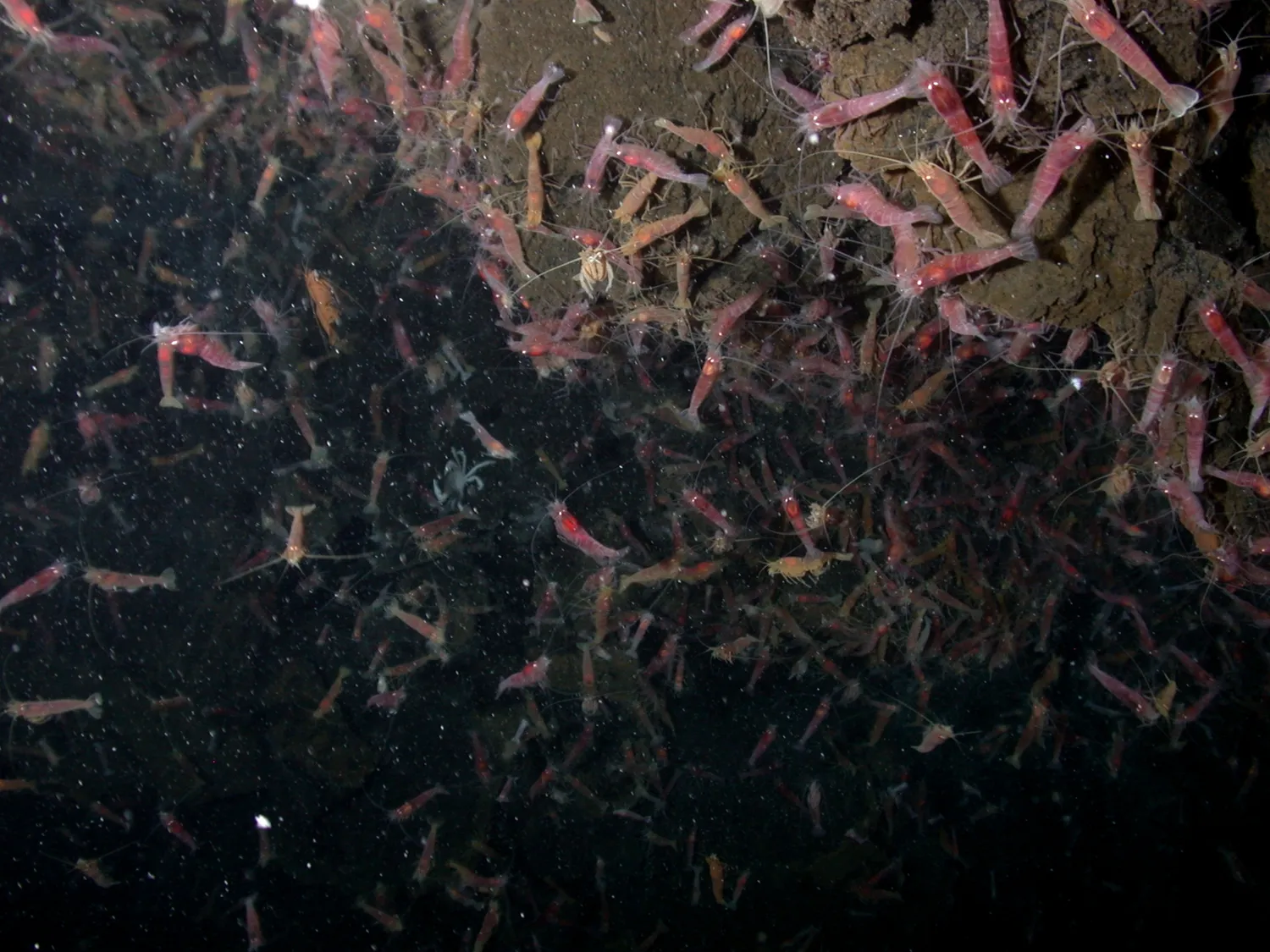
"Alvinocaris" by Image courtesy of Submarine Ring of Fire 2006 Exploration, NOAA Vents Program / Wikimedia Commons
Deep-sea vent shrimp are small crustaceans that live near hydrothermal vents, which are cracks in the ocean floor that release extremely hot water heated by volcanic activity. These shrimp survive in one of Earth's harshest environments, where temperatures can exceed 400 degrees Celsius near the vents, yet the surrounding water remains near freezing. No sunlight reaches these depths, which can be over 2,000 meters below the ocean surface. The shrimp have developed remarkable adaptations that allow them to thrive where most organisms cannot survive.
Unlike their shallow-water relatives, vent shrimp have lost their traditional eyes through natural selection over many generations. Instead, they possess a specialized light-sensing organ on their backs called a dorsal patch. This organ can detect the faint infrared radiation, or heat energy, emitted by the scorching vent water. Scientists estimate this helps the shrimp navigate toward the vents without getting too close and being cooked. The shrimp also farm chemosynthetic bacteria inside special chambers in their mouths and gills. These bacteria convert chemicals from the vent water, such as hydrogen sulfide, into energy and nutrients. This process is similar to how plants use sunlight for photosynthesis, except it uses chemical energy instead of light energy.
In 2021, researchers studying the Mid-Atlantic Ridge documented vent shrimp populations living at depths of 3,000 meters. At this depth, the water pressure is approximately 300 times greater than at sea level. The shrimp's bodies have adapted to withstand this crushing pressure through flexible exoskeletons and specialized proteins that maintain cell function. Scientists observed that individual shrimp can live for several years near the vents, constantly harvesting bacteria and avoiding predators like blind white crabs. Evidence suggests that when vents become inactive and cool down, the shrimp populations must relocate or face extinction.
Understanding these adaptations helps scientists recognize how evolution shapes organisms to fit specific environments. The vent shrimp demonstrate that life can adapt to extreme conditions through gradual changes over time. These adaptations show the connection between an organism's physical traits and its survival in a particular habitat, illustrating key principles of natural selection and environmental adaptation.
Interesting Fact: Some vent shrimp species can detect temperature differences as small as 0.1 degrees Celsius, allowing them to position themselves in the perfect zone where the water is warm enough for their bacteria to thrive but not hot enough to harm them.
What are hydrothermal vents?
Shallow pools of warm water near beachesCracks in the ocean floor that release extremely hot waterUnderground rivers that flow through cavesAreas where cold water rises from the deep ocean
Why have vent shrimp lost their traditional eyes over time?
The high pressure damaged their eyesThey do not need eyes in the total darkness of the deep oceanThe hot water burned their eyes awayThey use their antennae instead of eyes
What does the dorsal patch on a vent shrimp detect?
Sound waves from other shrimpChemicals dissolved in waterInfrared radiation or heat energy from the ventsMovements of predators nearby
How do chemosynthetic bacteria help vent shrimp survive?
They protect the shrimp from predatorsThey convert chemicals from vent water into energy and nutrientsThey help the shrimp swim fasterThey produce oxygen for the shrimp to breathe
According to the passage, what is the water pressure like at 3,000 meters deep?
About the same as at the surface50 times greater than at sea levelApproximately 300 times greater than at sea level1,000 times greater than at sea level
What does the term 'adaptation' mean in this passage?
The ability to learn new behaviors quicklySpecial features that help an organism survive in its environmentThe process of moving to a new locationA type of chemical reaction in cells
What happens to vent shrimp populations when a hydrothermal vent becomes inactive?
They adapt to eat different food sourcesThey grow larger to surviveThey must relocate or face extinctionThey hibernate until the vent reactivates
Based on the passage, which statement best explains how vent shrimp obtain food?
They hunt small fish and plankton in the dark waterThey farm bacteria that convert chemicals into nutrientsThey filter organic material that falls from the ocean surfaceThey absorb nutrients directly from the hot vent water
True or False: Sunlight reaches the depths where vent shrimp live.
TrueFalse
True or False: The process chemosynthetic bacteria use is exactly the same as photosynthesis in plants.
TrueFalse
Perfect For:
👩🏫 Teachers
• Reading comprehension practice
• Auto-graded assessments
• Literacy skill development
👨👩👧👦 Parents
• Reading practice at home
• Comprehension improvement
• Educational reading time
🏠 Homeschoolers
• Reading curriculum support
• Independent reading practice
• Progress monitoring
Reading Features:
📖
Reading Passage
Engaging fiction or nonfiction text
❓
Comprehension Quiz
Auto-graded questions
📊
Instant Feedback
Immediate results and scoring
📄
Printable Version
Download for offline reading
🔊
Read Aloud
Voice-over with word highlighting
Reviews & Ratings
No reviews yet. Be the first to share your experience!
Related Content
Vampire Squid Adaptations
This engaging 500-word science passage introduces middle school students to the vampire squid and its remarkable adaptat...
MS-LS4-4LS4.B: NATURAL SELECTIONLS4.C: ADAPTATION
Deep-Sea Crab Adaptations
This engaging 500-word science passage explores the remarkable adaptations of the Yeti Crab, a deep-sea creature discove...
MS-LS4-4LS4.B: NATURAL SELECTIONLS4.C: ADAPTATION
The Giant Isopod: Biological Evolution
This NGSS passage examines how giant isopods evolved for deep-sea survival, including slow metabolism for food scarcity,...
MS-LS4-4RI.6.3RI.7.3RI.8.8
What Is Biodiversity?
This comprehensive science reading passage for grades 6-8 introduces students to biodiversity and explores its importanc...
MS-LS2-5MS-LS4-4
Vertebrates: Fishes
This middle school science reading passage offers an in-depth look at fishes, a major group of vertebrates. It covers fi...
MS-LS4-2MS-LS4-4
Vertebrates: Amphibians
This comprehensive middle school science passage dives into the fascinating world of amphibians, a group of vertebrates ...
MS-LS4-2MS-LS4-4
Vertebrates: Reptiles
This comprehensive science passage for grades 6-8 introduces students to reptiles, a fascinating class of vertebrates. A...
MS-LS4-2MS-LS4-4
Vertebrates: Birds
This middle school science passage explores birds as vertebrates, focusing on their unique adaptations such as feathers,...
MS-LS4-2MS-LS4-4
Vertebrates: Mammals
This comprehensive passage introduces middle school students to the class Mammalia and their defining characteristics, i...
MS-LS4-2MS-LS4-4
Invertebrates: Arthropods
This comprehensive science passage introduces middle school students to the phylum Arthropoda, the largest and most dive...
MS-LS4-2MS-LS4-4
Biodiversity and Its Importance
This comprehensive middle school science passage explores the concept of biodiversity at the genetic, species, and ecosy...
MS-LS4-4MS-LS2-5
Galápagos Islands
This engaging science passage explores the Galápagos Islands, a volcanic archipelago located off the coast of Ecuador in...
MS-LS2-1MS-LS4-4MS-ESS3-4
Intertidal Zone
This middle school science reading passage introduces students to the intertidal zone, the area between high and low tid...
MS-LS2-1MS-LS4-4
Natural Selection
This comprehensive passage introduces middle school students (grades 6-8) to the concept of natural selection, aligning ...
MS-LS4-4MS-LS4-6
Speciation
This comprehensive science passage introduces middle school students to the concept of speciation, the process by which ...
MS-LS4-4
Adaptation
This engaging middle school science passage explores adaptation, focusing on how inherited traits enable organisms to su...
MS-LS4-4MS-LS4-6
Extinction and Biodiversity
This comprehensive middle school science passage explores the concepts of extinction and biodiversity, aligned to NGSS s...
MS-LS4-1MS-LS4-4
Environmental Change and Species Survival
This middle school science passage explores how environmental changes, such as climate change, habitat destruction, the ...
MS-LS4-4MS-LS4-6
Coevolution
This passage for grades 6-8 introduces students to the concept of coevolution, where two or more species evolve in respo...