This learning resource is available in interactive and printable formats. The interactive worksheet can be played online and assigned to students. The Printable PDF version can be downloaded and printed for completion by hand.
This engaging 500-word science passage introduces middle school students to the vampire squid and its remarkable adaptations for survival in the deep ocean's oxygen minimum zone. Aligned with NGSS standards MS-LS4-4, LS4.B (Natural Selection), and LS4.C (Adaptation), the passage explores how this mysterious creature uses its cloak-like webbing for protection, massive eyes to detect faint light, and bioluminescence to confuse predators. Students learn about the vampire squid's unique feeding strategy of consuming marine snow rather than hunting live prey, demonstrating energy conservation in an extreme environment. The passage includes audio integration for enhanced accessibility, differentiated versions for struggling readers and English Language Learners, Spanish translations, comprehension activities, and graphic organizers that help students understand structure-function relationships and adaptation concepts in evolutionary biology.
CONTENT PREVIEW
Expand content preview
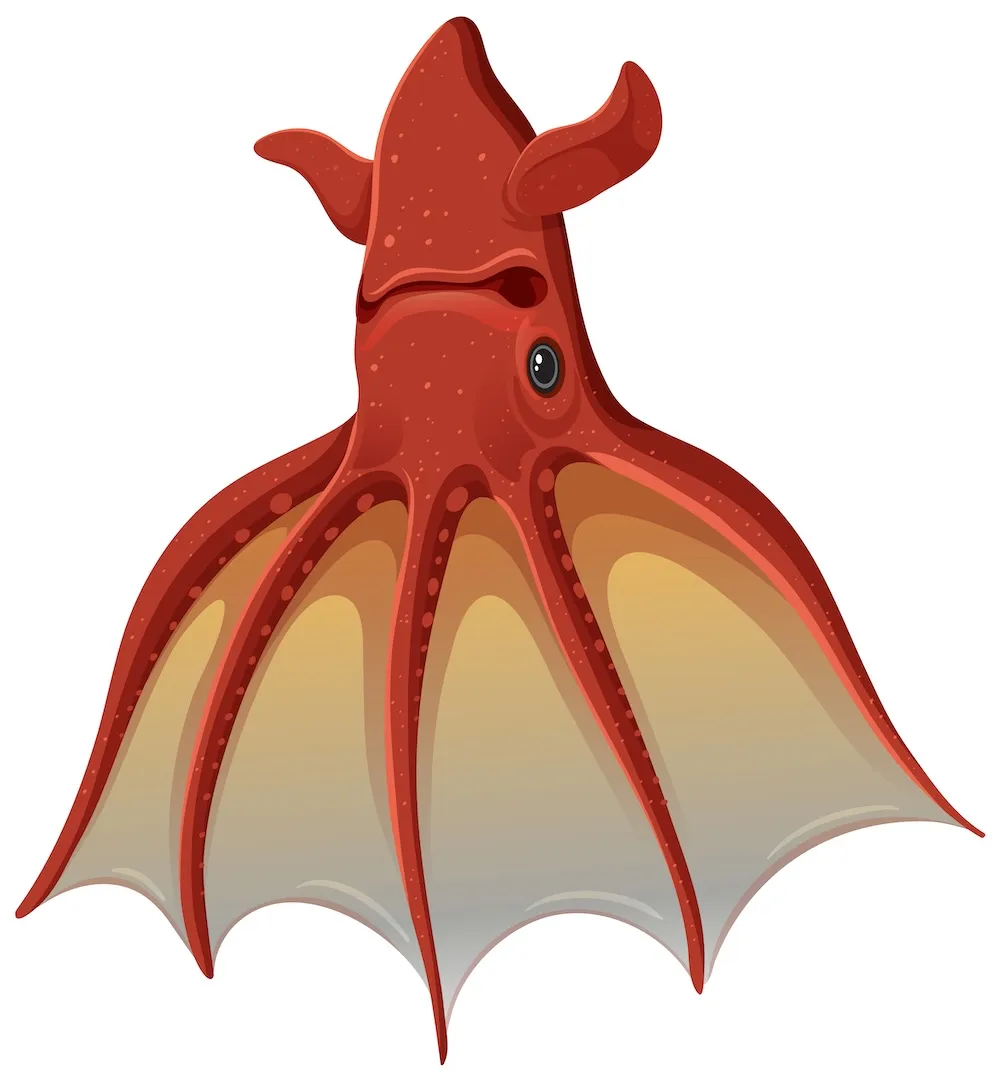
Vampire Squid s neither a true squid nor an octopus, but belongs to its own unique group.
The Vampire Squid is a deep-sea creature that lives in the oxygen minimum zone, a layer of ocean where oxygen levels drop extremely low. Despite its spooky name, this animal is neither a true squid nor an octopus, but belongs to its own unique group. The Vampire Squid survives between 2,000 and 3,000 feet below the ocean surface, where most other animals cannot live. Its dark, cloak-like webbing connects its eight arms and can wrap around its body for protection. Scientists have discovered that this creature possesses remarkable adaptations that allow it to thrive in one of Earth's most extreme environments.
The Vampire Squid has developed several features that help it survive in near-total darkness. Its eyes are the largest of any animal relative to body size, measuring up to one inch in diameter. These enormous eyes can detect even the faintest light from other creatures. The Vampire Squid also produces its own light through bioluminescence, using special organs called photophores located at the tips of its arms and on its body. When threatened by predators, it can create a glowing cloud of sticky mucus that confuses attackers while the squid escapes. This defensive strategy works like a bright smoke screen in the dark ocean. Instead of hunting live prey, the Vampire Squid uses two thin filaments that extend from its body to collect marine snow, which consists of dead plankton, waste, and other organic particles drifting down from surface waters.
Marine biologists studying the Vampire Squid have made important discoveries about its feeding behavior. Research conducted in Monterey Bay, California, using remotely operated vehicles has revealed that this creature can survive on a very low-energy diet. Scientists observed that the Vampire Squid extends its filaments like fishing lines to trap marine snow particles. Evidence suggests that this feeding method requires much less energy than actively hunting prey. A 2021 study found that the Vampire Squid's metabolic rate is extremely low, allowing it to survive in waters where oxygen concentrations can drop to just 5 percent of surface levels. This adaptation represents an efficient solution to life in a food-scarce environment.
Understanding how the Vampire Squid survives helps scientists learn about natural selection in extreme environments. The creature's adaptations show how organisms can evolve specialized features that match their habitat's challenges. As ocean conditions change due to warming waters and expanding oxygen minimum zones, studying these adaptations may help researchers predict how deep-sea ecosystems will respond. The Vampire Squid demonstrates that survival depends on matching an organism's traits to its environment's specific demands.
Interesting Fact: The Vampire Squid can turn itself inside out by pulling its webbed arms over its body, exposing spine-like structures called cirri that may help protect it from predators.
Where does the Vampire Squid live?
In shallow coral reefs near the surfaceIn the oxygen minimum zone 2,000-3,000 feet below the surfaceOn the ocean floor at the deepest pointIn warm tropical waters near the equator
What is bioluminescence?
The ability to see in complete darknessA type of deep-sea predatorThe ability to produce light through chemical reactionsA method of hunting live prey
How does the Vampire Squid obtain its food?
It hunts live fish and other preyIt uses filaments to collect marine snow particlesIt filters plankton from the waterIt steals food from other deep-sea creatures
What does the word 'photophores' mean in the passage?
The Vampire Squid's eyesPredators that hunt the Vampire SquidSpecial light-producing organsThe webbing between the squid's arms
Why are the Vampire Squid's eyes so large relative to its body?
To make it look more frightening to predatorsTo detect even the faintest light in near-total darknessTo help it swim faster through the waterTo store extra oxygen for survival
According to the 2021 study, what allows the Vampire Squid to survive in low-oxygen waters?
Its ability to hold its breath for long periodsIts extremely low metabolic rateIts large eyes that absorb oxygenIts thick skin that protects it from pressure
How does the Vampire Squid defend itself from predators?
It swims away very quicklyIt bites attackers with sharp teethIt creates a glowing cloud of sticky mucus to confuse attackersIt hides inside rocks on the ocean floor
What is marine snow?
Frozen water that falls in the deep oceanA type of bioluminescent planktonDead plankton, waste, and organic particles drifting down from surface watersWhite sand particles from the ocean floor
True or False: The Vampire Squid is a true squid that is closely related to other squid species.
TrueFalse
True or False: Scientists used remotely operated vehicles to study the Vampire Squid's feeding behavior in Monterey Bay, California.
TrueFalse
Perfect For:
👩🏫 Teachers
• Reading comprehension practice
• Auto-graded assessments
• Literacy skill development
👨👩👧👦 Parents
• Reading practice at home
• Comprehension improvement
• Educational reading time
🏠 Homeschoolers
• Reading curriculum support
• Independent reading practice
• Progress monitoring
Reading Features:
📖
Reading Passage
Engaging fiction or nonfiction text
❓
Comprehension Quiz
Auto-graded questions
📊
Instant Feedback
Immediate results and scoring
📄
Printable Version
Download for offline reading
🔊
Read Aloud
Voice-over with word highlighting
Reviews & Ratings
No reviews yet. Be the first to share your experience!
Related Content
Deep-Sea Shrimp Adaptations
This audio-integrated science reading passage explores the remarkable adaptations of deep-sea vent shrimp that live near...
MS-LS4-4LS4.B: NATURAL SELECTIONLS4.C: ADAPTATION
Deep-Sea Crab Adaptations
This engaging 500-word science passage explores the remarkable adaptations of the Yeti Crab, a deep-sea creature discove...
MS-LS4-4LS4.B: NATURAL SELECTIONLS4.C: ADAPTATION
The Giant Isopod: Biological Evolution
This NGSS passage examines how giant isopods evolved for deep-sea survival, including slow metabolism for food scarcity,...
MS-LS4-4RI.6.3RI.7.3RI.8.8
What Is Biodiversity?
This comprehensive science reading passage for grades 6-8 introduces students to biodiversity and explores its importanc...
MS-LS2-5MS-LS4-4
Vertebrates: Fishes
This middle school science reading passage offers an in-depth look at fishes, a major group of vertebrates. It covers fi...
MS-LS4-2MS-LS4-4
Vertebrates: Amphibians
This comprehensive middle school science passage dives into the fascinating world of amphibians, a group of vertebrates ...
MS-LS4-2MS-LS4-4
Vertebrates: Reptiles
This comprehensive science passage for grades 6-8 introduces students to reptiles, a fascinating class of vertebrates. A...
MS-LS4-2MS-LS4-4
Vertebrates: Birds
This middle school science passage explores birds as vertebrates, focusing on their unique adaptations such as feathers,...
MS-LS4-2MS-LS4-4
Vertebrates: Mammals
This comprehensive passage introduces middle school students to the class Mammalia and their defining characteristics, i...
MS-LS4-2MS-LS4-4
Invertebrates: Arthropods
This comprehensive science passage introduces middle school students to the phylum Arthropoda, the largest and most dive...
MS-LS4-2MS-LS4-4
Biodiversity and Its Importance
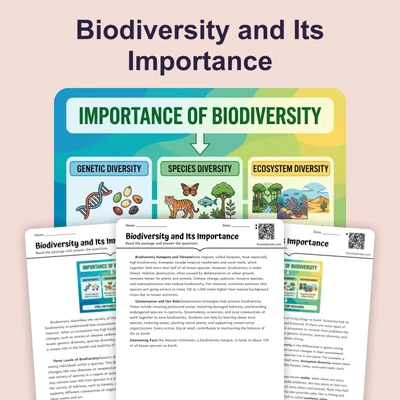
This comprehensive middle school science passage explores the concept of biodiversity at the genetic, species, and ecosy...
MS-LS4-4MS-LS2-5
Galápagos Islands
This engaging science passage explores the Galápagos Islands, a volcanic archipelago located off the coast of Ecuador in...
MS-LS2-1MS-LS4-4MS-ESS3-4
Intertidal Zone
This middle school science reading passage introduces students to the intertidal zone, the area between high and low tid...
MS-LS2-1MS-LS4-4
Natural Selection
This comprehensive passage introduces middle school students (grades 6-8) to the concept of natural selection, aligning ...
MS-LS4-4MS-LS4-6
Speciation
This comprehensive science passage introduces middle school students to the concept of speciation, the process by which ...
MS-LS4-4
Adaptation
This engaging middle school science passage explores adaptation, focusing on how inherited traits enable organisms to su...
MS-LS4-4MS-LS4-6
Extinction and Biodiversity
This comprehensive middle school science passage explores the concepts of extinction and biodiversity, aligned to NGSS s...
MS-LS4-1MS-LS4-4
Environmental Change and Species Survival
This middle school science passage explores how environmental changes, such as climate change, habitat destruction, the ...
MS-LS4-4MS-LS4-6
Coevolution
This passage for grades 6-8 introduces students to the concept of coevolution, where two or more species evolve in respo...