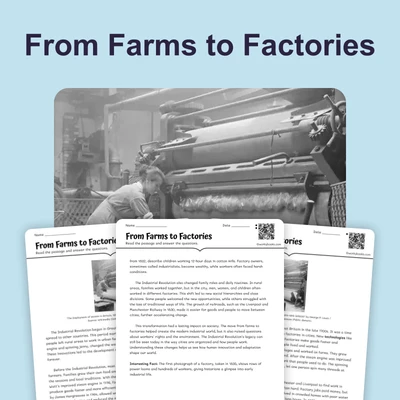
This learning resource is available in interactive and printable formats. The interactive worksheet can be played online and assigned to students. The Printable PDF version can be downloaded and printed for completion by hand.
This engaging world history reading passage examines the birth of labor unions during the Industrial Revolution. Students will learn how harsh factory conditions, long hours, and low pay led workers to organize for better treatment. The passage includes key vocabulary, multiple-choice and writing activities, graphic organizers, and a timeline. It references primary sources and provides concrete examples, such as the 1834 Lowell Mill strike and the formation of the British Trade Union Congress. Aligned to California HSS 6.7 and RH.6-8.1, RH.6-8.2 standards, this resource challenges students to analyze cause-and-effect relationships and understand the broader impact of labor movements. Read aloud audio and Spanish translation are included to support diverse learners.
CONTENT PREVIEW
Expand content preview
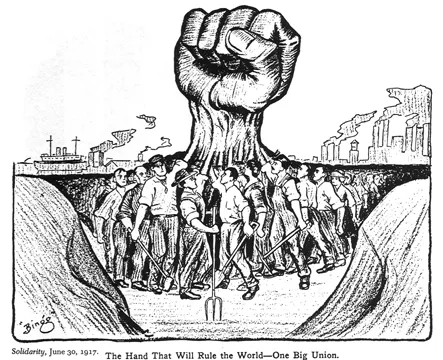
"The hand that will rule the world" by Ralph Chaplin / Source: Wikimedia Commons (Public domain).
The Industrial Revolution in the 18th and 19th centuries transformed work and daily life across Europe and North America. As factories replaced small workshops, millions of people moved from rural areas to rapidly growing cities. Factory jobs were often difficult, with workers facing long hours, dangerous machines, and low pay. In response, workers began to organize themselves into labor unions to fight for better conditions.
Life in the new industrial cities was challenging. Most factory workers, including women and children, worked up to 14 hours a day, six days a week. Factories were crowded and lacked safety rules. Accidents were common, and workers who were injured often lost their jobs. In Manchester, England, a report from 1833 described children as young as nine working in cotton mills. Similar conditions appeared in the United States, where the 1834 strike by the Lowell Mill Girls in Massachusetts became one of the first organized labor protests in American history. These workers demanded higher wages and shorter hours, using petitions and strikes to make their voices heard.
Workers realized that acting alone was not enough to change unfair practices. They formed unions—groups that represented all workers in a factory or trade. Unions used several methods to pressure employers, such as going on strike (refusing to work until demands were met), organizing marches, and writing letters to lawmakers. In Britain, the Combination Acts of 1799 and 1800 made unions illegal, but workers continued to meet secretly. By the 1820s, these laws were repealed, and unions like the British Trade Union Congress (TUC) were founded, helping workers gain the right to bargain as a group. Primary sources like union meeting records and newspaper articles from the 1800s show how workers’ voices grew stronger over time.
Labor unions faced many challenges. Factory owners sometimes hired new workers to replace those on strike or used the police to break up protests. Still, the efforts of union members led to important changes. By the late 1800s, new laws were passed in Britain, France, and the United States to limit child labor, set maximum working hours, and improve workplace safety. These changes took decades and were not always enforced evenly, but they marked a turning point in the rights of workers.
The rise of labor unions during the Industrial Revolution changed society by showing that ordinary people could work together to demand fairness. Labor unions set the stage for modern rights at work, influencing laws and social movements around the world.
Workers’ efforts to organize connect to broader themes of social change, justice, and the power of collective action throughout world history.
Interesting Fact: In 1886, the American Federation of Labor (AFL) was created, and its first president, Samuel Gompers, helped make the eight-hour workday a national goal for American workers.
When did the Lowell Mill Girls strike?
1834188618201799
What did the Combination Acts do?
Made unions illegalStarted new factoriesCreated the AFLHelped child workers
Which country had the Trade Union Congress?
BritainUnited StatesFranceGermany
Why did workers form unions?
For better pay and safetyTo buy factoriesTo build citiesFor more machines
What is a strike?
Stopping work for demandsBuilding new roadsVoting for leadersStarting factories
How did factory owners react to strikes?
Hired new workersClosed all factoriesGave more payHelped unions
Labor unions changed society. True or false?
TrueFalse
What does 'petition' mean in the passage?
A written request for changeA safety lawA factory machineA group of workers
Perfect For:
👩🏫 Teachers
• Reading comprehension practice
• Auto-graded assessments
• Literacy skill development
👨👩👧👦 Parents
• Reading practice at home
• Comprehension improvement
• Educational reading time
🏠 Homeschoolers
• Reading curriculum support
• Independent reading practice
• Progress monitoring
Reading Features:
📖
Reading Passage
Engaging fiction or nonfiction text
❓
Comprehension Quiz
Auto-graded questions
📊
Instant Feedback
Immediate results and scoring
📄
Printable Version
Download for offline reading
🔊
Read Aloud
Voice-over with word highlighting
Reviews & Ratings
No reviews yet. Be the first to share your experience!
Related Content
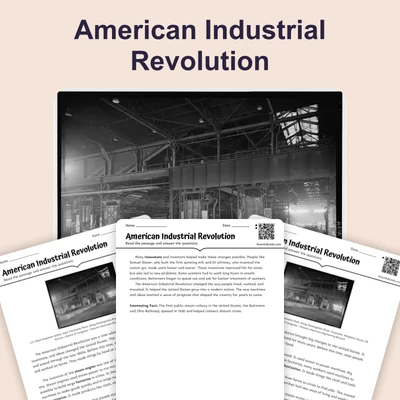
American Industrial Revolution
This World History reading passage explores the spread of the Industrial Revolution from Britain to the United States, f...
Industrial Revolution Global Impact
This world history reading passage examines the global impact of the Industrial Revolution, focusing on how industrializ...
Capitalism Industrial Revolution
This engaging world history passage examines the rise of capitalism and its critical role in the Industrial Revolution. ...
Industrial Revolution Child Labor
This rigorous world history reading passage examines the harsh reality of child labor in factories and mines during the ...
Industrial Revolution Working Conditions
This world history reading passage examines the working conditions and workers' struggles during the Industrial Revoluti...
Pollution and the Industrial Revolution
This passage explores the environmental costs of industrialization during the Industrial Revolution, focusing on air and...
The Steam Engine Revolution
This rigorous world history passage explores the origins and impact of the steam engine during the Industrial Revolution...
New Social Classes: Industrial Society
This reading passage examines how the Industrial Revolution led to the development of new social classes and changed the...
Women in the Industrial Workforce
This rigorous world history reading passage explores the key role women and girls played in the industrial workforce dur...
The Growth of Factory Towns and Industrial Cities
This history reading passage examines how the Industrial Revolution caused the rapid growth of factory towns and industr...
Steamboat Industrial Revolution
This engaging passage introduces students to the impact of steamboats during the Industrial Revolution in U.S. history. ...
D2.HIS.1.3-5D2.HIS.2.3-5RI.4.3RI.4.4
Industrial Revolution Cities
This engaging U.S. history passage explores the growth and transformation of American cities during the Industrial Revol...
D2.HIS.2.3-5D2.HIS.3.3-5RI.4.3RI.4.4
Industrial Revolution Pollution
This reading passage explores the impact of the Industrial Revolution on pollution in the United States, focusing on the...
D2.HIS.2.3-5D2.HIS.3.3-5RI.4.3RI.4.4
Industrial Revolution Benefits
This engaging reading passage explores the positive effects of the Industrial Revolution in the United States, highlight...
D2.HIS.3.3-5D2.HIS.14.3-5RI.4.3RI.4.4
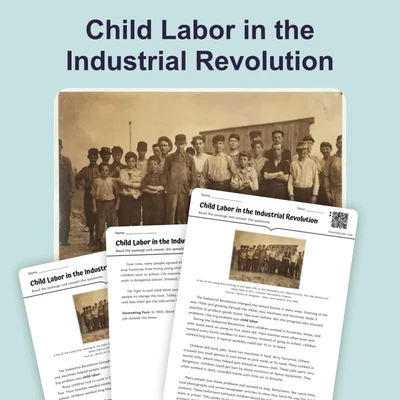
Child Labor in the Industrial Revolution
This engaging history reading passage introduces students to the topic of child labor during the Industrial Revolution i...
D2.HIS.2.3-5D2.HIS.16.3-5RI.4.3RI.4.4
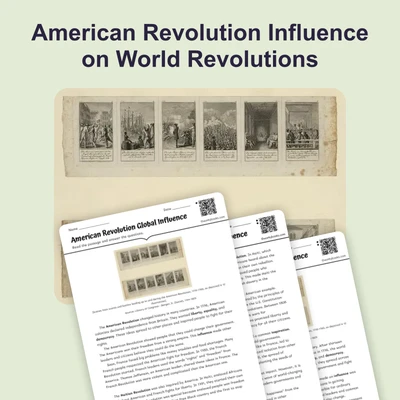
American Revolution Global Influence
This engaging U.S. History reading passage explores how the American Revolution influenced revolutions around the world,...
D2.HIS.2.3-5D2.HIS.3.3-5RI.4.3RI.4.4
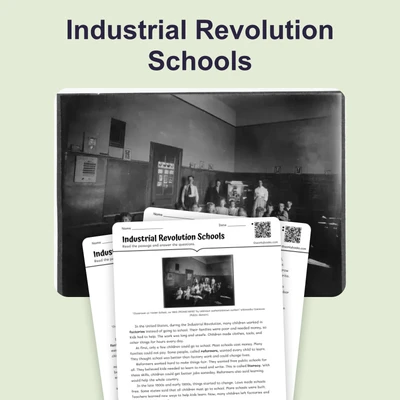
Industrial Revolution Schools
This engaging reading passage explores how schools changed during the Industrial Revolution and Progressive Era in the U...
D2.HIS.2.3-5D2.HIS.3.3-5RI.4.3RI.4.4
The Industrial Revolution in America
This engaging history reading passage explores the Industrial Revolution in America, a time of great change and innovati...
D2.HIS.1-6.3-5RI.4.3RI.4.4
From Farms to Factories
This engaging passage, "From Farms to Factories," delves into the profound changes brought by the Industrial Revolution ...
Life During the Industrial Revolution
This engaging reading passage introduces students to life during the Industrial Revolution in the United States. It expl...