The Bouncing Ball Energy Test — Reading Comprehension
Rate this
Premium Resource
Present
Present in classroom. No work saved
Assign
Classroom with student accounts, Track progress
Quick Play
No student accounts, assign with a link
Grades
3
4
5
6
PRINT+DIGITAL RESOURCE
This learning resource is available in interactive and printable formats. The interactive worksheet can be played online and assigned to students. The Printable PDF version can be downloaded and printed for completion by hand.
The Bouncing Ball Energy Test reading passage is a comprehensive resource designed to teach fourth-grade students about the fundamental scientific principles of energy transfer and conservation. It directly aligns with the Next Generation Science Standards (NGSS) Disciplinary Core Concept PS3.B: Conservation of Energy and Energy Transfer. The passage explains
CONTENT PREVIEW
Expand content preview
The Bouncing Ball Energy Test
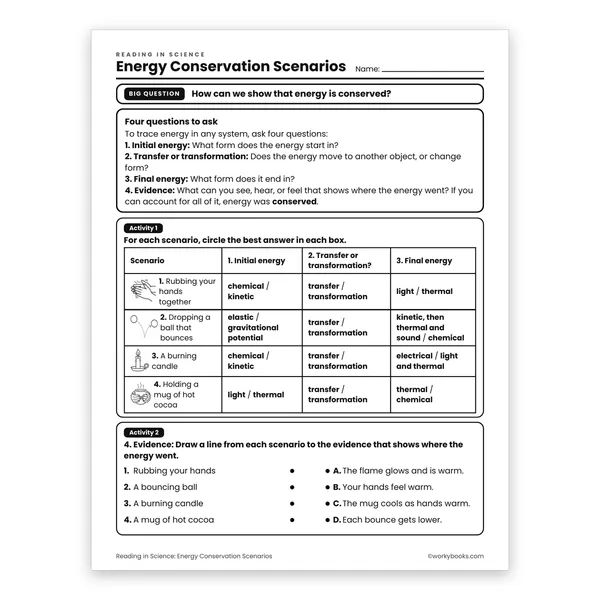
Balls bounce because of energy. When you hold a ball up high, it has potential energy. This means the ball is storing energy because it is above the ground. When you let go, the ball falls. Now, the stored energy turns into kinetic energy—the energy of moving things.
When the ball hits the ground, something interesting happens. The ball squishes for a moment. The energy from moving becomes elastic potential energy. This is energy stored when something is squeezed or stretched, like a rubber band. The ball then springs back to its shape and bounces up. As it rises, that elastic energy turns back into kinetic energy, and then into potential energy as the ball reaches its highest point.
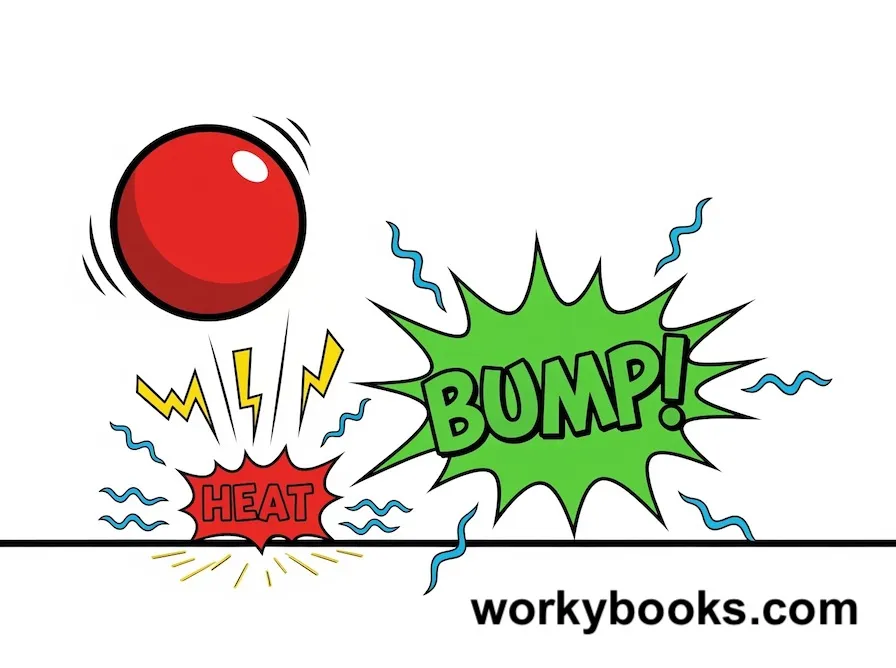
Balls never bounce back to the exact height they were dropped from. Some energy is always lost. But 'lost' energy isn’t gone—it just changes form. When the ball hits the ground, some energy turns into heat and sound. That’s why you hear a bounce!
Scientists test bounciness by dropping different balls (like tennis balls, basketballs, golf balls, and super balls) onto different surfaces (like concrete, grass, or carpet). They measure how high the ball bounces compared to how high it was dropped. The bounciness is the ratio of bounce height to drop height. For example, if a ball is dropped from 100 cm and bounces back to 60 cm, its bounciness is 60%.
People use this science in real life. Sports balls are designed to bounce in special ways. Engineers use these ideas for things like car shock absorbers and running shoes with bouncy soles. In every bounce, the ball pays a little energy 'tax' to the floor in the form of heat and sound, so it doesn’t bounce as high each time.
Interesting Fact: If you try different balls and surfaces, you might find a super ball on concrete gives the best bounce!
What is potential energy?
Stored energy due to positionEnergy from heatEnergy from foodEnergy from electricity
Which energy is moving energy?
Kinetic energyPotential energyElastic energySound energy
What happens when a ball hits the ground?
It squishes and stores elastic energyIt floatsIt meltsIt grows
Why do balls not bounce as high each time?
Some energy is lost to heat and soundThe ball gets heavierThe ball changes colorIt rains
Which ball-surface combo gives the best bounce?
Super ball on concreteTennis ball on grassGolf ball on carpetBasketball on sand
What is bounciness?
Ratio of bounce to drop heightWeight of the ballShape of the ballColor of the ball
Balls bounce higher as they lose energy.
TrueFalse
Which word means 'energy of movement'?
KineticPotentialElasticHeat
Perfect For:
👩🏫 Teachers
• Reading comprehension practice
• Auto-graded assessments
• Literacy skill development
👨👩👧👦 Parents
• Reading practice at home
• Comprehension improvement
• Educational reading time
🏠 Homeschoolers
• Reading curriculum support
• Independent reading practice
• Progress monitoring
Reading Features:
📖
Reading Passage
Engaging fiction or nonfiction text
❓
Comprehension Quiz
Auto-graded questions
📊
Instant Feedback
Immediate results and scoring
📄
Printable Version
Download for offline reading
🔊
Read Aloud
Voice-over with word highlighting
Reviews & Ratings
No reviews yet. Be the first to share your experience!
Related Content
How Speed Affects Energy
This Grade 4 physical science reading passage introduces students to the relationship between speed and kinetic energy, ...
NGSS 4-PS3-2
Science Vocabulary
This worksheet on domain-specific words will help students learn some science vocabulary. Students will be asked to matc...
L.3.6L.3.4.A
How Electric Current Transfers Energy
This 250-word reading passage introduces fourth-grade students to the concept of energy transfer through electric curren...
NGSS 4-PS3-2
What Is Potential Energy
This 250-word reading passage introduces fourth-grade students to the fundamental concept of potential energy aligned wi...
NGSS 4-PS3-1
Simple Machines Science Report
This science writing task requires students to clearly explain how three simple machines work using precise domain-speci...
W.5.4
What Is Energy
This engaging 250-word reading passage introduces fourth-grade students to the fundamental concept of energy as outlined...
NGSS 4-PS3-1
Work and Energy
This science reading passage for grades 6-8 introduces students to the concepts of work and energy, aligned with NGSS st...
MS-PS3-1
Motion Energy
This NGSS-aligned science passage for 4th graders focuses on the disciplinary core concept of Motion Energy (PS1.A). It'...
Energy Transformation
This middle school science passage aligned to NGSS standard MS-PS3-5 explains the concept of energy transformation—the p...
MS-PS3-5
Heat Energy Transfer
This Grade 4 physical science reading passage explores heat energy transfer aligned to NGSS standard 4-PS3-2 and Discipl...
NGSS 4-PS3-2
Thermal Energy
This comprehensive passage explores the concept of thermal energy, aligning with NGSS standards MS-PS3-3 and MS-PS3-4. S...
MS-PS3-3MS-PS3-4
Beach Day Science
This passage addresses NGSS K-PS3-1 by comparing temperature differences in materials exposed to sunlight versus shade. ...
K-PS3-1RL.1.1
How Circuits Convert Energy
This 250-word reading passage introduces Grade 4 students to the concept of energy conversion in electric circuits, alig...
NGSS 4-PS3-2
Sound Energy
This engaging science passage, titled "What is Sound Energy?", is designed for 4th-grade students and aligns with the NG...
What Happens When Cars Collide
This 250-word reading passage introduces fourth-grade students to the concept of energy transfer and transformation duri...
NGSS 4-PS3-3
Energy Transformations
This engaging middle school science passage explores the concept of energy transformations, aligning with NGSS standards...
MS-PS3-1MS-PS3-2MS-PS3-5
Pool Table Physics
The Pool Table Physics reading passage is a highly engaging educational resource designed for fourth-grade science stude...
Energy Transfer
This NGSS-aligned science passage introduces middle school students to the concept of energy transfer, aligned to standa...
MS-PS3-5
Where Does Our Energy Come From
This 250-word reading passage aligns with NGSS standard ESS3.A and introduces fourth-grade students to the fundamental c...
NGSS 4-ESS3-1
The Future of Energy
This engaging science passage for grades 6-8, aligned with NGSS standards MS-PS3-4, MS-ESS3-3, and MS-ESS3-4, introduces...