The Confederate States of America — Reading Comprehension
Rate this
Premium Resource
Present
Present in classroom. No work saved
Assign
Classroom with student accounts, Track progress
Quick Play
No student accounts, assign with a link
Grades
6
7
8
PRINT+DIGITAL RESOURCE
This learning resource is available in interactive and printable formats. The interactive worksheet can be played online and assigned to students. The Printable PDF version can be downloaded and printed for completion by hand.
This comprehensive history reading passage examines the formation and significance of the Confederate States of America. It explores the causes, motivations, and consequences of Southern secession, the establishment of a rival government, and the start of the Civil War. Multiple perspectives are included, with clear analysis of the complex conflicts between states’ rights and union unity. The passage features a primary source quote, glossary, timeline, and activities designed to deepen critical thinking. Students can access read aloud audio, Spanish translations, and differentiated versions for accessibility. The resource is aligned with CA HSS 8.10 and TEKS 8.8 history standards, as well as Common Core RI.6-8 and W.6-8 ELA standards, ensuring rigorous content for developing historical understanding. Ideal for building vocabulary and analytical skills, this lesson enhances knowledge about a pivotal era in U.S. history.
CONTENT PREVIEW
Expand content preview
"The Confederate States of America : 22 February 1862 - deo vindice" by Graham, Andrew B. / Library of Congress.
The Confederate States of America was formed in February 1861 when several Southern states decided to leave the United States. These states, including South Carolina, Mississippi, Florida, Alabama, Georgia, Louisiana, and Texas, believed that their rights and way of life were threatened, especially regarding the issue of slavery. This decision to secede from the Union created a serious conflict that would lead to the American Civil War.
One major challenge facing the Southern states was how to establish a new government. They needed to organize their own laws, military, and leadership. To solve this, delegates from the seceded states met in Montgomery, Alabama. There, they wrote a new constitution for the Confederacy. This document was similar to the United States Constitution but included clear protections for slavery and states’ rights. The Confederacy’s leaders believed that this new system would preserve their independence and way of life.
Jefferson Davis was elected the first president of the Confederate States of America. Davis, a former U.S. senator from Mississippi, was chosen for his experience and leadership. He faced the enormous task of uniting the new nation, organizing an army, and gaining support from other countries. While Davis led the Confederacy, Abraham Lincoln became president of the United States. The two leaders had very different views on slavery and the future of the country.
The formation of the Confederacy created major tensions in the United States. Many Northerners saw secession as a threat to the nation’s unity and the rule of law. Meanwhile, Southerners argued that each state had the right to self-determination—the power to decide its own future. These differences could not be resolved peacefully. In April 1861, the first shots were fired at Fort Sumter, beginning the Civil War.
The Civil War lasted four years and had lasting consequences for the country. The Confederacy struggled with issues like lack of resources, internal disagreements, and the challenge of fighting a longer war than expected. In 1865, the Confederate States were defeated, and the Union was preserved. The issues of slavery and states’ rights continued to shape the nation’s history long after the war ended.
Interesting Fact: The Confederate States of America chose Richmond, Virginia, as its capital after Montgomery, Alabama. Richmond became a key target during the Civil War.
When was the Confederacy formed?
February 1861July 1776April 1865March 1820
Who was the first Confederate president?
Abraham LincolnUlysses S. GrantJefferson DavisRobert E. Lee
What was the first capital of the Confederacy?
RichmondMontgomeryAtlantaNew Orleans
Why did the Southern states secede?
To gain goldFor religious freedomOver slavery and states' rightsTo avoid taxes
How did the Civil War begin?
Signing a treatyFiring at Fort SumterBuilding a railroadWriting a constitution
What was a key challenge for the Confederacy?
Too many resourcesInternal disagreementsEasy victorySupport from all states
The Confederacy was defeated in 1865. True or false?
TrueFalse
What does 'constitution' mean?
Country leaderGroup of lawsFighting forceA type of state
Perfect For:
👩🏫 Teachers
• Reading comprehension practice
• Auto-graded assessments
• Literacy skill development
👨👩👧👦 Parents
• Reading practice at home
• Comprehension improvement
• Educational reading time
🏠 Homeschoolers
• Reading curriculum support
• Independent reading practice
• Progress monitoring
Reading Features:
📖
Reading Passage
Engaging fiction or nonfiction text
❓
Comprehension Quiz
Auto-graded questions
📊
Instant Feedback
Immediate results and scoring
📄
Printable Version
Download for offline reading
🔊
Read Aloud
Voice-over with word highlighting
Reviews & Ratings
No reviews yet. Be the first to share your experience!
Related Content
Civil War Causes
This comprehensive U.S. history reading passage investigates the complex causes of the Civil War, focusing on the debate...
D2.HIS.2.3-5D2.HIS.3.3-5RI.4.3RI.4.4
Women's Roles in Civil War
This reading passage explores the critical roles women played during the U.S. Civil War, highlighting how they managed f...
HSS 8.10.7RI.6-8.1RI.6-8.2
Challenges After the Civil War
This engaging history reading passage explores the key challenges Americans faced after the Civil War, such as rebuildin...
D2.HIS.1-6.3-5RI.4.3RI.4.4W.4.2
African American Soldiers in Civil War
This engaging history reading passage examines the pivotal role African American soldiers played in the American Civil W...
D2.HIS.2.3-5D2.HIS.3.3-5RI.4.3RI.4.4
Children and Women During the Civil War
This engaging history reading passage explores the important roles of children and women during the Civil War. Aligned w...
D2.HIS.2.3-5D2.HIS.3.3-5D2.HIS.16.3-5RI.4.1
Sharecropping System After Civil War
This engaging U.S. history reading passage examines the rise of the sharecropping system in the South after the Civil Wa...
D2.HIS.2.3-5D2.HIS.3.3-5RI.4.3RI.4.4
Home Front Life Civil War
This engaging U.S. history reading passage explores daily life on the home front during the Civil War, focusing on how c...
The Civil War Finally Ends
This engaging reading passage explores the end of the Civil War, focusing on the events of 1865 when General Robert E. L...
D2.HIS.1-6.3-5RI.4.3RI.4.4RI.4.10
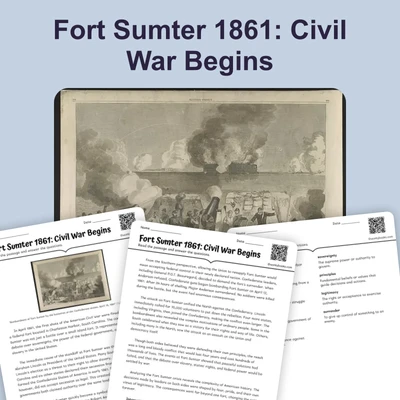
Fort Sumter 1861: Civil War Begins
This passage explores the pivotal events at Fort Sumter in April 1861, marking the beginning of the American Civil War. ...
D2.HIS.2.3-5D2.HIS.3.3-5RI.4.3RI.4.4
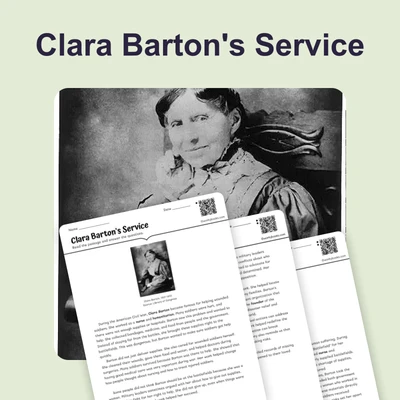
Clara Barton: Civil War Nurse and Founder
This comprehensive U.S. history reading passage explores the life and legacy of Clara Barton, a pivotal figure during th...
D2.HIS.2.3-5D2.HIS.3.3-5RI.4.3RI.4.4
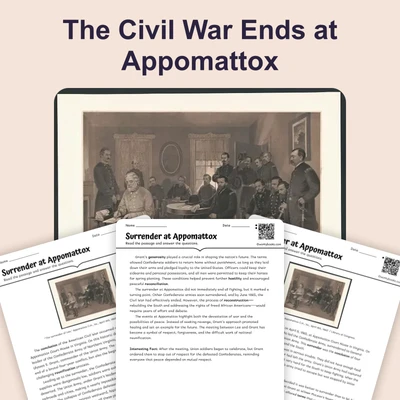
Surrender at Appomattox
This reading passage explores the historic surrender at Appomattox Court House in April 1865, which marked the conclusio...
HSS 8.10.7RI.6-8.1RI.6-8.6
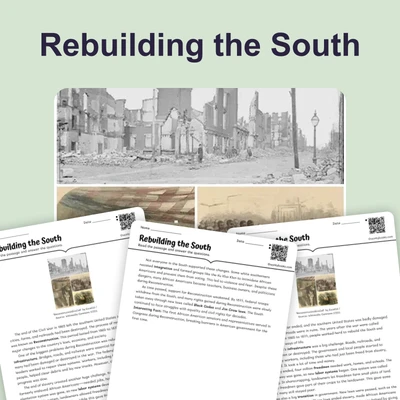
Rebuilding the South
This engaging history reading passage explores the challenges and debates over the future of the South after the U.S. Ci...
Civil Rights Act of 1964
This reading passage explores the Civil Rights Act of 1964, a landmark piece of U.S. legislation that outlawed discrimin...
HSS 11.10.5RI.6-8.1RI.6-8.6
Advantages and Disadvantages: North vs. South
This history reading passage examines the contrasting strengths of the Union and Confederacy during the U.S. Civil War. ...
HSS 8.10.5RI.6-8.1RI.6-8.3
Segregation in America After World War II
This rigorous U.S. history reading passage explores the persistence of segregation and continued inequality in the Unite...
D2.HIS.2.3-5D2.HIS.3.3-5RI.4.3RI.4.4
New York Draft Riots 1863
This engaging reading passage explores the 1863 New York City Draft Riots, one of the most turbulent moments in American...
D2.HIS.2.3-5D2.HIS.3.3-5RI.4.3RI.4.4
African Americans Fight for the Union
This engaging U.S. history reading passage explores the important role African Americans played in helping the Union dur...
D2.HIS.2.3-5D2.HIS.14.3-5RI.4.3RI.4.4
New Schools in the South
This U.S. history reading passage explores the creation of new public schools in the Southern United States during and a...
Soldiers' Letters from the Battlefield
This passage examines the experiences of Civil War soldiers by analyzing their letters from the battlefield. Students wi...
War Bonds: Financing World War II
This passage examines the critical role of war bonds in financing World War II, focusing on how the U.S. government enco...