This learning resource is available in interactive and printable formats. The interactive worksheet can be played online and assigned to students. The Printable PDF version can be downloaded and printed for completion by hand.
The Domino Chain Reaction passage is a dynamic and engaging educational resource designed for fourth-grade science students. The text aligns with the Next Generation Science Standards (NGSS) Disciplinary Core Concept PS3.B: Conservation of Energy and Energy Transfer, offering a clear and relatable example of this complex topic. Students will learn about potential and kinetic energy as they follow the journey of a domino chain reaction. The passage explains how pushing the first domino transfers kinetic energy from one to the next, and how some energy is converted into sound and heat along the way. The included assessment, featuring multiple-choice questions at varying DOK levels, helps teachers gauge student comprehension and critical thinking skills. This material is an excellent tool for hands-on learning and reinforces key scientific principles.
CONTENT PREVIEW
Expand content preview
What Is a Domino Chain Reaction?
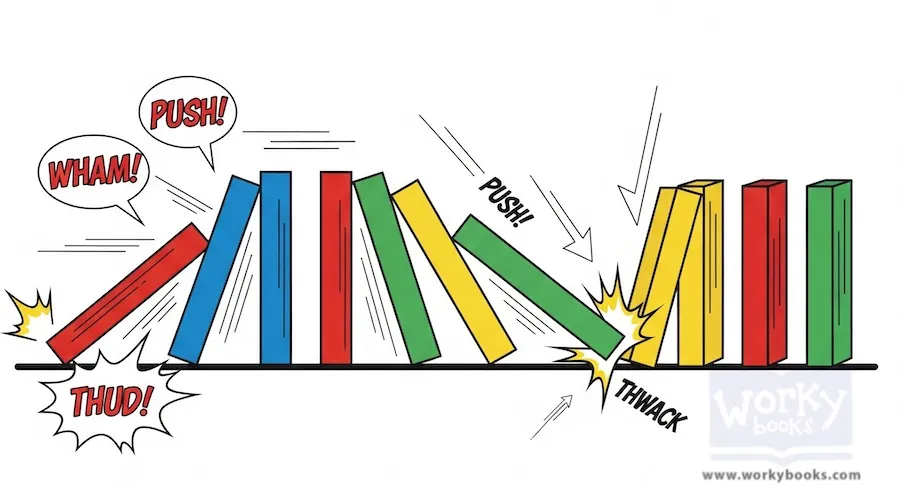
A chain reaction happens when one event starts a series of other events. In a domino chain reaction, a row of standing dominoes is set up close together. When you push the first domino, it falls and knocks into the next one. This keeps happening, and the energy moves down the line until every domino has fallen.
How Does Energy Move?
Before you touch the dominoes, each one has potential energy. This is stored energy because the domino is standing up and could fall. When you push the first domino, that potential energy turns into kinetic energy, which is energy of movement. As each domino falls, it hits the next one, passing on its energy. This is called energy transfer. Some energy also turns into sound and a tiny bit of heat.
Why Are Chain Reactions Special?
A domino chain reaction is special because a tiny push can make a huge change. It’s like the world’s longest game of tag—each domino "tags" the next one with energy until all have fallen! One small action can have a big result.
Design Challenges
Setting up dominoes isn’t always easy. If dominoes are too far apart, the chain reaction stops. If the surface is slippery, dominoes may slide instead of standing up. You can also make patterns, curves, or even tricks. Changing the spacing or adding obstacles can make the reaction more exciting or harder to complete.
Real-World Chain Reactions
Domino chain reactions help us understand other chain reactions, too. For example, a forest fire can start with one spark and quickly spread. Nuclear power plants use chain reactions to create energy. Even viral videos online spread from one person to many, like dominoes falling. That’s why we are careful with things like fire—one small action can cause a big reaction.
Hands-On Activity
Try making your own domino chain reaction. Experiment with different patterns, spacings, and obstacles. See how changing one thing can affect the whole reaction!
Interesting Fact: The world record for most dominoes toppled in a chain reaction is over 4 million!
What is a chain reaction?
One event causes another and so onOnly one thing happensThings happen randomlyDominoes never fall
What energy do standing dominoes have?
Potential energyKinetic energySound energyNo energy
What happens if dominoes are too far apart?
Chain reaction stopsThey fall fasterThey make more soundThey bounce up
What is energy transfer?
Energy moves to another objectEnergy disappearsEnergy gets colderEnergy stays in one place
Why are chain reactions important?
Small action causes big resultThey always stop quicklyThey use no energyThey never happen
How are domino chains like viral videos?
One spreads to many quicklyThey both make noiseThey both are gamesThey use electricity
Domino chain reactions always make a lot of heat.
TrueFalse
What is a trigger in a chain reaction?
The action that starts itThe last dominoA type of energyA pattern
Perfect For:
👩🏫 Teachers
• Reading comprehension practice
• Auto-graded assessments
• Literacy skill development
👨👩👧👦 Parents
• Reading practice at home
• Comprehension improvement
• Educational reading time
🏠 Homeschoolers
• Reading curriculum support
• Independent reading practice
• Progress monitoring
Reading Features:
📖
Reading Passage
Engaging fiction or nonfiction text
❓
Comprehension Quiz
Auto-graded questions
📊
Instant Feedback
Immediate results and scoring
📄
Printable Version
Download for offline reading
🔊
Read Aloud
Voice-over with word highlighting
Reviews & Ratings
No reviews yet. Be the first to share your experience!
Related Content
How Speed Affects Energy
This Grade 4 physical science reading passage introduces students to the relationship between speed and kinetic energy, ...
NGSS 4-PS3-2
Science Vocabulary
This worksheet on domain-specific words will help students learn some science vocabulary. Students will be asked to matc...
L.3.6L.3.4.A
How Electric Current Transfers Energy
This 250-word reading passage introduces fourth-grade students to the concept of energy transfer through electric curren...
NGSS 4-PS3-2
What Is Potential Energy
This 250-word reading passage introduces fourth-grade students to the fundamental concept of potential energy aligned wi...
NGSS 4-PS3-1
Simple Machines Science Report
This science writing task requires students to clearly explain how three simple machines work using precise domain-speci...
W.5.4
What Is Energy
This engaging 250-word reading passage introduces fourth-grade students to the fundamental concept of energy as outlined...
NGSS 4-PS3-1
Work and Energy
This science reading passage for grades 6-8 introduces students to the concepts of work and energy, aligned with NGSS st...
MS-PS3-1
Motion Energy
This NGSS-aligned science passage for 4th graders focuses on the disciplinary core concept of Motion Energy (PS1.A). It'...
Energy Transformation
This middle school science passage aligned to NGSS standard MS-PS3-5 explains the concept of energy transformation—the p...
MS-PS3-5
Heat Energy Transfer
This Grade 4 physical science reading passage explores heat energy transfer aligned to NGSS standard 4-PS3-2 and Discipl...
NGSS 4-PS3-2
Thermal Energy
This comprehensive passage explores the concept of thermal energy, aligning with NGSS standards MS-PS3-3 and MS-PS3-4. S...
MS-PS3-3MS-PS3-4
Beach Day Science
This passage addresses NGSS K-PS3-1 by comparing temperature differences in materials exposed to sunlight versus shade. ...
K-PS3-1RL.1.1
How Circuits Convert Energy
This 250-word reading passage introduces Grade 4 students to the concept of energy conversion in electric circuits, alig...
NGSS 4-PS3-2
Sound Energy
This engaging science passage, titled "What is Sound Energy?", is designed for 4th-grade students and aligns with the NG...
What Happens When Cars Collide
This 250-word reading passage introduces fourth-grade students to the concept of energy transfer and transformation duri...
NGSS 4-PS3-3
Energy Transformations
This engaging middle school science passage explores the concept of energy transformations, aligning with NGSS standards...
MS-PS3-1MS-PS3-2MS-PS3-5
Pool Table Physics
The Pool Table Physics reading passage is a highly engaging educational resource designed for fourth-grade science stude...
Energy Transfer
This NGSS-aligned science passage introduces middle school students to the concept of energy transfer, aligned to standa...
MS-PS3-5
Where Does Our Energy Come From
This 250-word reading passage aligns with NGSS standard ESS3.A and introduces fourth-grade students to the fundamental c...
NGSS 4-ESS3-1
The Future of Energy
This engaging science passage for grades 6-8, aligned with NGSS standards MS-PS3-4, MS-ESS3-3, and MS-ESS3-4, introduces...