The Rain Shadow Effect: Mountains create Wet and Dry Climates — Reading Comprehension
Rate this
Premium Resource
Present
Present in classroom. No work saved
Assign
Classroom with student accounts, Track progress
Quick Play
No student accounts, assign with a link
Grades
6
PRINT+DIGITAL RESOURCE
This learning resource is available in interactive and printable formats. The interactive worksheet can be played online and assigned to students. The Printable PDF version can be downloaded and printed for completion by hand.
This educational passage, audio-integrated for enhanced learning, explores the fascinating phenomenon of why one side of a mountain can be lush and green while the other side remains a dry desert. Aligned with NGSS standard MS-ESS2-5, it delves into how the movement and complex interactions of air masses result in distinct weather conditions. Students will learn about key concepts like the rain shadow effect, **windward** and **leeward** sides of mountains, and the role of moisture and precipitation in creating diverse **ecosystems**. The passage uses simple language, making complex scientific ideas accessible to Grade 6 learners, and includes engaging activities to reinforce comprehension of these crucial weather and climate topics.
CONTENT PREVIEW
Expand content preview
The rain shadow effect: mountains create wet and dry climates
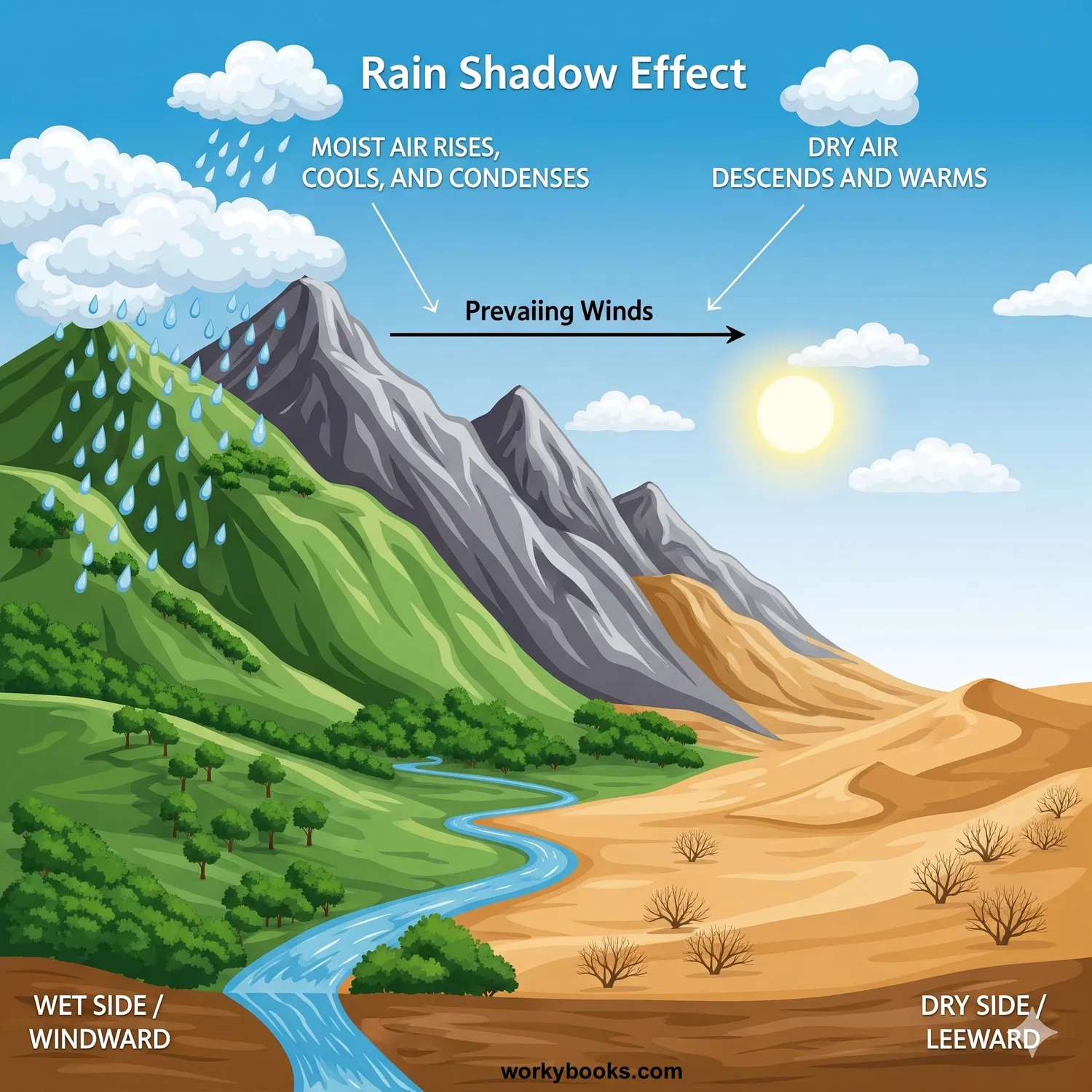
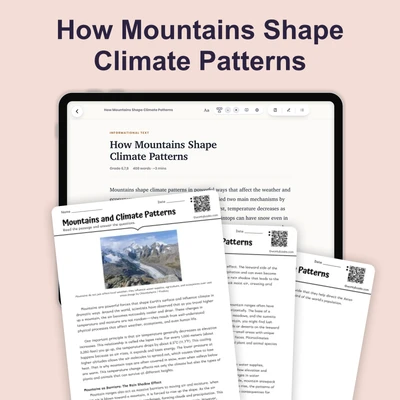
Have you ever wondered why, one side of mountain range might be filled with green trees and flowing rivers, while the other side is dry and desert-like. This amazing difference is all thanks to something called the rain shadow effect, and it has a lot to do with how air masses move and interact with mountains.
Imagine warm, moist air rising from an ocean or a large body of water. As this air moves towards a mountain, it's forced upwards. We call the side of the mountain that faces the wind and gets this moist air the windward side. As the moist air rises, it gets cooler. When air cools, it can't hold as much water vapor. This causes the water vapor to condense into tiny droplets, forming clouds and leading to heavy precipitation, like rain or snow, on the windward side. This is why the windward side of mountains, like those in the Pacific Northwest of the United States, are often so green and fertile.
Once the air has released most of its moisture, it continues to move over the mountain peak and starts to descend on the other side. This side, which is sheltered from the wind and moist air, is called the leeward side. As the air moves down the leeward side, it gets warmer and drier. Because it's warmer, it can hold more moisture, which means it doesn't release much rain. This lack of rain creates a dry area, often a desert or a very arid region, on the leeward side. This dry area is the 'rain shadow'.
The Sierra Nevada mountains in California are a great example of the rain shadow effect. The western, windward side is home to lush forests, while the eastern, leeward side drops into the dry Great Basin Desert. The complex interactions of these air masses and the mountain's barrier create drastically different climates and ecosystems on opposite sides. Understanding the rain shadow effect helps us see how natural barriers shape our planet's diverse landscapes and weather conditions.
Interesting Fact: The Atacama Desert in Chile, one of the driest places on Earth, is largely a result of a double rain shadow created by both the Andes Mountains and a coastal mountain range.
What is the main reason one side of a mountain is lush and the other a desert?
What happens to moist air as it rises up the windward side of a mountain?
It gets warmerIt gets drierIt cools downIt speeds up
The windward side of a mountain typically receives more precipitation. True or False?
TrueFalse
Which term describes the dry, sheltered side of a mountain?
Windward sideLeeward sidePeak sideCoastal side
Why does air descending on the leeward side cause dryness?
It gains moistureIt becomes colderIt holds more waterIt loses all oxygen
What causes water vapor to form clouds on the windward side?
EvaporationCondensationSublimationVaporization
If you were planning a farm, which side of a mountain would be better for crops needing a lot of rain?
Windward sideLeeward sideMountain peakAny side is fine
Which of the following describes an 'ecosystem' as used in the passage?
Weather conditionLiving communityAir mass typeMountain slope
A town is built on the leeward side of a mountain. What kind of weather would its residents most likely experience?
Lots of rainSnowy wintersDry, sunny daysFrequent fog
How do mountains change weather conditions in nearby areas?
By blocking sunlightBy attracting stormsBy forcing air upwardBy cooling the ground
Perfect For:
👩🏫 Teachers
• Reading comprehension practice
• Auto-graded assessments
• Literacy skill development
👨👩👧👦 Parents
• Reading practice at home
• Comprehension improvement
• Educational reading time
🏠 Homeschoolers
• Reading curriculum support
• Independent reading practice
• Progress monitoring
Reading Features:
📖
Reading Passage
Engaging fiction or nonfiction text
❓
Comprehension Quiz
Auto-graded questions
📊
Instant Feedback
Immediate results and scoring
📄
Printable Version
Download for offline reading
🔊
Read Aloud
Voice-over with word highlighting
Reviews & Ratings
No reviews yet. Be the first to share your experience!
Related Content
Tools and Technology in Earth Science
This middle school science reading passage explores the wide range of tools and technologies used in Earth science, from...
MS-ESS2-2MS-ESS3-2MS-ETS1-1MS-PS4-3
Scientific Inquiry in Earth Science
This passage explores scientific inquiry in Earth science for grades 6-8, aligned with NGSS standards MS-ESS1-4, MS-ESS2...
MS-ESS1-4MS-ESS2-1MS-ESS3-5SEP
What Is Earth Science?
This engaging middle school science passage introduces students to the field of Earth science, aligning with NGSS standa...
MS-ESS1MS-ESS2MS-ESS3SEP
Earth: Our Home in Space
This engaging Grade 4-5 science passage, aligned to NGSS, introduces students to Earth's special place in the solar syst...
Earth's Spheres
This middle school science passage introduces students to Earth's four major spheres: the geosphere, hydrosphere, atmosp...
MS-ESS2-4MS-ESS2-6
What Is Space Weather and How Does It Affect the Earth?
This NGSS-aligned science passage for middle school explains what space weather is and how it affects Earth. Students le...
MS-ESS2-2
Earth's Energy Balance
This engaging, NGSS-aligned science passage for grades 6–8 explores Earth's energy balance, a key process that keeps our...
MS-ESS2-6
Earth's Rotation
This middle school science passage, aligned with NGSS standard MS-ESS1-1, focuses on Earth's rotation—how Earth spins on...
MS-ESS1-1
Earth's Interior
This comprehensive passage for grades 6-8 explores Earth's layered interior, including the crust, mantle, outer core, an...
MS-ESS2-1MS-ESS2-2
Facts About Earth
This engaging science reading passage introduces Grade 4 and 5 students to Earth, our home planet. Aligned with NGSS sta...
Meteorite Impacts on Earth
This engaging science reading passage for Grades 4-5 explores meteorite impacts on Earth, aligning with NGSS standards. ...
Venus: Earth's Twin?
This comprehensive science passage for grades 6-8 examines Venus—often called Earth's twin—by exploring its similarities...
MS-ESS1-2MS-ESS1-3
Earth Changes Over Millions of Years
This engaging, audio-integrated science passage for Grade 4-5 students explores how Earth has changed over millions of y...
Earth's Quick and Slow Changes
In 'Earth's Quick and Slow Changes,' students categorize 12 Earth events by their speed of occurrence, enhancing underst...
Earth's Moon Facts
This engaging science passage, 'The Moon: Earth's Companion,' is designed for Grade 4-5 students and aligns with NGSS ge...
Earth: Our Home Planet
This comprehensive science passage for grades 6-8 explores Earth’s unique characteristics and the interconnected systems...
MS-ESS1-2
Earth's Revolution
This middle school science passage explores the science behind Earth's revolution around the Sun, closely aligned with N...
MS-ESS1-1
Earth's Seasons
This comprehensive reading passage for grades 6-8 explains why Earth has seasons, revealing the scientific mechanisms be...
MS-ESS1-1
Earth's Place in the Universe
This reading passage explains Earth's place in the universe, supporting NGSS 1-ESS1-1. It describes how Earth is one of ...
1-ESS1-1
Aphelion and Perihelion
This engaging reading passage, 'Aphelion and Perihelion,' delves into the fascinating aspects of Earth's elliptical orbi...
MS-ESS1-1: DEVELOP AND USE A MODEL OF THE EARTH-SUN-MOON SYSTEM TO DESCRIBE THE CYCLIC PATTERNS OF LUNAR PHASESECLIPSES OF THE SUN AND MOONAND SEASONS.