The Role of Globular Clusters in Understanding Galactic Evolution — Reading Comprehension
Rate this
Premium Resource
Present
Present in classroom. No work saved
Assign
Classroom with student accounts, Track progress
Quick Play
No student accounts, assign with a link
Grades
6
PRINT+DIGITAL RESOURCE
This learning resource is available in interactive and printable formats. The interactive worksheet can be played online and assigned to students. The Printable PDF version can be downloaded and printed for completion by hand.
This passage, integrated with audio, explores 'The Role of Globular Clusters in Understanding Galactic Evolution,' a topic crucial for students studying the universe. It aligns with NGSS MS-ESS1-2, focusing on how gravity drives motions within galaxies. Students will learn about globular clusters, ancient collections of stars, and their importance as cosmic time capsules. The passage explains their structure, how they help scientists understand the history of galaxies, and their connection to the Milky Way. Key terms like gravity and galactic evolution are defined in simple language, making complex astronomical concepts accessible for Grade 6 learners. The accompanying activities, including multiple-choice questions, a glossary, and short answer questions, reinforce understanding of these fascinating celestial objects and their role in the vastness of space.
CONTENT PREVIEW
Expand content preview
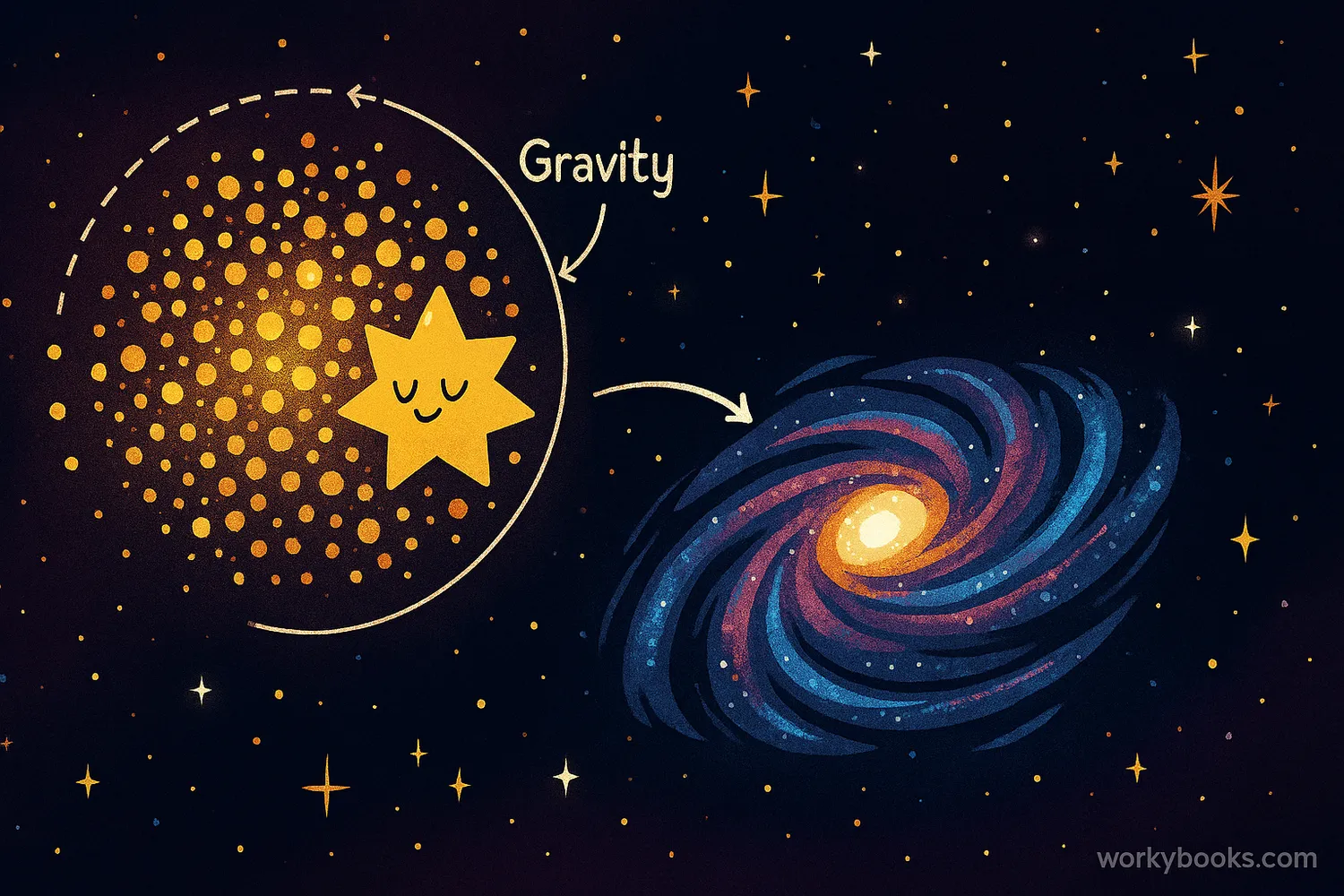
Globular clusters orbit galaxies, revealing clues about gravity, star age, and galactic history.
Have you ever looked up at the night sky and wondered about the billions of stars? Many stars gather together in groups. Some of the most amazing groups are called globular clusters. Imagine a giant ball of hundreds of thousands, or even millions, of very old stars packed closely together. That's a globular cluster! These ancient stellar neighborhoods are found orbiting galaxies, like our own Milky Way galaxy.
Globular clusters are incredibly important for understanding galactic evolution, which is how galaxies change and grow over billions of years. Because all the stars in a globular cluster formed at roughly the same time, they act like cosmic time capsules. By studying these stars, scientists can learn about the early universe and how galaxies first began to form. They are some of the oldest objects we know in the universe, often being more than 10 billion years old! The stars in them are usually very old, low-mass stars, which burn their fuel slowly.
What holds these massive clusters together? The answer is gravity! Gravity is a natural force that pulls objects toward each other. In a globular cluster, the immense gravity from all the stars pulls them together, keeping the cluster in a tight, spherical shape. This same force of gravity also causes globular clusters to orbit their host galaxies, much like planets orbit the sun. The study of these clusters helps astronomers understand how gravity works on a grand scale and its role in the motions within galaxies.
By observing the stars in globular clusters, scientists can figure out the age and makeup of the galaxy they belong to. For example, the Milky Way has about 150 known globular clusters. Their positions and movements give us clues about how our galaxy formed and changed over time. These observations are a key part of modern astronomy and help us build a clearer picture of the vast universe.
Interesting Fact: Some globular clusters are so dense that if you lived on a planet inside one, the night sky would be lit up by thousands of stars much brighter than our Sun!
A few million yearsOver 10 billion yearsAround 1 billion yearsLess than a million years
True or False: Globular clusters are loose groups of young stars.
TrueFalse
What is 'galactic evolution'?
Star birth processGalaxy changes over timePlanet formationUniverse expansion
Why are globular clusters like 'cosmic time capsules'?
They contain future starsStars formed at onceThey travel through timeThey hold dark matter
What does studying globular clusters help scientists understand?
Earth's weather patternsEarly universe and galaxy formationOcean currentsVolcanic eruptions
How many globular clusters does the Milky Way have?
About 50About 150About 500About 1000
If a galaxy has very few globular clusters, what might this suggest about its history?
It's a very old galaxyIt has lots of gasIt might be a younger galaxyIt's a very bright galaxy
Which force is primarily responsible for the spherical shape of globular clusters?
Magnetic forceNuclear forceGravitational forceFriction force
What does 'astronomy' mean as used in the passage?
Study of rocksStudy of stars and spaceStudy of oceansStudy of plants
Perfect For:
👩🏫 Teachers
• Reading comprehension practice
• Auto-graded assessments
• Literacy skill development
👨👩👧👦 Parents
• Reading practice at home
• Comprehension improvement
• Educational reading time
🏠 Homeschoolers
• Reading curriculum support
• Independent reading practice
• Progress monitoring
Reading Features:
📖
Reading Passage
Engaging fiction or nonfiction text
❓
Comprehension Quiz
Auto-graded questions
📊
Instant Feedback
Immediate results and scoring
📄
Printable Version
Download for offline reading
🔊
Read Aloud
Voice-over with word highlighting
Reviews & Ratings
No reviews yet. Be the first to share your experience!
Related Content
Earth: Our Home in Space
This engaging Grade 4-5 science passage, aligned to NGSS, introduces students to Earth's special place in the solar syst...
Tools and Technology in Earth Science
This middle school science reading passage explores the wide range of tools and technologies used in Earth science, from...
MS-ESS2-2MS-ESS3-2MS-ETS1-1MS-PS4-3
Earth's Place in the Universe
This reading passage explains Earth's place in the universe, supporting NGSS 1-ESS1-1. It describes how Earth is one of ...
1-ESS1-1
Scientific Inquiry in Earth Science
This passage explores scientific inquiry in Earth science for grades 6-8, aligned with NGSS standards MS-ESS1-4, MS-ESS2...
MS-ESS1-4MS-ESS2-1MS-ESS3-5SEP
What Is Space Weather and How Does It Affect the Earth?
This NGSS-aligned science passage for middle school explains what space weather is and how it affects Earth. Students le...
MS-ESS2-2
Escape Velocity and Space Travel
This middle school science passage introduces students to the concept of escape velocity—the minimum speed required to b...
MS-ESS1-2MS-PS2-4
Space Stations
This informational science reading passage for grades 6-8 explores the complex systems and technology behind space stati...
MS-ESS1-3MS-ETS1-1
What Is Earth Science?
This engaging middle school science passage introduces students to the field of Earth science, aligning with NGSS standa...
MS-ESS1MS-ESS2MS-ESS3SEP
The Space Garden
This innovative passage combines plant science with space exploration, aligning with NGSS standards for life sciences an...
RL.3.1RL.2.1RL.4.9
Measuring Distances in Space
This middle school science passage explores how astronomers measure the vast distances in space, aligning with NGSS stan...
MS-ESS1-3
Earth: Our Home Planet
This comprehensive science passage for grades 6-8 explores Earth’s unique characteristics and the interconnected systems...
MS-ESS1-2
Meteorite Impacts on Earth
This engaging science reading passage for Grades 4-5 explores meteorite impacts on Earth, aligning with NGSS standards. ...
Exploring Space: Rockets and Spacecraft
Space exploration has been one of humanity's greatest achievements, made possible by rockets and spacecraft. Rockets act...
RI.4.4RI.4.2
Earth's Rotation
This middle school science passage, aligned with NGSS standard MS-ESS1-1, focuses on Earth's rotation—how Earth spins on...
MS-ESS1-1
Facts About Earth
This engaging science reading passage introduces Grade 4 and 5 students to Earth, our home planet. Aligned with NGSS sta...
Earth's Moon Facts
This engaging science passage, 'The Moon: Earth's Companion,' is designed for Grade 4-5 students and aligns with NGSS ge...
International Space Station
Discover the wonders of the International Space Station with this informative coloring page showcasing the orbiting outpost where astronauts live and work in space. As children color the complex modul...
Earth's Seasons
This comprehensive reading passage for grades 6-8 explains why Earth has seasons, revealing the scientific mechanisms be...
MS-ESS1-1
Venus: Earth's Twin?
This comprehensive science passage for grades 6-8 examines Venus—often called Earth's twin—by exploring its similarities...
MS-ESS1-2MS-ESS1-3
The Space Needle
Students read a passage about the history and features of Seattle's Space Needle, then answer comprehension questions to...