Types of Elements
Interactive passage with audio narration, comprehension questions, and printable PDF.
By completing this purchase you agree to our Terms of Use and Privacy Policy. Your subscription renews automatically until you cancel. You can cancel anytime from your account settings. All sales are final and non-refundable. Digital content is available for download in your account immediately upon purchase.
What's included
Types of Elements preview and details
Sample passage and quiz from Types of Elements
Reading passage and comprehension quiz preview
Types of Elements
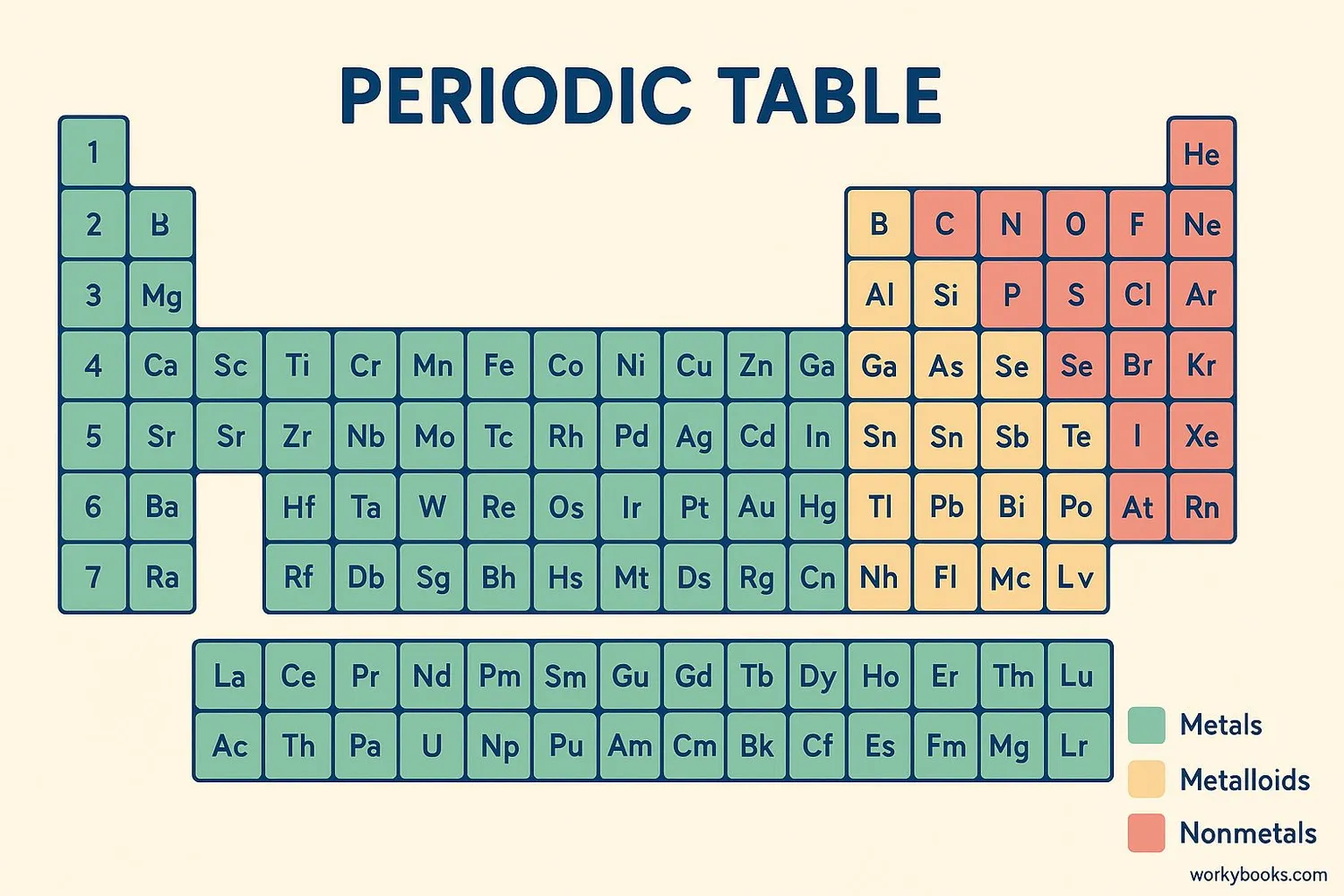
All matter is made of elements, but not all elements are alike. On the periodic table, elements are arranged by their atomic number and grouped based on their properties. Scientists classify elements into three main categories: metals, nonmetals, and metalloids. Each type has unique characteristics that influence how it behaves in nature and technology. Understanding these differences is essential for chemistry and for designing new materials.
How Elements Are Classified
The periodic table is organized in a way that shows relationships between elements. Most elements—about 75%—are classified as metals. Metals are usually found on the left and center of the periodic table. They have high conductivity, meaning they easily transfer electricity and heat. Metals are typically shiny, can be shaped or stretched, and are often solid at room temperature. For example, copper is a metal used in electrical wires because it conducts electricity so well. In contrast, nonmetals are found mostly on the right side of the periodic table. Nonmetals like oxygen and carbon do not conduct electricity well and can be gases, liquids, or brittle solids. Between metals and nonmetals are the metalloids, which have properties of both. Silicon, a metalloid, is crucial in making computer chips because it can conduct electricity, but not as easily as metals.
Properties and Interactions
The properties of each element type are determined by how their atoms are arranged and how they bond with other elements. Metals have loosely held electrons that can move easily, which explains their high conductivity and malleability. Nonmetals, with tightly held electrons, are poor conductors and often form molecules rather than solid structures. Metalloids act as a bridge—sometimes conducting electricity under certain conditions, a property called semiconductivity. This property is vital in modern electronics. Scientists observe that when metals and nonmetals react, they often form compounds like salts, which are important in biology and industry. For example, when sodium (a metal) reacts with chlorine (a nonmetal), they form sodium chloride, or table salt.
Real-World Applications and Scientific Connections
The classification of elements is not just for organization—it has major impacts on technology, health, and the environment. Metals like aluminum are used in building materials because they are strong and lightweight. Nonmetals such as oxygen are essential for life, as they are involved in respiration and photosynthesis. Metalloids like silicon are the foundation of the digital world, making computers and solar panels possible. By studying the properties and interactions of elements, scientists can predict how they will behave in new situations, which is critical for developing new medicines, sustainable energy solutions, and advanced materials.
Understanding the types of elements reveals the underlying structure of matter and highlights the connections between chemistry and everyday life. As research continues, new uses and combinations of metals, nonmetals, and metalloids will shape the future of science and society.
Interesting Fact: Only about 7 elements are classified as metalloids, and they are essential for making modern electronic devices work.
Comprehension quiz (10 questions)
1. Where are most metals located on the periodic table?
2. Which property is most common in metals?
3. What is the main difference between metals and nonmetals?
4. Which element is a metalloid important for electronics?
5. In the passage, what does the word 'conductivity' mean?
6. What does 'semiconductivity' allow metalloids to do?
7. Why do scientists study the properties of different types of elements?
8. If an element is shiny, conducts heat, and can be stretched, it is most likely a:
9. True or False: Nonmetals are usually good conductors of electricity.
10. True or False: Only about 7 elements are classified as metalloids.
Perfect for the way you teach
- Build comprehension skills
- Auto-graded quiz
- Differentiated reading
- Read together at home
- Improve fluency
- Quiet reading time
- Reading curriculum support
- Independent practice
- Track Lexile growth