This learning resource is available in interactive and printable formats. The interactive worksheet can be played online and assigned to students. The Printable PDF version can be downloaded and printed for completion by hand.
This comprehensive middle school science passage examines the uses of radioactivity, aligning with NGSS MS-PS1-1. Students will learn how radiation benefits society in various fields, including medical diagnostics and treatment (such as X-rays, CT scans, and cancer therapy), industrial applications (like thickness gauges and leak detection), agricultural pest control, food preservation, and scientific research (including dating fossils and artifacts). The passage explains the mechanisms behind these applications, such as how radioactive tracers work and why certain isotopes are effective tools. Real-world examples, such as smoke detectors using americium-241, illustrate cause-and-effect chains and the importance of safe, controlled use. The passage includes a glossary, differentiated version, Spanish translations, comprehension questions, writing prompts, and graphic organizers, all audio-integrated for accessibility. This resource is designed for grades 6-8, providing a clear connection to larger scientific principles and the disciplinary core idea. It is ideal for engaging students in understanding the positive impacts and considerations of radioactivity.
CONTENT PREVIEW
Expand content preview
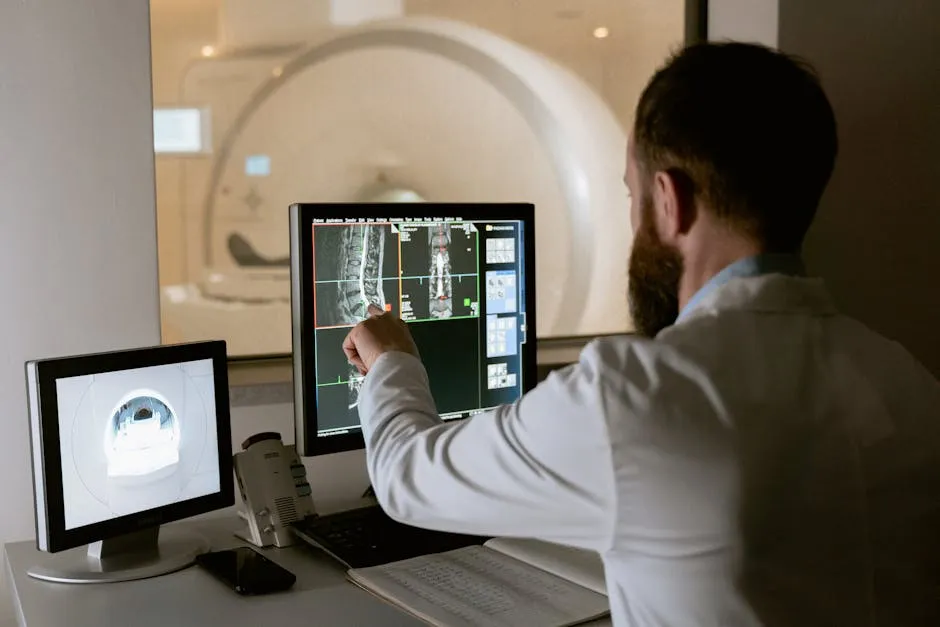
CT scans use controlled radiation to create images of bones and organs. Image by MART PRODUCTION / Pexels.
Radioactivity is a process that releases invisible energy from the nuclei of certain atoms. This energy, called radiation, can be detected and measured using scientific tools. In modern society, radioactivity is not just a natural phenomenon; it is a powerful tool used in many fields. Understanding how radioactivity is safely controlled and applied helps us see how it solves real-world problems, from diagnosing diseases to making food safer.
How Radioactivity Works and Its Detection
Radioactive atoms, or isotopes, become unstable and release energy as they change into more stable forms. This transformation emits particles and energy, which scientists call radioactive decay. The rate at which a radioactive isotope decays is measured by its half-life—the time it takes for half of the atoms to decay. Some isotopes decay quickly, while others take thousands of years. Because each isotope has a unique decay pattern, scientists can use them as tracers to follow and study processes in the body, industry, or the environment. Detectors such as Geiger counters convert these invisible emissions into measurable signals, making it possible to safely monitor and control radioactivity.
Applications in Medicine, Industry, and Science
Radioactivity has many beneficial uses. In medicine, X-rays and CT scans use controlled radiation to create images of bones and organs, helping doctors diagnose injuries and diseases. In cancer treatment, focused beams of radiation are used to destroy cancer cells while limiting harm to healthy tissue; this is known as radiation therapy. Radioactive tracers, such as technetium-99m, are injected into the body to track blood flow or locate tumors by emitting signals detected by special cameras. In industry, radiation is key for measuring the thickness of materials, detecting leaks in sealed pipes, and sterilizing equipment to kill germs. In agriculture, radiation helps control pests without chemicals and preserves food by eliminating bacteria and insects. In science, radioactivity allows researchers to date fossils and ancient artifacts by measuring the remaining radioactive isotopes, a process called radiometric dating. Even household smoke detectors use a tiny amount of americium-241 to sense smoke through changes in electrical current.
Interactions, Safety, and Broader Implications
The use of radioactivity shows the importance of scientific controls and safety. Because high doses of radiation can be harmful, strict guidelines regulate its use. Specialized shielding, such as lead walls, and distance from sources are key safety measures. The careful choice of isotopes, their half-lives, and their chemical properties make applications effective and safe. For example, the short half-life of medical tracers means they disappear from the body quickly, reducing risk. The ability to harness radioactivity for positive uses demonstrates how science can transform a natural force into a valuable tool for society. As technology advances, new applications—such as improved cancer treatments and better environmental monitoring—are constantly being developed.
Understanding radioactivity connects to larger scientific principles, including the structure of matter and the conservation of energy. It highlights how scientific knowledge grows by observation, measurement, and careful experimentation.
Interesting Fact: Bananas naturally contain potassium-40, a radioactive isotope, which means eating a banana gives you a tiny, harmless dose of radiation!
What is radioactivity?
The process by which unstable atoms release energy from their nuclei.A type of visible light used in X-rays.A way to grow plants faster.A kind of bacteria that causes disease.
Which tool is commonly used to detect and measure radiation?
ThermometerGeiger counterMicroscopeBarometer
What does 'half-life' mean in the context of radioactivity?
The time it takes for half the atoms in a sample to decay.The average age of a fossil.The amount of energy released by radiation.The time it takes for radiation to travel one mile.
How is radiation therapy used in medicine?
To create images of bones.To destroy cancer cells while limiting harm to healthy tissue.To test new medicines.To measure blood pressure.
What is the main purpose of using radioactive tracers in the human body?
To clean medical equipment.To track blood flow or find tumors using emitted signals.To make bones stronger.To sterilize food.
What is one industrial use of radioactivity mentioned in the passage?
Making new medicines.Detecting leaks in sealed pipes.Painting cars.Building bridges.
What is 'radiometric dating' used for?
To treat cancer.To measure the age of fossils and artifacts.To make food last longer.To detect smoke in homes.
Which isotope is mentioned as being used in smoke detectors?
Technetium-99mPotassium-40Americium-241Carbon-12
True or False: All forms of radiation are dangerous and should be avoided.
TrueFalse
True or False: The short half-life of medical tracers helps reduce risk to patients.
TrueFalse
Perfect For:
👩🏫 Teachers
• Reading comprehension practice
• Auto-graded assessments
• Literacy skill development
👨👩👧👦 Parents
• Reading practice at home
• Comprehension improvement
• Educational reading time
🏠 Homeschoolers
• Reading curriculum support
• Independent reading practice
• Progress monitoring
Reading Features:
📖
Reading Passage
Engaging fiction or nonfiction text
❓
Comprehension Quiz
Auto-graded questions
📊
Instant Feedback
Immediate results and scoring
📄
Printable Version
Download for offline reading
🔊
Read Aloud
Voice-over with word highlighting
Reviews & Ratings
No reviews yet. Be the first to share your experience!
Related Content
Atomic Structure
This reading passage on Atomic Structure provides middle school students with an accessible explanation of the fundament...
MS-PS1-1RI.6.3RI.7.1
Parts of an Atom
This reading passage on Parts of an Atom provides middle school students with a structured and accessible explanation of...
MS-PS1-1RI.6.3RI.7.1
Chemical Bonds
This reading passage on Chemical Bonds provides middle school students with a clear explanation of how and why atoms con...
MS-PS1-1RI.6.3RI.7.1
The Freezing Point of Water
This science reading passage, titled 'The Freezing Point of Water', introduces students to a key physical science concep...
MS-PS1-1RI.6.3RI.7.1
Physical Properties of Matter
This comprehensive reading passage introduces grades 6-8 students to the concept of physical properties of matter, perfe...
MS-PS1-1
Mixtures and Pure Substances
This middle school science passage provides an in-depth exploration of mixtures and pure substances, directly aligned to...
MS-PS1-1
Types of Mixtures
This comprehensive science passage for grades 6-8 introduces students to the concept of mixtures, focusing on distinguis...
MS-PS1-1
Solutions, Suspensions, and Colloids
This comprehensive science passage explores the differences between solutions, suspensions, and colloids, focusing on ho...
MS-PS1-1
The Nature of Science
This passage explores the nature of science for middle school students, aligning with NGSS standards MS-ETS1-4, MS-PS1-1...
MS-ETS1-4MS-PS1-1MS-LS1-1
Scientific Theories
This reading passage for grades 6-8 introduces students to the concept of scientific theories, emphasizing that these ar...
MS-PS1-1MS-PS1-4MS-PS3-4SCIENCE AND ENGINEERING PRACTICES
Particle Model of Matter
This comprehensive science reading passage for grades 6-8 explores the particle model of matter, aligning with NGSS stan...
MS-PS1-1MS-PS1-4
Valence Electrons
This middle school science passage introduces students to the concept of valence electrons, the outermost electrons that...
MS-PS1-1
The Idea of the Atom
This informational science passage introduces middle school students (grades 6-8) to the concept that all matter is made...
MS-PS1-1
Protons, Neutrons, and Electrons
This comprehensive middle school science passage explores the roles of protons, neutrons, and electrons, the three main ...
MS-PS1-1
What are Ions
This passage introduces middle school students to the concept of ions, explaining the processes by which atoms gain or l...
MS-PS1-1
Nucleus of the Atom
This comprehensive passage for grades 6-8 introduces students to the nucleus of the atom, the dense center that contains...
MS-PS1-1
How Atoms Differ
This middle school science reading passage, aligned with NGSS standard MS-PS1-1, explores the fundamental differences am...
MS-PS1-1
Isotopes
This middle school science passage explores the concept of isotopes, which are atoms of the same element with different ...
MS-PS1-1
Compounds vs. Mixtures
This educational passage for grades 6-8 explores the fundamental differences between compounds and mixtures, aligning wi...
MS-PS1-1
Organizing the Elements
This passage for middle school science explores how scientists organized the elements as more were discovered, leading t...