What Are Convection Currents — Reading Comprehension
Rate this
Premium Resource
Present
Present in classroom. No work saved
Assign
Classroom with student accounts, Track progress
Quick Play
No student accounts, assign with a link
Grades
6
PRINT+DIGITAL RESOURCE
This learning resource is available in interactive and printable formats. The interactive worksheet can be played online and assigned to students. The Printable PDF version can be downloaded and printed for completion by hand.
This educational passage, audio-integrated for enhanced learning, explores 'What Are Convection Currents,' a key concept for understanding Earth's climate. Students will learn how unequal heating of the Earth's surface and atmosphere creates these currents, driving global **atmospheric circulation** and **oceanic circulation**. The passage defines essential terms like **density**, **thermal energy**, and **fluid** using simple language suitable for a Grade 6 reading level. It also explains how these continuous movements impact **weather patterns** and **regional climates**, directly aligning with NGSS standard MS-ESS2-6. By understanding convection currents, students grasp the fundamental processes that shape our planet's environment, covering essential **Earth science** topics.
CONTENT PREVIEW
Expand content preview
Convection currents move heat through fluids, shaping climate and global energy flow.
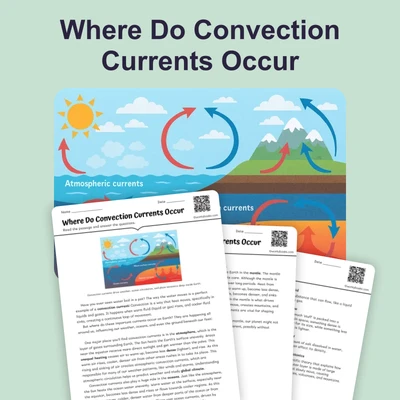
Have you ever wondered why some parts of the world are hot and others are cold? Or why ocean currents move in specific ways? The answer often lies in something called convection currents. These are a fundamental part of how energy moves through liquids and gases, influencing everything from the weather to deep ocean movements. Understanding convection currents helps us understand global weather patterns and regional climates.
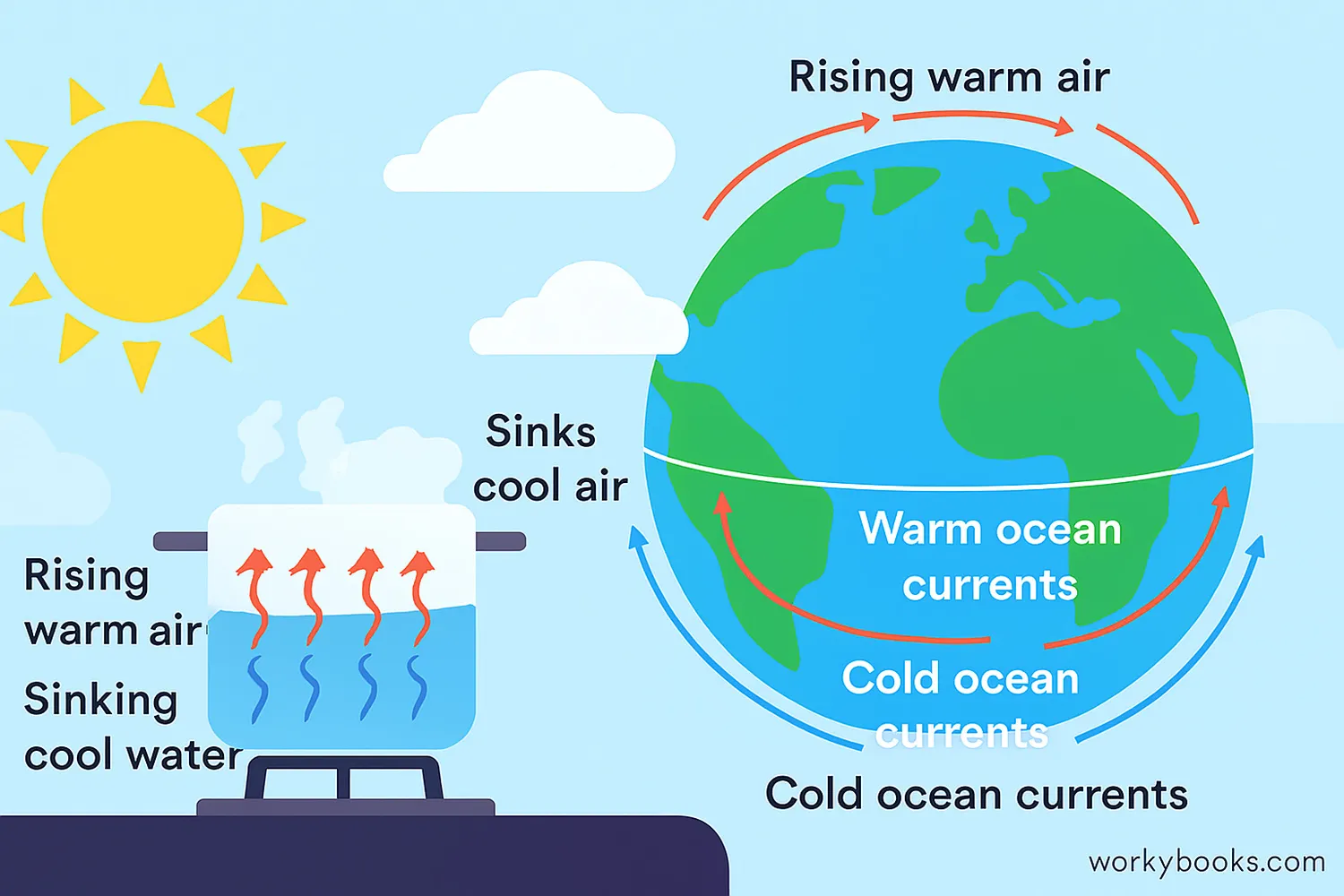
Let's break down how they work. Imagine heating a pot of water on a stove. The water at the bottom gets warm first. When water warms up, it becomes less dense, meaning it gets lighter. Think of it like a hot air balloon – hot air rises! So, the warm water at the bottom rises to the top. As this warm water rises, cooler, denser water from the top sinks down to take its place at the bottom of the pot. This cooler water then gets heated, rises, and the cycle continues. This continuous movement of fluid (liquid or gas) due to heating and cooling is a convection current.
On Earth, the sun is the main source of heat. However, the sun doesn't heat the entire Earth evenly. Areas near the equator receive more direct sunlight, making them warmer. The poles receive less direct sunlight, making them colder. This unequal heating is the driving force behind large-scale convection currents in both our atmosphere and oceans.
In the atmosphere, warm air near the equator becomes less dense and rises. As it rises, it cools and eventually sinks back down towards the poles, creating large loops of air movement known as atmospheric circulation. These currents carry thermal energy around the globe, influencing temperatures and precipitation. Similarly, in the oceans, warm water from the equator moves towards the poles, and cold water from the poles moves towards the equator, creating oceanic circulation. These ocean currents are vital for distributing heat and nutrients.
So, convection currents are simply the way heat moves in fluids like air and water. They are a continuous cycle of rising warm material and sinking cool material, all driven by the sun's energy and the unequal heating of our planet. These currents are essential for shaping the environments and climates we experience all over the world.
Interesting Fact: Without convection currents, the Earth's equator would be much hotter, and the poles much colder, making many parts of the planet uninhabitable!
What causes warm water to rise in a pot?
It becomes denserIt becomes lighterIt gets colderIt disappears
What is the main source of heat for Earth's convection currents?
The MoonThe SunVolcanoesEarth's core
True or False: Convection currents occur only in liquids.
TrueFalse
Which word means 'the amount of matter in a given space'?
CurrentFluidDensityEnergy
How does unequal heating contribute to convection currents?
Creates uniform temperaturesCauses different densitiesStops fluid movementGenerates light only
What happens to cool, dense fluid in a convection current?
It risesIt disappearsIt sinksIt expands
Why are convection currents important for Earth's climate?
They make oceans stillThey distribute heatThey cause earthquakesThey block sunlight
If a heater is on the floor, where will the warmest air be?
Near the floorNear the ceilingNear the doorNear the window
Which of these is an example of a fluid?
A solid rockA block of woodOcean waterA metal rod
How do convection currents affect regional climates?
They stop all rainThey change temperaturesThey create mountainsThey build cities
Perfect For:
👩🏫 Teachers
• Reading comprehension practice
• Auto-graded assessments
• Literacy skill development
👨👩👧👦 Parents
• Reading practice at home
• Comprehension improvement
• Educational reading time
🏠 Homeschoolers
• Reading curriculum support
• Independent reading practice
• Progress monitoring
Reading Features:
📖
Reading Passage
Engaging fiction or nonfiction text
❓
Comprehension Quiz
Auto-graded questions
📊
Instant Feedback
Immediate results and scoring
📄
Printable Version
Download for offline reading
🔊
Read Aloud
Voice-over with word highlighting
Reviews & Ratings
No reviews yet. Be the first to share your experience!
Related Content
Tools and Technology in Earth Science
This middle school science reading passage explores the wide range of tools and technologies used in Earth science, from...
MS-ESS2-2MS-ESS3-2MS-ETS1-1MS-PS4-3
Scientific Inquiry in Earth Science
This passage explores scientific inquiry in Earth science for grades 6-8, aligned with NGSS standards MS-ESS1-4, MS-ESS2...
MS-ESS1-4MS-ESS2-1MS-ESS3-5SEP
What Is Earth Science?
This engaging middle school science passage introduces students to the field of Earth science, aligning with NGSS standa...
MS-ESS1MS-ESS2MS-ESS3SEP
Earth: Our Home in Space
This engaging Grade 4-5 science passage, aligned to NGSS, introduces students to Earth's special place in the solar syst...
Earth's Spheres
This middle school science passage introduces students to Earth's four major spheres: the geosphere, hydrosphere, atmosp...
MS-ESS2-4MS-ESS2-6
What Is Space Weather and How Does It Affect the Earth?
This NGSS-aligned science passage for middle school explains what space weather is and how it affects Earth. Students le...
MS-ESS2-2
Earth's Energy Balance
This engaging, NGSS-aligned science passage for grades 6–8 explores Earth's energy balance, a key process that keeps our...
MS-ESS2-6
Earth's Rotation
This middle school science passage, aligned with NGSS standard MS-ESS1-1, focuses on Earth's rotation—how Earth spins on...
MS-ESS1-1
Earth's Interior
This comprehensive passage for grades 6-8 explores Earth's layered interior, including the crust, mantle, outer core, an...
MS-ESS2-1MS-ESS2-2
Facts About Earth
This engaging science reading passage introduces Grade 4 and 5 students to Earth, our home planet. Aligned with NGSS sta...
Meteorite Impacts on Earth
This engaging science reading passage for Grades 4-5 explores meteorite impacts on Earth, aligning with NGSS standards. ...
Venus: Earth's Twin?
This comprehensive science passage for grades 6-8 examines Venus—often called Earth's twin—by exploring its similarities...
MS-ESS1-2MS-ESS1-3
Earth Changes Over Millions of Years
This engaging, audio-integrated science passage for Grade 4-5 students explores how Earth has changed over millions of y...
Earth's Quick and Slow Changes
In 'Earth's Quick and Slow Changes,' students categorize 12 Earth events by their speed of occurrence, enhancing underst...
Earth's Moon Facts
This engaging science passage, 'The Moon: Earth's Companion,' is designed for Grade 4-5 students and aligns with NGSS ge...
Earth: Our Home Planet
This comprehensive science passage for grades 6-8 explores Earth’s unique characteristics and the interconnected systems...
MS-ESS1-2
Earth's Revolution
This middle school science passage explores the science behind Earth's revolution around the Sun, closely aligned with N...
MS-ESS1-1
Earth's Seasons
This comprehensive reading passage for grades 6-8 explains why Earth has seasons, revealing the scientific mechanisms be...
MS-ESS1-1
Earth's Place in the Universe
This reading passage explains Earth's place in the universe, supporting NGSS 1-ESS1-1. It describes how Earth is one of ...
1-ESS1-1
Aphelion and Perihelion
This engaging reading passage, 'Aphelion and Perihelion,' delves into the fascinating aspects of Earth's elliptical orbi...
MS-ESS1-1: DEVELOP AND USE A MODEL OF THE EARTH-SUN-MOON SYSTEM TO DESCRIBE THE CYCLIC PATTERNS OF LUNAR PHASESECLIPSES OF THE SUN AND MOONAND SEASONS.