Reading PassagePremium

What Are Earth's Layers

Interactive passage with audio narration, comprehension questions, and printable PDF.

No ratings yet|
1
Grades 5–8ScienceElaEnglish · SpanishInteractive · Printable
Aligned toMS-ESS2-1
Just this resource
$1.50
One-time purchase
Best value
Unlock everything
$49.99$29.99/yr
40% off until Aug 1 — 10,000+ resources
Renews at $49.99/year.
Unlock above to use these actions

What's included

Reading passage
Audio narration
Comprehension quiz
Writing activity
Glossary & flashcards
Differentiated version
Spanish translation

What Are Earth's Layers preview and details

About this printable What Are Earth's Layers science reading passage, NGSS-aligned (Grades 5-8)

science,ela
Written by Workybooks TeamPublished by Workybooks
Preview

Sample passage and quiz from What Are Earth's Layers

Reading passage and comprehension quiz preview

What Are Earth's Layers
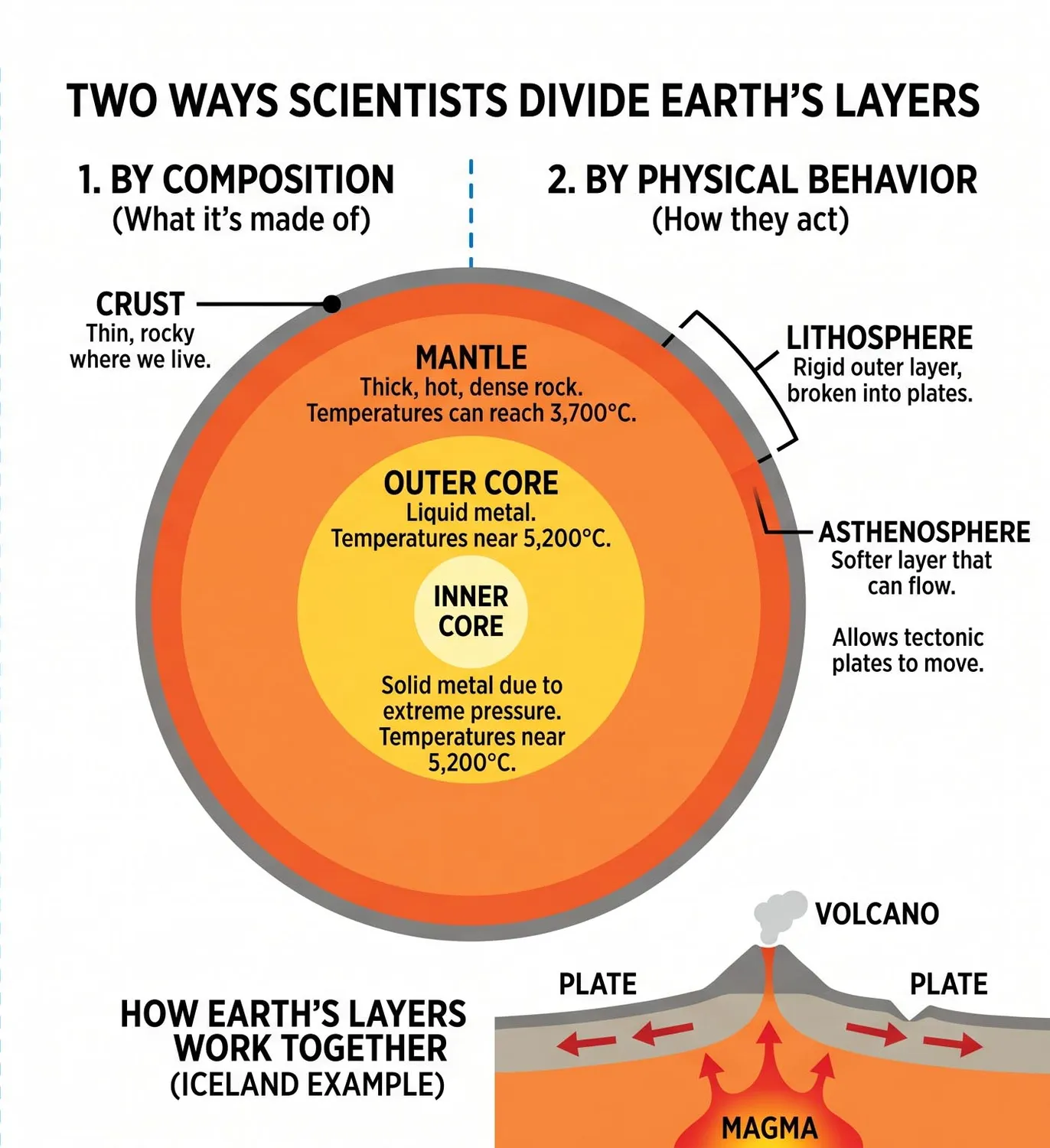
Diagram comparing Earth's layered structure to a peach with labeled interior layers.
Earth's layers by composition and physical behavior, illustrated with a peach analogy.

Earth may look like a solid ball of rock, but it is actually arranged in layers. Scientists explain that our planet has a structure similar to a peach. A peach has thin skin, a thick fleshy middle, and a hard pit at the center. Earth works in a similar way. Each layer has different materials, temperatures, and physical properties.

Scientists divide Earth's interior in two important ways. The first way is by composition, or what each layer is made of. From the outside in, these layers are the crust, the mantle, and the core. The crust is the thin, rocky outer shell where we live. Below the crust lies the mantle, a thick layer of hot, dense rock. The core sits at Earth's center and contains mostly iron and nickel.

The second way scientists classify Earth's layers is by how they behave physically. The outermost rigid layer is called the lithosphere. It includes the crust and the upper part of the mantle. The lithosphere is broken into large pieces called tectonic plates. Beneath the lithosphere sits the asthenosphere, a zone where rock is so hot it can flow slowly like thick honey. This softer layer allows the rigid plates above to move.

Temperature and pressure increase as you travel deeper into Earth. The crust remains relatively cool, but temperatures in the mantle can reach 3,700 degrees Celsius. The core is even hotter, with temperatures near 5,200 degrees Celsius. Evidence shows that the outer core is liquid metal, while the inner core is solid. The extreme pressure at Earth's center keeps the inner core solid despite the intense heat.

Understanding Earth's layers helps explain many geological processes. The island of Iceland sits on a boundary where two tectonic plates pull apart. Magma from the mantle rises through the crust, creating volcanoes and new land. This process demonstrates how Earth's internal heat drives surface changes. The heat trapped inside Earth powers the movement of plates, the formation of mountains, and the rock cycle itself.

Earth's layered structure matters because it controls how our planet works. The thin crust provides a habitat for all life. The flowing asthenosphere allows continents to drift over millions of years. The liquid outer core generates Earth's magnetic field, which protects us from harmful solar radiation. Without Earth's layers working together, our planet would be a very different place.

Interesting Fact: Earth's inner core is a solid ball of iron about the size of the Moon. Scientists discovered it rotates slightly faster than the rest of the planet.

Comprehension quiz (10 questions)

1. What are the three main layers of Earth based on composition?

Crust, mantle, and core
Lithosphere, asthenosphere, and core
Upper mantle, lower mantle, and core
Inner core, outer core, and mantle

2. Which layer allows tectonic plates to move?

The crust
The lithosphere
The asthenosphere
The outer core

3. What does the term 'composition' mean in the passage?

How hot something is
What something is made of
How something moves
Where something is located

4. The asthenosphere is described as flowing 'like thick honey.' What does this comparison help explain?

The asthenosphere is sweet
The asthenosphere is yellow in color
The asthenosphere can flow slowly even though it is solid rock
The asthenosphere is sticky

5. Why is the inner core solid even though it is extremely hot?

It is made of different materials than the outer core
The extreme pressure keeps it solid
It is actually cooler than the outer core
It does not contain any metal

6. Based on the passage, what drives the movement of tectonic plates?

Ocean currents
Earth's rotation
Heat trapped inside Earth
The Moon's gravity

7. How does the example of Iceland support the main idea of the passage?

It shows that all islands have volcanoes
It demonstrates how Earth's internal heat drives surface changes
It proves that the crust is very thick
It explains why the core is solid

8. What can you infer about why scientists study Earth's layers?

To understand geological processes like volcanoes and earthquakes
To find new places to live
To measure the exact size of Earth
To prove Earth is round

9. True or False: The lithosphere includes both the crust and part of the mantle.

True
False

10. True or False: The outer core is solid metal while the inner core is liquid.

True
False
Who it's for

Perfect for the way you teach

Teachers
  • Build comprehension skills
  • Auto-graded quiz
  • Differentiated reading
Parents
  • Read together at home
  • Improve fluency
  • Quiet reading time
Homeschoolers
  • Reading curriculum support
  • Independent practice
  • Track Lexile growth
Topics

Reviews & Ratings

No reviews yet. Be the first to share your experience!

More reading you might love

20 more
Passage
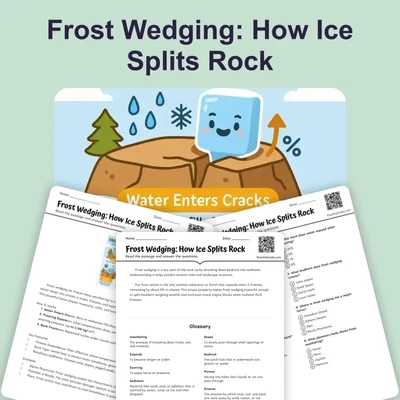
Frost Wedging: How Ice Splits Rock - reading educational content
Grades 5–8

Frost Wedging: How Ice Splits Rock

earth and space science · MS-ESS2-1

$1.50
Passage
Limestone Caves: Nature’s Underground Wonders - reading educational content
Grades 5–8

Limestone Caves: Nature’s Underground Wonders

science · MS-ESS2-1

Free
Passage
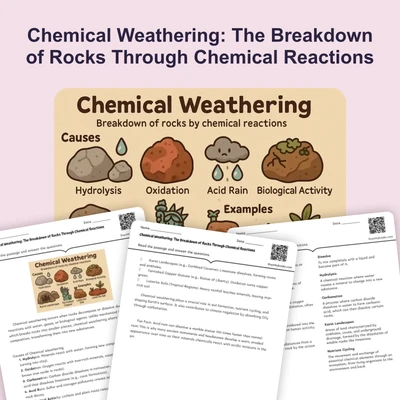
Chemical Weathering: The Breakdown of Rocks Through Chemical Reactions - reading educational content
Grades 5–8

Chemical Weathering: The Breakdown of Rocks Through Chemical Reactions

earth and space science · MS-ESS2-1

Free
Passage
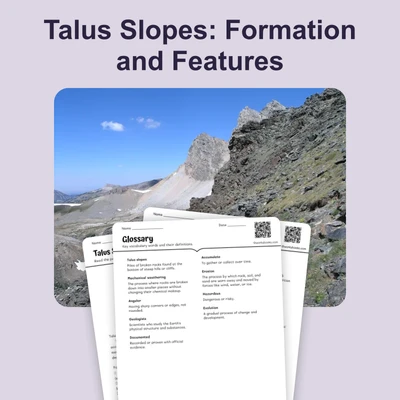
Talus Slopes: Formation and Features - reading educational content
Grades 5–8

Talus Slopes: Formation and Features

science · MS-ESS2-1

Free
Passage
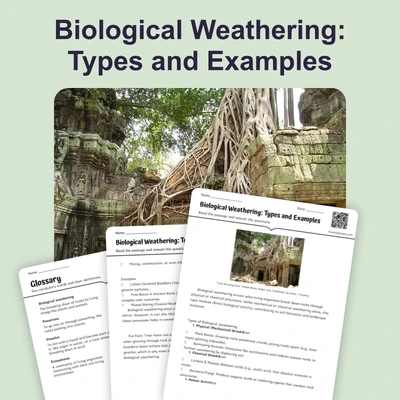
Biological Weathering: Types and Examples - reading educational content
Grades 5–8

Biological Weathering: Types and Examples

science · MS-ESS2-1

Free
Passage
The Coldest City in the World: Yakutsk - reading educational content
Grades 5–8

The Coldest City in the World: Yakutsk

weather and climate · MS-ESS2-1

$1.50
Passage
Igneous Rocks - reading educational content
Grades 5–8

Igneous Rocks

earth and space science · MS-ESS2-1

$1.50
Passage
Sedimentary Rocks - reading educational content
Grades 5–8

Sedimentary Rocks

earth and space science · MS-ESS2-1

$1.50
Passage
Metamorphic Rocks - reading educational content
Grades 5–8

Metamorphic Rocks

earth and space science · MS-ESS2-1

Free
Passage
Scientific Inquiry in Earth Science - reading educational content
Grades 5–8

Scientific Inquiry in Earth Science

earth and space science · MS-ESS1-4

$1.50
Passage
Contour Lines and Elevation - reading educational content
Grades 5–8

Contour Lines and Elevation

earth and space science · MS-ESS2-2

$1.50
Passage
Weathering - reading educational content
Grades 5–8

Weathering

earth and space science · MS-ESS2-1

$1.50
Passage
Erosion - reading educational content
Grades 5–8

Erosion

earth and space science · MS-ESS2-1

$1.50
Passage
Stream Erosion and Deposition - reading educational content
Grades 5–8

Stream Erosion and Deposition

earth and space science · MS-ESS2-1

$1.50
Passage
Wind Erosion and Deposition - reading educational content
Grades 5–8

Wind Erosion and Deposition

earth and space science · MS-ESS2-1

$1.50
Passage
Glacial Erosion and Deposition - reading educational content
Grades 5–8

Glacial Erosion and Deposition

earth and space science · MS-ESS2-1

$1.50
Passage
Mass Movements - reading educational content
Grades 5–8

Mass Movements

science · MS-ESS2-1

$1.50
Passage
Soil Formation and Composition - reading educational content
Grades 5–8

Soil Formation and Composition

earth and space science · MS-ESS2-1

$1.50
Passage
Constructive and Destructive Forces - reading educational content
Grades 5–8

Constructive and Destructive Forces

earth and space science · MS-ESS2-1

Free
Passage
Mountains and Mountain Building - reading educational content
Grades 5–8

Mountains and Mountain Building

earth and space science · MS-ESS2-1

$1.50
Copyright © 2026 Workybooks. Made with ♥ in California.