Reading PassagePremium

What Are Earth's Magnetic Poles

Interactive passage with audio narration, comprehension questions, and printable PDF.

No ratings yet|
1
Grades 5–8ScienceElaEnglish · SpanishInteractive · Printable
Aligned toMS-ESS2-1
Just this resource
$1.50
One-time purchase
Best value
Unlock everything
$49.99$29.99/yr
40% off until Aug 1 — 10,000+ resources
Renews at $49.99/year.
Unlock above to use these actions

What's included

Reading passage
Audio narration
Comprehension quiz
Writing activity
Glossary & flashcards
Differentiated version
Spanish translation

What Are Earth's Magnetic Poles preview and details

About this printable What Are Earth's Magnetic Poles science reading passage, NGSS-aligned (Grades 5-8)

This comprehensive middle school science reading passage explores Earth's magnetic poles and how they differ from geographic poles. Aligned with NGSS standard MS-ESS2-1 and disciplinary core idea MS-ESS2.A, students learn that Earth's magnetic field has two poles where invisible field lines are strongest and dive into the planet. The passage clarifies the common confusion between magnetic poles and geographic poles, explaining that the magnetic north pole is separate from the geographic North Pole and actually wanders many miles each year. Students discover why compass needles point toward magnetic north rather than true north, and why explorers and pilots must account for this difference. The audio-integrated lesson includes real-world applications of understanding Earth's magnetic field, making abstract concepts concrete through practical examples. This foundational passage helps students develop critical thinking about Earth's systems and prepares them for more advanced study of planetary magnetism and navigation.
Written by Workybooks TeamPublished by Workybooks
Preview

Sample passage and quiz from What Are Earth's Magnetic Poles

Reading passage and comprehension quiz preview

What Are Earth's Magnetic Poles
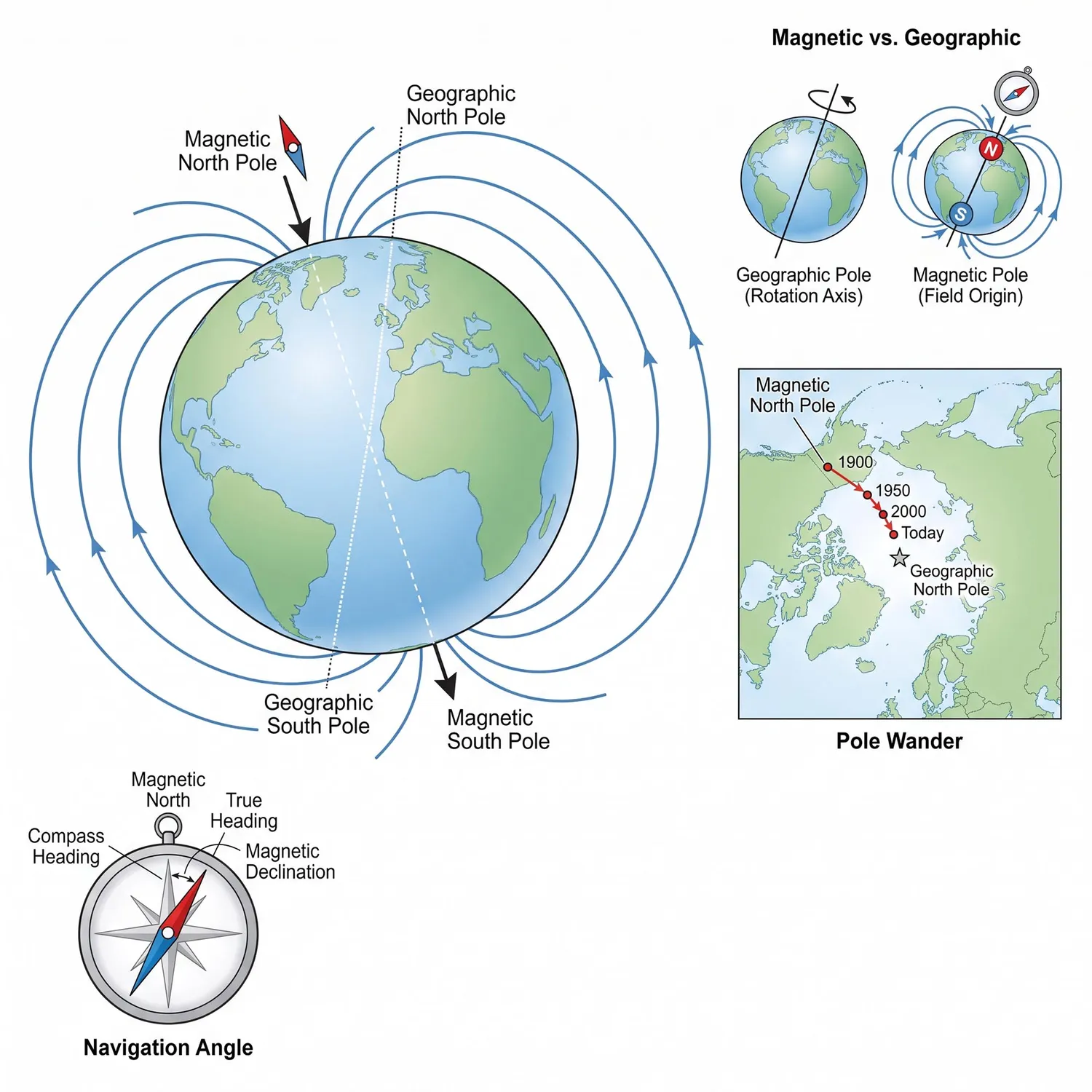
Earth's magnetic and geographic poles with magnetic field and compass navigation
Earth's magnetic poles differ from geographic poles and guide compass navigation.

Earth's magnetic poles are the two ends of our planet's magnetic field, similar to the ends of a bar magnet. These poles mark the spots where invisible field lines are strongest and dive into Earth. One magnetic pole sits in the far north, and one sits in the far south. Scientists observe that these poles create a protective shield around our planet.

Many people confuse magnetic poles with geographic poles, but they are not the same thing. The geographic North Pole is a fixed point where Earth's rotation axis emerges from the surface. Earth spins around this imaginary line every day. The magnetic north pole, however, is a separate location. Evidence shows it sits close to the geographic North Pole but not at the exact same spot. The two poles can be hundreds of miles apart.

The magnetic north pole has another surprising feature: it moves. Scientists track the magnetic pole's position and find it drifts many miles each year. Over the past century, the magnetic north pole has wandered from northern Canada toward Siberia. This movement happens because Earth's magnetic field comes from swirling molten iron deep inside the planet. As this liquid metal flows, the magnetic field shifts position.

Understanding the difference between magnetic and geographic poles matters for navigation. A compass needle points toward magnetic north, not true north. Explorers, pilots, and ship captains must account for this difference when plotting their routes. The angle between magnetic north and true north varies depending on your location on Earth. In some places, the difference can be more than 20 degrees. Without correcting for this variation, travelers could end up far from their intended destination.

This practical knowledge has real-world importance today. GPS systems and digital maps help with navigation, but compasses remain essential backup tools. Hikers in remote wilderness areas rely on compasses when technology fails. Understanding Earth's magnetic poles helps us navigate safely and teaches us about the dynamic systems operating beneath our feet.

Interesting Fact: Scientists can examine ancient rocks to see where Earth's magnetic poles were located millions of years ago. They have discovered that the magnetic poles have completely flipped positions many times throughout Earth's history!

Comprehension quiz (10 questions)

1. What are Earth's magnetic poles?

The two ends of Earth's magnetic field where field lines are strongest
The points where Earth's rotation axis meets the surface
The hottest places on Earth's surface
The places where compasses are made

2. How do magnetic poles differ from geographic poles?

They are exactly the same location
Magnetic poles are fixed while geographic poles move
Magnetic poles are separate locations that can be hundreds of miles from geographic poles
Geographic poles move while magnetic poles stay in one place

3. What does the word 'drift' mean in the passage when describing the magnetic north pole?

To stay completely still
To move slowly over time
To spin rapidly
To disappear completely

4. What causes Earth's magnetic field to exist?

The sun's heat
Swirling molten iron deep inside Earth
Frozen water at the poles
Wind patterns in the atmosphere

5. Why do explorers and pilots need to account for the difference between magnetic north and true north?

To make their maps look better
Because compass needles point to magnetic north, not geographic north, which could cause navigation errors
To save fuel on their journeys
Because it makes their jobs more interesting

6. Based on the passage, what can scientists learn by examining ancient rocks?

The age of Earth
Where magnetic poles were located in the past
How to make better compasses
The temperature of Earth's core

7. If the angle between magnetic north and true north is 20 degrees in a certain location, what might happen to a traveler who doesn't account for this difference?

They would arrive at exactly the right destination
Their compass would break
They could end up far from their intended destination
Nothing would happen

8. What evidence shows that the magnetic north pole has moved over the past century?

Scientists have tracked its position moving from northern Canada toward Siberia
Compasses have stopped working
The geographic poles have moved
GPS systems have failed

9. True or False: The geographic North Pole and the magnetic north pole are located at exactly the same spot.

True
False

10. True or False: A compass needle points toward the geographic North Pole.

True
False
Who it's for

Perfect for the way you teach

Teachers
  • Build comprehension skills
  • Auto-graded quiz
  • Differentiated reading
Parents
  • Read together at home
  • Improve fluency
  • Quiet reading time
Homeschoolers
  • Reading curriculum support
  • Independent practice
  • Track Lexile growth
Topics

Reviews & Ratings

No reviews yet. Be the first to share your experience!

More reading you might love

20 more
Passage
Frost Wedging: How Ice Splits Rock - reading educational content
Grades 5–8

Frost Wedging: How Ice Splits Rock

earth and space science · MS-ESS2-1

$1.50
Passage
Limestone Caves: Nature’s Underground Wonders - reading educational content
Grades 5–8

Limestone Caves: Nature’s Underground Wonders

science · MS-ESS2-1

Free
Passage
Chemical Weathering: The Breakdown of Rocks Through Chemical Reactions - reading educational content
Grades 5–8

Chemical Weathering: The Breakdown of Rocks Through Chemical Reactions

earth and space science · MS-ESS2-1

Free
Passage
Talus Slopes: Formation and Features - reading educational content
Grades 5–8

Talus Slopes: Formation and Features

science · MS-ESS2-1

Free
Passage
Biological Weathering: Types and Examples - reading educational content
Grades 5–8

Biological Weathering: Types and Examples

science · MS-ESS2-1

Free
Passage
The Coldest City in the World: Yakutsk - reading educational content
Grades 5–8

The Coldest City in the World: Yakutsk

weather and climate · MS-ESS2-1

$1.50
Passage
Igneous Rocks - reading educational content
Grades 5–8

Igneous Rocks

earth and space science · MS-ESS2-1

$1.50
Passage
Sedimentary Rocks - reading educational content
Grades 5–8

Sedimentary Rocks

earth and space science · MS-ESS2-1

$1.50
Passage
Metamorphic Rocks - reading educational content
Grades 5–8

Metamorphic Rocks

earth and space science · MS-ESS2-1

Free
Passage
Scientific Inquiry in Earth Science - reading educational content
Grades 5–8

Scientific Inquiry in Earth Science

earth and space science · MS-ESS1-4

$1.50
Passage
Contour Lines and Elevation - reading educational content
Grades 5–8

Contour Lines and Elevation

earth and space science · MS-ESS2-2

$1.50
Passage
Weathering - reading educational content
Grades 5–8

Weathering

earth and space science · MS-ESS2-1

$1.50
Passage
Erosion - reading educational content
Grades 5–8

Erosion

earth and space science · MS-ESS2-1

$1.50
Passage
Stream Erosion and Deposition - reading educational content
Grades 5–8

Stream Erosion and Deposition

earth and space science · MS-ESS2-1

$1.50
Passage
Wind Erosion and Deposition - reading educational content
Grades 5–8

Wind Erosion and Deposition

earth and space science · MS-ESS2-1

$1.50
Passage
Glacial Erosion and Deposition - reading educational content
Grades 5–8

Glacial Erosion and Deposition

earth and space science · MS-ESS2-1

$1.50
Passage
Mass Movements - reading educational content
Grades 5–8

Mass Movements

science · MS-ESS2-1

$1.50
Passage
Soil Formation and Composition - reading educational content
Grades 5–8

Soil Formation and Composition

earth and space science · MS-ESS2-1

$1.50
Passage
Constructive and Destructive Forces - reading educational content
Grades 5–8

Constructive and Destructive Forces

earth and space science · MS-ESS2-1

Free
Passage
Mountains and Mountain Building - reading educational content
Grades 5–8

Mountains and Mountain Building

earth and space science · MS-ESS2-1

$1.50
Copyright © 2026 Workybooks. Made with ♥ in California.