This learning resource is available in interactive and printable formats. The interactive worksheet can be played online and assigned to students. The Printable PDF version can be downloaded and printed for completion by hand.
This passage on mechanical waves is designed for middle school students, aligning with NGSS standards related to energy transfer and waves. It provides a foundational understanding of what mechanical waves are, detailing the key characteristics of both transverse and longitudinal waves. The text uses relatable examples, such as sound and seismic waves, to illustrate these concepts and connect them to real-world phenomena. The passage defines essential vocabulary and is structured to be clear and direct, making it suitable for self-study. It aims to not only inform but also to engage students by highlighting the significance of these waves in everyday life and the natural world, all while maintaining a factual and accessible tone for grades 6-8.
CONTENT PREVIEW
Expand content preview
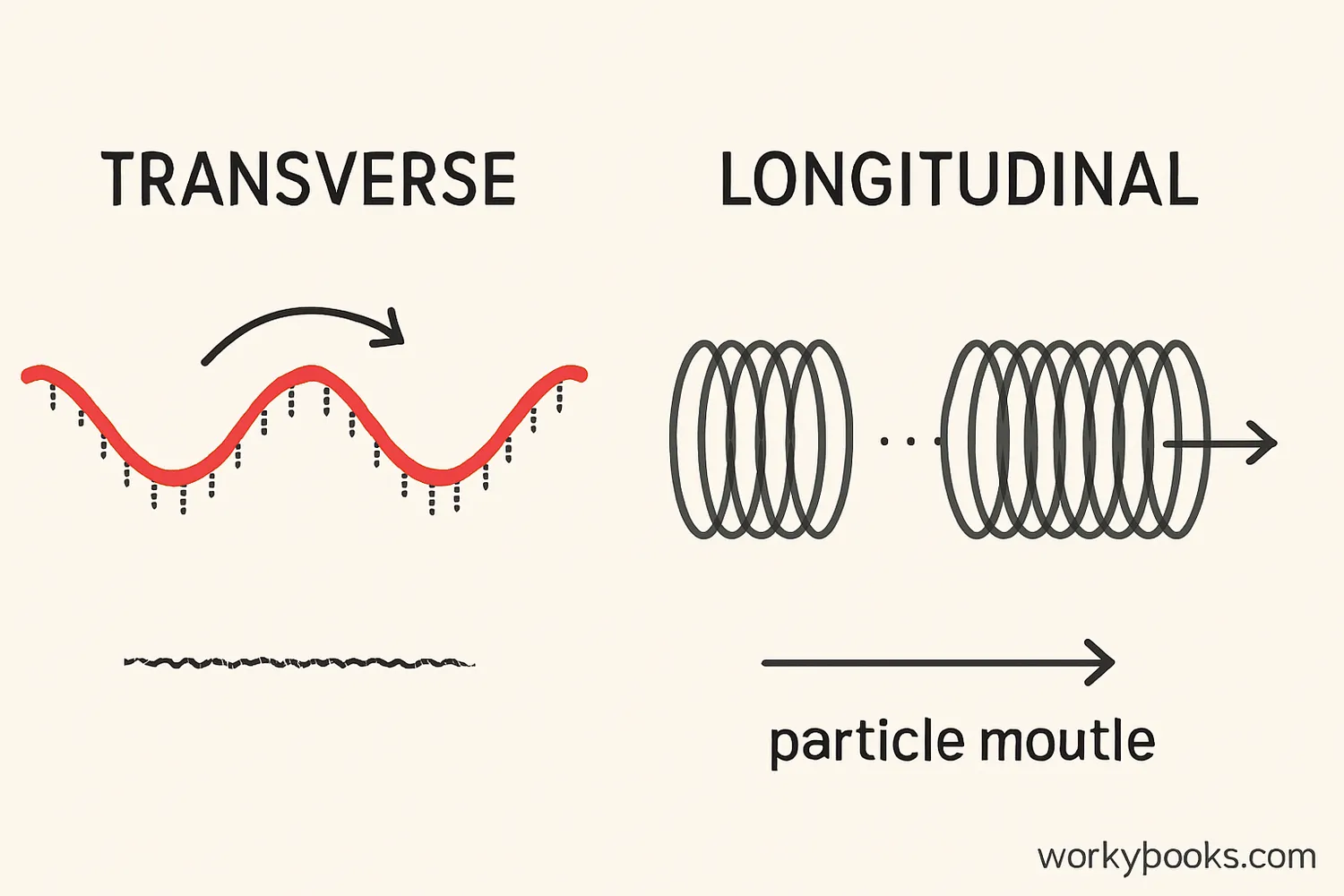
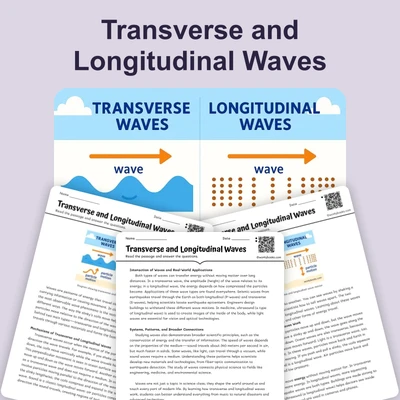
The two main types of mechanical waves: transverse waves, where particles move perpendicular to the wave's direction, and longitudinal waves, where particles move parallel to the wave's direction.
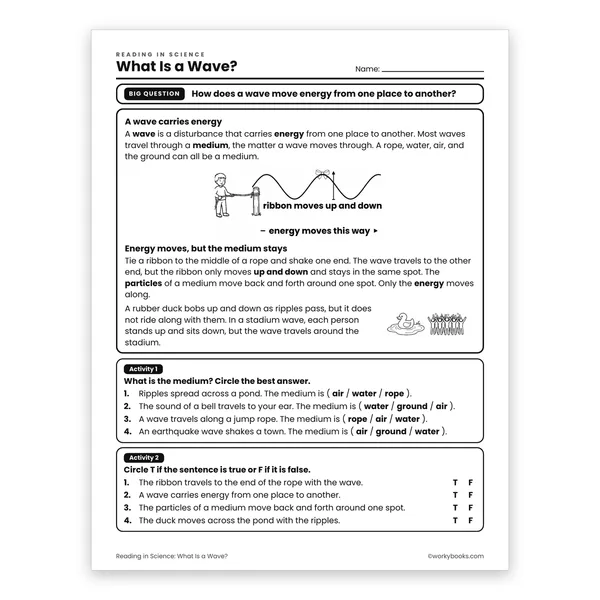
A mechanical wave is a disturbance that transfers energy through a medium. A medium is a substance or material that a wave moves through, such as air, water, or solid ground. Mechanical waves cannot travel through a vacuum, like outer space, because they require a medium to propagate. These waves are created when a source of energy causes a vibration. The vibration disturbs the particles of the medium, and this disturbance is passed from one particle to the next, transferring energy without the particles themselves traveling along with the wave.
There are two primary types of mechanical waves: transverse and longitudinal. In a transverse wave, the particles of the medium vibrate perpendicular to the direction of the wave's energy transfer. A common example is a wave on a rope; as you shake one end up and down, the wave travels horizontally, while the rope particles move vertically. In a longitudinal wave, the particles of the medium vibrate parallel to the direction of energy transfer. A sound wave is an excellent example. When a sound is made, particles in the air are compressed and then spread apart, creating a series of compressions and rarefactions that travel forward, carrying the sound to your ears.
Mechanical waves are vital to our daily lives. Sound waves are longitudinal waves that allow us to communicate and hear the world around us, from music to a ringing doorbell. Seismic waves, which are a type of mechanical wave, travel through the Earth's crust during an earthquake. They provide scientists with valuable data about the planet's internal structure. Water waves are a combination of transverse and longitudinal movements. They demonstrate how mechanical waves can be seen and felt, transferring energy from one place to another.
Fun Fact: The sound you hear when you pop your knuckles is a longitudinal mechanical wave caused by the collapse of gas bubbles in the synovial fluid of your joints.
What is a key characteristic of all mechanical waves?
They can travel through a vacuum.They do not transfer energy.They require a medium to travel.Their particles move with the wave.
How do particles in a transverse wave move relative to the direction of energy transfer?
Perpendicularly.In the same direction.In a circular motion.They do not move.
The vacuum of space.Air.A sound wave.The vibration itself.
What is the main idea of the provided passage?
To explain the different types of electromagnetic waves.To describe how sound waves are made in space.To define mechanical waves and their types and examples.To detail the history of wave research.
If a wave is created by an earthquake, what type of waves are produced?
A student is watching a rope wave. What is the student observing?
Particles moving horizontally with the wave.The rope particles vibrating perpendicularly.Energy being transferred without a medium.A longitudinal wave.
If you were to create a mechanical wave in a pool of water, what would be the result?
The water molecules would travel to the other side.The wave would be a purely longitudinal wave.Energy would be transferred across the pool.The water would become a vacuum.
Perfect For:
👩🏫 Teachers
• Reading comprehension practice
• Auto-graded assessments
• Literacy skill development
👨👩👧👦 Parents
• Reading practice at home
• Comprehension improvement
• Educational reading time
🏠 Homeschoolers
• Reading curriculum support
• Independent reading practice
• Progress monitoring
Reading Features:
📖
Reading Passage
Engaging fiction or nonfiction text
❓
Comprehension Quiz
Auto-graded questions
📊
Instant Feedback
Immediate results and scoring
📄
Printable Version
Download for offline reading
🔊
Read Aloud
Voice-over with word highlighting
Reviews & Ratings
No reviews yet. Be the first to share your experience!
Related Content
Transverse and Longitudinal Waves
This passage introduces middle school students to the fundamental concepts of transverse and longitudinal waves, in alig...
MS-PS4-1
Wave Amplitude and Energy
This comprehensive middle school science passage explores the connection between wave amplitude and energy, aligned with...
MS-PS4-1
Waves and Communication
This comprehensive passage for grades 6-8 explores how waves enable communication in our modern world, in alignment with...
MS-PS4-3
Light Waves
This middle school science passage introduces students in grades 6-8 to the concept of light as an electromagnetic wave,...
MS-PS4-2
Wave Amplitude
This engaging 350-word reading passage introduces Grade 4-5 students to the concept of wave amplitude and its relationsh...
NGSS 4-PS4-1
Wave Crests and Troughs
This engaging 250-word passage introduces Grade 4-5 students to the fundamental parts of transverse waves: crests and tr...
NGSS 4-PS4-1
Parts of a Wave
This informational passage, aligned with NGSS MS-PS4-1, introduces middle school students (grades 6-8) to the anatomy of...
MS-PS4-1
Wave Refraction
This comprehensive science passage introduces middle school students to the concept of refraction, a key phenomenon in w...
MS-PS4-2
Wave Speed
This comprehensive middle school science passage explores the concept of wave speed, aligned with NGSS MS-PS4-1. Student...
MS-PS4-1
Circular Wave Patterns
This engaging 250-word science passage introduces Grade 4-5 students to circular wave patterns and how they behave in na...
NGSS 4-PS4-1
Wave Absorption
This engaging science passage for grades 6-8 explores the mechanism of wave absorption, where waves transfer energy to m...
MS-PS4-2
Wave Reflection
This middle school science passage explores the behavior of waves during reflection, focusing on how and why waves bounc...
MS-PS4-2
Wave Behavior: Transmission
This informational science reading passage for grades 6-8 explores the concept of wave behavior, focusing on transmissio...
MS-PS4-2
Wavelength and Frequency
This engaging middle school science passage explores the concepts of wavelength and frequency, aligning with NGSS standa...
MS-PS4-1
Science Vocabulary
This worksheet on domain-specific words will help students learn some science vocabulary. Students will be asked to matc...
L.3.6L.3.4.A
Sound Waves and Vibrations
This passage and assessment are designed for a 4th-grade science class to explore the disciplinary core concept of PS4.A...
Frequency and Pitch
This comprehensive passage for grades 6-8 introduces students to the concepts of frequency and pitch, aligned to NGSS st...
MS-PS4-1
Ultrasound and Infrasound
This engaging middle school science passage introduces students to the concepts of ultrasound and infrasound, frequencie...
MS-PS4-1
Amplitude and Volume
This comprehensive middle school science reading passage introduces students to the concepts of amplitude and volume in ...