This learning resource is available in interactive and printable formats. The interactive worksheet can be played online and assigned to students. The Printable PDF version can be downloaded and printed for completion by hand.
This comprehensive science passage introduces middle school students to the concept of refraction, a key phenomenon in wave behavior and physical science. Aligned with NGSS MS-PS4-2, the passage explains how and why refraction occurs when waves, especially light waves, travel from one medium to another at an angle. Using clear examples such as a straw appearing bent in water, the splitting of light by a prism, and the focusing action of lenses, students explore the real-world applications of refraction in technology, vision, and nature. The resource includes a glossary for key vocabulary, multiple choice and writing activities, differentiated and Spanish versions, and engaging graphic organizers. Audio integration supports diverse learners. Ideal for grades 6-8 classrooms studying the properties and behaviors of waves.
CONTENT PREVIEW
Expand content preview
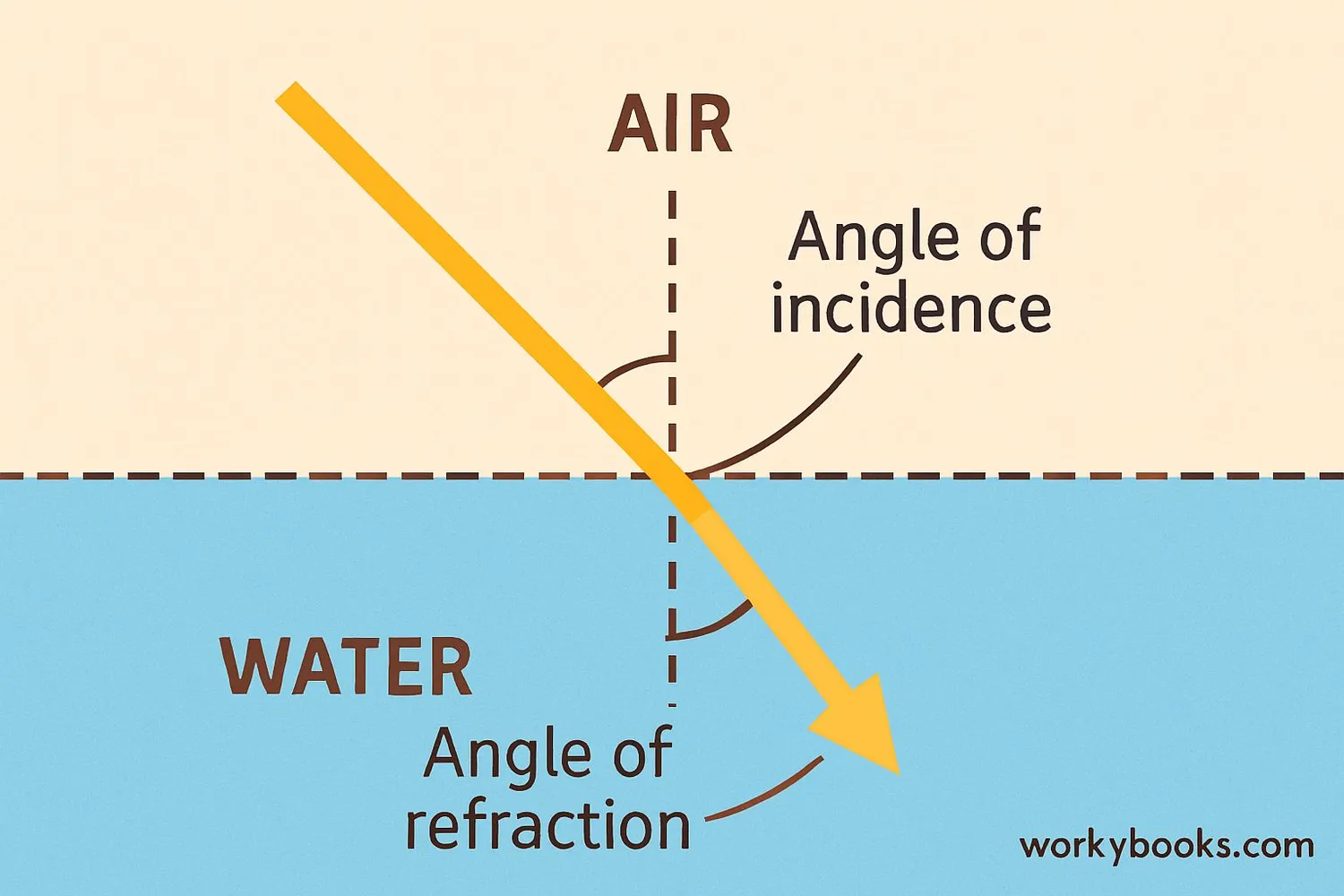
Light bending as it passes from air into water
Refraction is a key phenomenon in physics that explains why a straw appears bent when partially submerged in a glass of water. This effect is not just an optical illusion—it is a result of how light waves change direction when they move from one material to another. Understanding refraction helps scientists design useful tools like eyeglasses and cameras and explains natural phenomena like rainbows and mirages.
How Refraction Works
Refraction occurs when a wave—such as light or sound—enters a new medium at an angle. The wave changes speed due to the different properties of each medium, such as density. For example, light travels faster in air than in water. When light hits the boundary between air and water at an angle, one side of the wave slows down before the other. This causes the wave to bend. The amount of bending depends on the angle and the difference in speed between the two media. Scientists use the index of refraction to measure how much a material slows down light.
Examples and Applications of Refraction
One common example of refraction is the apparent bending of a straw in a glass of water. The light from the straw travels from water to air, changing direction at the surface. Another example is a mirage in the desert. Hot air near the ground bends light from the sky downward, making it look like there is water on the road. Prisms use refraction to split white light into a spectrum of colors, because each color bends a different amount. Lenses in eyeglasses and cameras use carefully shaped glass or plastic to refract light and bring it into focus. Without refraction, we would not be able to correct vision or take sharp photographs.
Connections to Other Wave Behavior
Refraction is related to other wave interactions, such as reflection (when waves bounce off surfaces) and diffraction (when waves spread out after passing through an opening). Engineers and scientists often consider all of these behaviors when studying waves in sound, light, or water. For instance, understanding refraction is crucial for designing fiber optic cables that carry data as light signals over long distances. Fiber optics use controlled refraction and reflection to keep light inside thin glass strands.
Recognizing how refraction works helps us explain everyday experiences and develop new technologies. As we continue to explore the universe, the principles of wave behavior—including refraction—remain central to scientific discovery and innovation.
Interesting Fact: Diamonds sparkle so brightly because they have a very high index of refraction, which bends and splits light into many brilliant colors!
What is refraction?
The bending of a wave when it enters a new medium at an angle.The bouncing of a wave off a surface.The spreading out of a wave after passing through an opening.The breaking apart of a wave into pieces.
Why does a straw appear bent in a glass of water?
Because light bends as it moves from water to air.Because water makes the straw flexible.Because of diffraction at the surface.Because the straw is broken.
Which of these is an example of refraction in technology?
Eyeglasses focusing light.A drum making sound.A ball bouncing off the ground.A mirror reflecting an image.
What does the index of refraction measure?
How much a material slows down light.How wide a wave spreads out.The size of a wave.The number of waves per second.
What is a mirage?
An optical illusion caused by refraction in layers of air.A rainbow in the sky.A type of lens used in cameras.A sound wave bouncing off a wall.
In the passage, what does the word 'medium' mean?
A substance a wave travels through.A type of wave.A scientist's tool.A measurement of color.
What causes light to bend when entering a new medium?
A change in speed as it passes into a medium with a different density.It bounces off the surface.It stops moving.The color of the light.
How is refraction important in fiber optic cables?
It keeps light signals inside the cable for long-distance communication.It makes the cable stronger.It allows sound to travel through the cable.It splits light into colors.
True or False: Refraction only happens with light waves.
TrueFalse
True or False: The amount a wave bends depends on the angle and the difference in speed between two media.
TrueFalse
Perfect For:
👩🏫 Teachers
• Reading comprehension practice
• Auto-graded assessments
• Literacy skill development
👨👩👧👦 Parents
• Reading practice at home
• Comprehension improvement
• Educational reading time
🏠 Homeschoolers
• Reading curriculum support
• Independent reading practice
• Progress monitoring
Reading Features:
📖
Reading Passage
Engaging fiction or nonfiction text
❓
Comprehension Quiz
Auto-graded questions
📊
Instant Feedback
Immediate results and scoring
📄
Printable Version
Download for offline reading
🔊
Read Aloud
Voice-over with word highlighting
Reviews & Ratings
No reviews yet. Be the first to share your experience!
Related Content
Remote Sensing
This middle school science passage introduces students to the concept of remote sensing—the collection of information ab...
MS-ESS3-3MS-PS4-2MS-ETS1-1MS-ETS1-3
The Electromagnetic Spectrum
This comprehensive science reading passage introduces middle school students (grades 6-8) to the electromagnetic spectru...
MS-PS4-1MS-PS4-2
Visible Light and Color
This comprehensive science passage for grades 6-8 explores visible light as the part of the electromagnetic spectrum tha...
MS-PS4-2
Light Waves
This middle school science passage introduces students in grades 6-8 to the concept of light as an electromagnetic wave,...
MS-PS4-2
Wave Absorption
This engaging science passage for grades 6-8 explores the mechanism of wave absorption, where waves transfer energy to m...
MS-PS4-2
Wave Behavior: Transmission
This informational science reading passage for grades 6-8 explores the concept of wave behavior, focusing on transmissio...
MS-PS4-2
Wave Reflection
This middle school science passage explores the behavior of waves during reflection, focusing on how and why waves bounc...
MS-PS4-2
Types of Waves
This comprehensive passage for grades 6-8 explores the fundamental differences between mechanical and electromagnetic wa...
MS-PS4-1MS-PS4-2
What Is Light?
This comprehensive middle school science passage explains the nature of light, defined as visible electromagnetic radiat...
MS-PS4-2
Reflection and Mirrors
This engaging passage explores the science behind reflection and mirrors, designed for students in grades 6-8. Aligned w...
MS-PS4-2
Lasers
This passage explores the science of lasers for middle school students, aligning with NGSS standard MS-PS4-2. Students l...
MS-PS4-2
How We See
This informational science passage for grades 6-8 explores the mechanisms behind human vision, focusing on how light ent...
MS-PS4-2
Optical Instruments
This passage introduces middle school students to the fascinating world of optical instruments. Aligned to NGSS standard...
MS-PS4-2
What Is Sound?
This passage explores the science of sound for middle school students, aligned with NGSS standards MS-PS4-1 and MS-PS4-2...
MS-PS4-1MS-PS4-2
Speed of Sound
This comprehensive passage for grades 6-8 explores the science behind the speed of sound and how it varies depending on ...
MS-PS4-1MS-PS4-2
Absorption of Sound
This comprehensive passage, aligned to NGSS MS-PS4-2, explores the science behind the absorption of sound. Students in g...
MS-PS4-2
Sound Through Different Materials
This comprehensive middle school science passage, aligned to NGSS standard MS-PS4-2, explores the fascinating topic of h...
MS-PS4-2
Reflection of Sound: Echoes
This comprehensive middle school science passage explores the phenomenon of echoes, focusing on the reflection of sound ...
MS-PS4-2
How We Hear
This engaging middle school science passage explores the fascinating process of how we hear, tracing sound’s journey fro...