This learning resource is available in interactive and printable formats. The interactive worksheet can be played online and assigned to students. The Printable PDF version can be downloaded and printed for completion by hand.
This middle school science passage explores the behavior of waves during reflection, focusing on how and why waves bounce off surfaces according to the law of reflection. The text covers the difference between regular and diffuse reflection, and provides real-world examples such as mirrors, echoes, sonar, radar, and ultrasound imaging. Students will learn how reflection is essential for seeing objects, understanding echoes, and using technological applications that impact health and society. The passage is designed for grades 6-8 and aligns with NGSS standard MS-PS4-2. It includes a glossary, multiple choice questions, writing prompts, Spanish translation, and graphic organizers to support comprehension. Audio integration is available to further support diverse learners. This resource is ideal for teachers seeking engaging, standards-based content on wave behavior and the fundamental role of reflection in science and technology.
CONTENT PREVIEW
Expand content preview
Laws of reflection
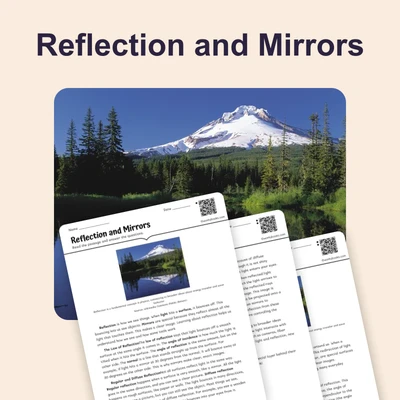
Reflection is a fundamental property of waves that allows us to see the world around us and to detect objects using technology. When a wave, such as light or sound, hits a surface and bounces back, this process is called reflection. This phenomenon explains why we can see ourselves in a mirror or hear an echo in a canyon. Scientists have studied reflection for centuries, discovering that it follows precise patterns and laws. Understanding reflection is essential for fields ranging from physics and engineering to medicine and navigation.
How Reflection Works: The Law of Reflection
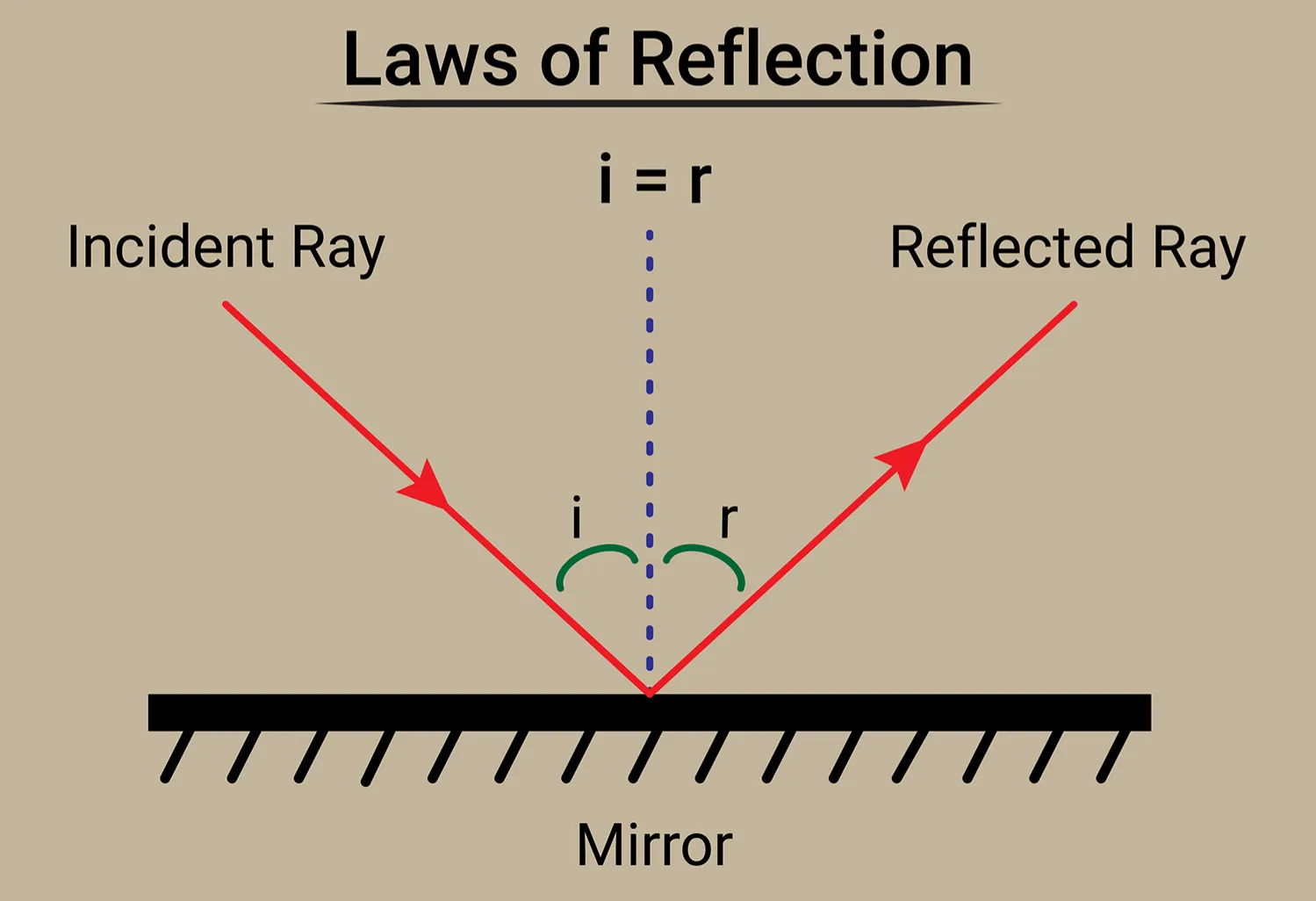
Waves reflect off surfaces according to the law of reflection. This law states that the angle of incidence—the angle at which a wave strikes a surface—is always equal to the angle of reflection—the angle at which it bounces off. The law of reflection can be written as: angle in = angle out. For example, if a beam of light strikes a mirror at a 30-degree angle, it will reflect off at a 30-degree angle on the other side of the normal line (an imaginary line perpendicular to the surface). This rule applies to all types of waves, including light, sound, and water waves. The regularity of this law allows engineers to design devices such as periscopes and lasers with great accuracy.
Types of Reflection: Regular vs. Diffuse
Not all surfaces reflect waves in the same way. Regular reflection happens when waves bounce off a smooth, shiny surface, like a mirror or calm water. In regular reflection, all reflected waves travel in the same direction, forming a clear image. In contrast, diffuse reflection occurs when waves hit a rough or uneven surface, such as paper or a wall. The unevenness causes the reflected waves to scatter in many directions, so no clear image forms. However, diffuse reflection is essential for seeing most objects—if all surfaces reflected light regularly, we could only see images in mirrors, not the objects themselves.
Applications and Implications
The principles of reflection are used in many technologies. Sonar systems send out sound waves that reflect off underwater objects, helping ships navigate and scientists explore the ocean. Radar uses reflected radio waves to detect airplanes and weather patterns. In medicine, ultrasound imaging relies on the reflection of high-frequency sound waves to create pictures of organs inside the body. Even our ability to see relies on light waves reflecting off objects and entering our eyes. Reflection is also crucial for designing energy-efficient buildings and safe roadways, where the control of reflected light can affect visibility and safety.
Reflection is a key process that links many areas of science and technology. It shows how energy and information can be transferred and detected using waves. By understanding the mechanisms of reflection, scientists and engineers can solve real-world problems and improve our daily lives.
Interesting Fact: The world’s largest steerable radio telescope, the Green Bank Telescope, uses a huge reflecting dish 100 meters wide to collect faint radio waves from distant galaxies.
What is reflection in terms of wave behavior?
When a wave bounces back from a surface.When a wave passes through a material.When a wave disappears completely.When a wave slows down in a new material.
According to the law of reflection, what is always true?
Angle of incidence equals angle of reflection.Waves always pass through surfaces.Only sound waves can reflect.Waves reflect at random angles.
Which type of reflection creates a clear image, like in a mirror?
Light bouncing off a wallA reflection in a mirrorA laser beam on glassA periscope
Which statement best describes sonar?
It uses sound waves to detect underwater objects.It uses light waves to create images.It only works in outer space.It measures angles of light.
What does 'angle of incidence' mean as used in the passage?
The angle at which a wave hits a surface.The angle at which a wave is absorbed.The angle at which a wave is created.The angle at which a wave travels in air.
Why is diffuse reflection important for seeing most objects?
It scatters light so we can see objects from different angles.It forms perfect images like a mirror.It blocks light completely.It only happens on shiny surfaces.
How does ultrasound imaging use reflection?
By using reflected sound waves to make images inside the body.By using reflected light to see bones.By bouncing radio waves off the skin.By using sound to heat tissues.
True or False: The angle of reflection is always smaller than the angle of incidence.
TrueFalse
True or False: Radar uses reflected waves to detect distant objects.
TrueFalse
Perfect For:
👩🏫 Teachers
• Reading comprehension practice
• Auto-graded assessments
• Literacy skill development
👨👩👧👦 Parents
• Reading practice at home
• Comprehension improvement
• Educational reading time
🏠 Homeschoolers
• Reading curriculum support
• Independent reading practice
• Progress monitoring
Reading Features:
📖
Reading Passage
Engaging fiction or nonfiction text
❓
Comprehension Quiz
Auto-graded questions
📊
Instant Feedback
Immediate results and scoring
📄
Printable Version
Download for offline reading
🔊
Read Aloud
Voice-over with word highlighting
Reviews & Ratings
No reviews yet. Be the first to share your experience!
Related Content
Remote Sensing
This middle school science passage introduces students to the concept of remote sensing—the collection of information ab...
MS-ESS3-3MS-PS4-2MS-ETS1-1MS-ETS1-3
The Electromagnetic Spectrum
This comprehensive science reading passage introduces middle school students (grades 6-8) to the electromagnetic spectru...
MS-PS4-1MS-PS4-2
Visible Light and Color
This comprehensive science passage for grades 6-8 explores visible light as the part of the electromagnetic spectrum tha...
MS-PS4-2
Light Waves
This middle school science passage introduces students in grades 6-8 to the concept of light as an electromagnetic wave,...
MS-PS4-2
Wave Absorption
This engaging science passage for grades 6-8 explores the mechanism of wave absorption, where waves transfer energy to m...
MS-PS4-2
Wave Behavior: Transmission
This informational science reading passage for grades 6-8 explores the concept of wave behavior, focusing on transmissio...
MS-PS4-2
Wave Refraction
This comprehensive science passage introduces middle school students to the concept of refraction, a key phenomenon in w...
MS-PS4-2
Types of Waves
This comprehensive passage for grades 6-8 explores the fundamental differences between mechanical and electromagnetic wa...
MS-PS4-1MS-PS4-2
What Is Light?
This comprehensive middle school science passage explains the nature of light, defined as visible electromagnetic radiat...
MS-PS4-2
Reflection and Mirrors
This engaging passage explores the science behind reflection and mirrors, designed for students in grades 6-8. Aligned w...
MS-PS4-2
Lasers
This passage explores the science of lasers for middle school students, aligning with NGSS standard MS-PS4-2. Students l...
MS-PS4-2
How We See
This informational science passage for grades 6-8 explores the mechanisms behind human vision, focusing on how light ent...
MS-PS4-2
Optical Instruments
This passage introduces middle school students to the fascinating world of optical instruments. Aligned to NGSS standard...
MS-PS4-2
What Is Sound?
This passage explores the science of sound for middle school students, aligned with NGSS standards MS-PS4-1 and MS-PS4-2...
MS-PS4-1MS-PS4-2
Speed of Sound
This comprehensive passage for grades 6-8 explores the science behind the speed of sound and how it varies depending on ...
MS-PS4-1MS-PS4-2
Absorption of Sound
This comprehensive passage, aligned to NGSS MS-PS4-2, explores the science behind the absorption of sound. Students in g...
MS-PS4-2
Sound Through Different Materials
This comprehensive middle school science passage, aligned to NGSS standard MS-PS4-2, explores the fascinating topic of h...
MS-PS4-2
Reflection of Sound: Echoes
This comprehensive middle school science passage explores the phenomenon of echoes, focusing on the reflection of sound ...
MS-PS4-2
How We Hear
This engaging middle school science passage explores the fascinating process of how we hear, tracing sound’s journey fro...