What Are Solstices
Interactive passage with audio narration, comprehension questions, and printable PDF.
By completing this purchase you agree to our Terms of Use and Privacy Policy. Your subscription renews automatically until you cancel. You can cancel anytime from your account settings. All sales are final and non-refundable. Digital content is available for download in your account immediately upon purchase.
What's included
What Are Solstices preview and details
About this printable What Are Solstices science reading passage, NGSS-aligned (Grades 5-8)
Sample passage and quiz from What Are Solstices
Reading passage and comprehension quiz preview
What Are Solstices
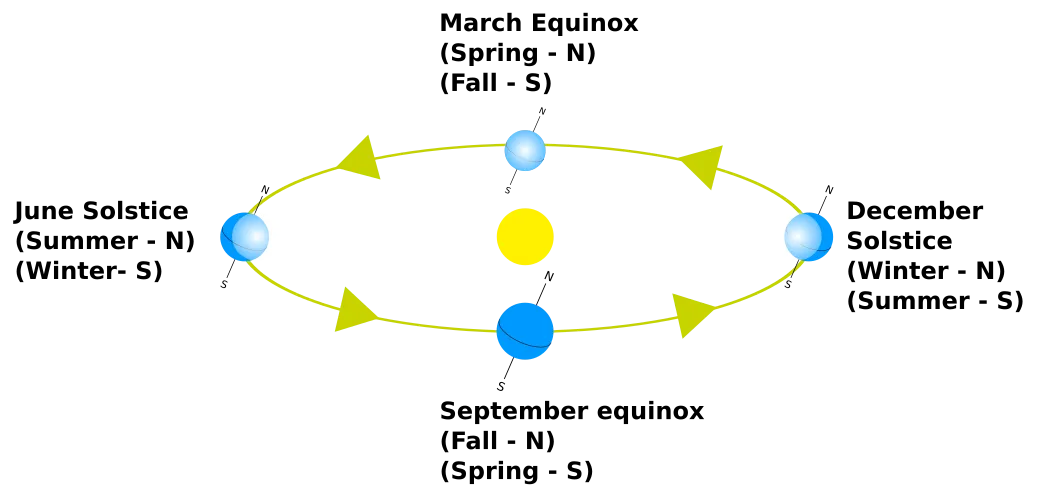
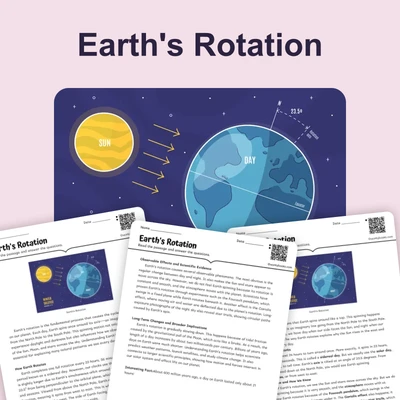
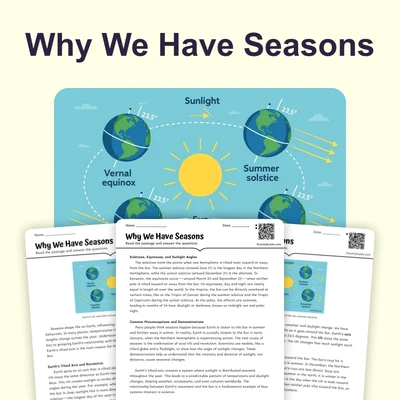
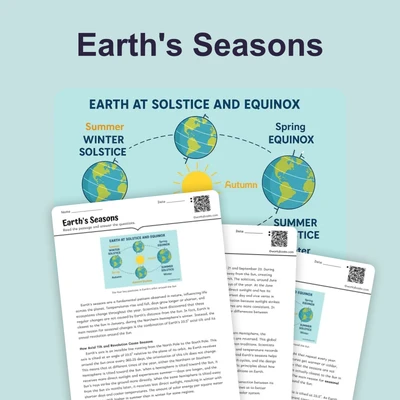
Solstices are the two days each year when Earth's tilt produces the most extreme differences in sunlight. These special days occur because Earth rotates on an axis that tilts at 23.5 degrees. As Earth orbits the Sun, this tilt causes different parts of the planet to receive varying amounts of sunlight throughout the year. The summer solstice happens around June 21 in the Northern Hemisphere. On this day, the North Pole tilts directly toward the Sun. This creates the longest day and shortest night of the year. The winter solstice occurs around December 21. The North Pole then tilts away from the Sun, producing the shortest day and longest night.
Scientists explain that solstices result from Earth's axial tilt combined with its orbital motion. During the summer solstice, sunlight strikes the Northern Hemisphere more directly. The Sun appears higher in the sky and stays above the horizon longer. Evidence shows that locations near the Arctic Circle can experience nearly 24 hours of daylight. During the winter solstice, sunlight hits the Northern Hemisphere at a lower angle. The Sun appears lower in the sky and remains visible for fewer hours. Meanwhile, the Southern Hemisphere experiences opposite conditions. When the Northern Hemisphere has its summer solstice, the Southern Hemisphere has its winter solstice.
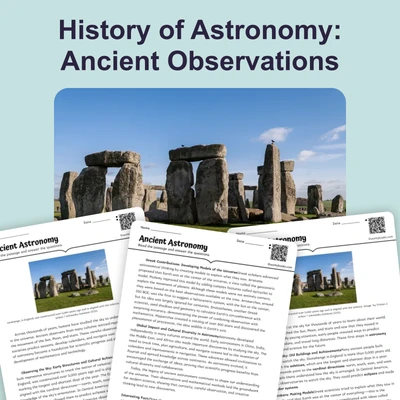
The word solstice comes from Latin words meaning "sun stands still." Ancient observers noticed that the Sun's path across the sky seems to pause before reversing direction. At Stonehenge in England, massive stones align perfectly with the sunrise on the summer solstice. This 5,000-year-old monument shows that early cultures tracked these astronomical events carefully. Many societies still celebrate solstices today. The summer solstice marks the official start of summer in many cultures. The winter solstice signals winter's beginning.
Understanding solstices helps scientists study Earth's climate patterns and seasonal changes. The amount of sunlight a hemisphere receives affects temperature, weather, and ecosystems. Farmers use knowledge of solstices to plan planting and harvesting schedules. The changing daylight hours influence animal behavior and plant growth cycles. Solstices remind us that Earth's position and tilt create predictable patterns that shape life on our planet.
Interesting Fact: During the winter solstice in the Northern Hemisphere, locations north of the Arctic Circle experience polar night, where the Sun never rises above the horizon for at least 24 hours. Some places remain in darkness for weeks or even months.
Comprehension quiz (10 questions)
1. What causes solstices to occur each year?
2. When does the summer solstice occur in the Northern Hemisphere?
3. What does the term 'axial tilt' refer to in the passage?
4. Based on the passage, what does 'hemisphere' mean?
5. Why does the Southern Hemisphere experience winter when the Northern Hemisphere experiences summer?
6. What evidence from the passage shows that ancient cultures understood solstices?
7. How can understanding solstices help farmers?
8. What happens during polar night in the Arctic Circle?
9. The summer solstice produces the shortest night of the year in the Northern Hemisphere.
10. During the winter solstice, the Sun appears higher in the sky in the Northern Hemisphere.
Perfect for the way you teach
- Build comprehension skills
- Auto-graded quiz
- Differentiated reading
- Read together at home
- Improve fluency
- Quiet reading time
- Reading curriculum support
- Independent practice
- Track Lexile growth