This 400-500 word informational science passage explains time zones for middle school students in grades 6-8. Students learn how Earth's rotation creates 24 distinct time zones, each separated by approximately 15 degrees of longitude. The passage covers key concepts including the Prime Meridian, Greenwich Mean Time, and how time zones help coordinate activities across the globe. Aligned with NGSS MS-ESS1-1 and MS-ESS1.B, this passage helps students understand Earth's place in the universe and how our planet's rotation affects daily life. The content includes real-world examples comparing time differences between cities like New York, Los Angeles, and London. Audio-integrated features support diverse learners, including English Language Learners and struggling readers. The passage includes essential vocabulary such as rotation, longitude, meridian, and coordinated universal time. Students engage with multiple-choice questions, writing activities, and graphic organizers that reinforce understanding of this foundational Earth science concept.
Written by Workybooks TeamPublished by Workybooks
Preview
Sample passage and quiz content
CONTENT PREVIEW
Expand content preview
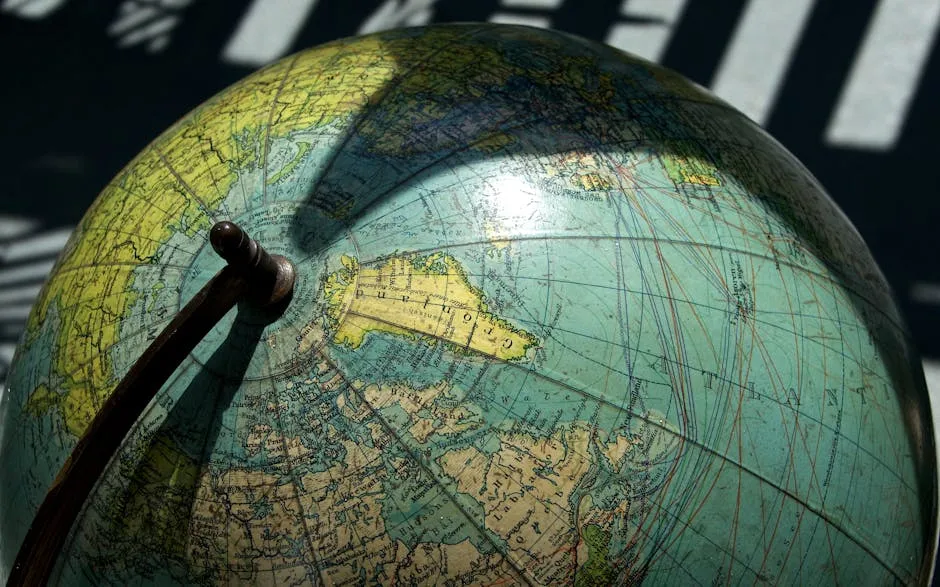
"A detailed globe showcasing northern regions with visible longitude and latitude lines." Image by Pixabay / Pexels.
Time zones are regions on Earth where everyone uses the same clock time. Scientists explain that our planet rotates once every 24 hours, completing a full circle of 360 degrees. This rotation creates day and night as different parts of Earth face the sun. To organize time across the globe, Earth is divided into 24 time zones, with each zone covering approximately 15 degrees of longitude.
The system works because Earth rotates from west to east. As our planet turns, the sun appears to move across the sky. When sunlight reaches one location, it is daytime there. Meanwhile, the opposite side of Earth experiences nighttime. Each time zone represents one hour of Earth's rotation. When you travel east across a time zone boundary, clocks move forward one hour. When you travel west, clocks move backward one hour.
The lines of longitude, an imaginary line running through Greenwich, England, serves as the starting point for measuring time zones. This location uses Greenwich Mean Time, also called Coordinated Universal Time or UTC. All other time zones are calculated based on their distance east or west from this meridian. Evidence shows that this system helps coordinate international communication, travel, and business activities.
Consider a real-world example: When it is 12:00 noon in New York City, it is 9:00 a.m. in Los Angeles and 5:00 p.m. in London. New York sits in a time zone five hours behind UTC, while Los Angeles is eight hours behind. London uses UTC, so it is five hours ahead of New York. These differences occur because each city occupies a different position on Earth's surface as the planet rotates.
Time zones matter because they allow people worldwide to coordinate schedules and understand when events happen in different locations. Without time zones, communicating across distances would create confusion. Airlines, shipping companies, and international organizations rely on this system daily. Scientists also use time zones to record observations and share data accurately across research stations worldwide.
Interesting Fact: The International Date Line runs through the Pacific Ocean, roughly following the 180-degree meridian. When you cross this line traveling west, you skip forward one full day, and traveling east moves you back one day.
What are time zones?
Regions where everyone uses the same clock timeLines that run from pole to pole on EarthPlaces where the sun never setsAreas where clocks do not work properly
How many time zones does Earth have?
12 time zones24 time zones36 time zones48 time zones
What does the word 'rotation' mean in the passage?
The distance between two citiesThe spinning motion of Earth on its axisThe movement of the sun across the skyThe change in weather patterns
What is the Prime Meridian?
The line where day and night meetAn imaginary line through Greenwich, England, used as the starting point for time zonesThe boundary between two countriesThe center of Earth
Why do different cities have different times?
Because people prefer different timesBecause the sun moves at different speedsBecause each city occupies a different position on Earth's surface as the planet rotatesBecause clocks are set randomly
When you travel east across a time zone boundary, what happens to the clock?
The clock moves backward one hourThe clock moves forward one hourThe clock stays the sameThe clock moves forward one day
What can you infer about why airlines need time zones?
To make flights arrive fasterTo coordinate flight schedules across different locationsTo reduce the cost of fuelTo make planes fly higher
If it is 3:00 p.m. in a city that is two hours ahead of UTC, what time is it in UTC?
1:00 p.m.5:00 p.m.3:00 p.m.2:00 p.m.
True or False: Earth rotates from east to west.
TrueFalse
True or False: The International Date Line runs through the Pacific Ocean.
TrueFalse
Who it's for
Perfect for the way you teach
Teachers
Build comprehension skills
Auto-graded quiz
Differentiated reading
Parents
Read together at home
Improve fluency
Quiet reading time
Homeschoolers
Reading curriculum support
Independent practice
Track Lexile growth
Topics
time zonesEarth rotationlongitudemeridiansGreenwich Mean TimeUTCinternational date linemiddle school science
Reviews & Ratings
No reviews yet. Be the first to share your experience!
More reading you might love
20 more
What is Solar Radiation
This NGSS-aligned science reading passage for middle school students explores the concept of solar radiation. Solar radi...
MS-ESS1-1
How Incoming Solar Radiation Changes with Latitude
This NGSS-aligned science reading passage helps middle school students understand how solar radiation, or insolation, ch...
MS-ESS1-1
Tides and Tidal Forces
This middle school science passage explores the mechanisms of tides and tidal forces, aligning with NGSS standards MS-ES...
MS-ESS1-1MS-ESS1-2
The Night Sky
This comprehensive science reading passage for grades 6-8 aligns with NGSS standard MS-ESS1-1 and explores the systems a...
MS-ESS1-1
Ancient Astronomy
This engaging passage for grades 6-8 explores the history of astronomy through the lens of ancient observations. Student...
MS-ESS1-1
Tools of Modern Astronomy
This passage introduces middle school students to modern astronomy, aligning with NGSS standard MS-ESS1-1. It explains h...
MS-ESS1-1
How Astronomy Became a Science
This passage explores the transformative period known as the Scientific Revolution, with a special focus on the history ...
MS-ESS1-1
Earth's Rotation
This middle school science passage, aligned with NGSS standard MS-ESS1-1, focuses on Earth's rotation—how Earth spins on...
MS-ESS1-1
Earth's Revolution
This middle school science passage explores the science behind Earth's revolution around the Sun, closely aligned with N...
MS-ESS1-1
Why We Have Seasons
This comprehensive middle school science reading passage explains the mechanisms behind Earth's seasons, directly addres...
MS-ESS1-1
Earth's Seasons
This comprehensive reading passage for grades 6-8 explains why Earth has seasons, revealing the scientific mechanisms be...
MS-ESS1-1
Phases of the Moon
This comprehensive middle school science passage explains the phases of the Moon, focusing on the mechanisms behind the ...
MS-ESS1-1
Tides
This comprehensive middle school science reading passage explores the phenomenon of ocean tides, aligned to NGSS standar...
MS-ESS1-1MS-ESS1-2
Eclipses
This comprehensive passage for grades 6-8 explores the science behind eclipses, including solar and lunar eclipses, thei...
MS-ESS1-1
The Moon's Characteristics
This comprehensive science reading passage for grades 6-8 examines the Moon's physical characteristics, including its si...
MS-ESS1-1MS-ESS1-2
Lunar Eclipses
This passage introduces middle school students to the phenomenon of lunar eclipses, connecting observable events to the ...
MS-ESS1-1
The Sun's Characteristics
This engaging science passage introduces middle school students to the Sun’s key characteristics, such as its classifica...
MS-ESS1-1MS-ESS1-2
What Is a Galaxy?
This comprehensive middle school science passage answers the question: What is a galaxy? Aligned to NGSS standard MS-ESS...
MS-ESS1-1
The Milky Way: Our Home Galaxy
This comprehensive science passage introduces middle school students to the Milky Way, the barred spiral galaxy that is ...
MS-ESS1-1
Types of Galaxies
This comprehensive middle school science passage introduces students to the classification and characteristics of galaxi...