What Are Umbra and Penumbra
Interactive passage with audio narration, comprehension questions, and printable PDF.
By completing this purchase you agree to our Terms of Use and Privacy Policy. Your subscription renews automatically until you cancel. You can cancel anytime from your account settings. All sales are final and non-refundable. Digital content is available for download in your account immediately upon purchase.
What's included
What Are Umbra and Penumbra preview and details
About this printable What Are Umbra and Penumbra science reading passage, NGSS-aligned (Grades 5-8)
Sample passage and quiz from What Are Umbra and Penumbra
Reading passage and comprehension quiz preview
What Are Umbra and Penumbra
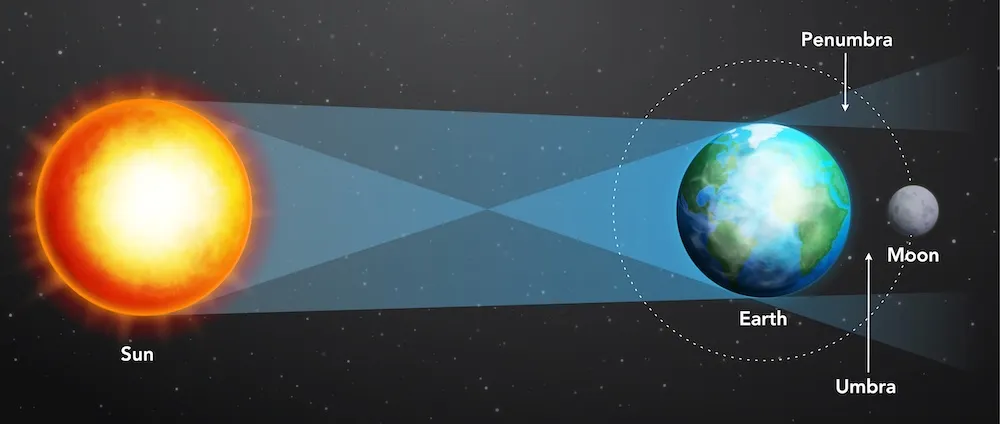
When one object in space blocks light from reaching another object, it creates a shadow. These shadows have two distinct parts called the umbra and the penumbra. The umbra is the darkest inner part of a shadow where light is completely blocked. The penumbra is the outer, lighter region where light is only partially blocked.
Scientists explain that these two shadow regions form because light travels in straight lines from a source. During an eclipse, the Moon or Earth casts a shadow into space. The umbra forms where the blocking object prevents all direct sunlight from reaching a specific area. This creates a cone-shaped region of complete darkness. The penumbra surrounds the umbra and forms where the blocking object only covers part of the light source. Some sunlight can still reach this area, making it appear dimmer rather than completely dark.
The type of eclipse observers see depends on which shadow zone they stand in. During a total eclipse, viewers position themselves within the umbra. Evidence shows that the sky darkens dramatically during totality. Stars may become visible even during daytime. A partial eclipse occurs when viewers stand in the penumbra. They see only part of the Sun or Moon blocked from view. The August 21, 2017 solar eclipse created an umbra path about 70 miles wide across the United States. Millions of people traveled to this narrow zone to experience totality.
Understanding umbra and penumbra helps scientists predict eclipse paths and timing. These shadow zones also explain why eclipses appear different from various locations on Earth. The alignment of the Sun, Moon, and Earth determines the size and shape of these shadows. This knowledge allows astronomers to calculate exactly when and where future eclipses will occur. Shadow formation demonstrates how light interacts with objects in predictable ways throughout our solar system.
Interesting Fact: The Moon's umbra during a solar eclipse travels across Earth's surface at speeds exceeding 1,000 miles per hour. This rapid movement explains why total solar eclipses last only a few minutes at any single location.
Comprehension quiz (10 questions)
1. What is the umbra?
2. What causes the penumbra to appear lighter than the umbra?
3. What does the word 'alignment' mean in this passage?
4. According to the passage, what term describes the shape of the umbra?
5. Why do total solar eclipses last only a few minutes at any single location?
6. If you are standing in the penumbra during a solar eclipse, what type of eclipse will you observe?
7. How does understanding umbra and penumbra help scientists?
8. Based on the passage, what can you infer about the relationship between light and shadow formation?
9. True or False: During the 2017 solar eclipse, the umbra path across the United States was about 70 miles wide.
10. True or False: The penumbra is darker than the umbra because less light reaches it.
Perfect for the way you teach
- Build comprehension skills
- Auto-graded quiz
- Differentiated reading
- Read together at home
- Improve fluency
- Quiet reading time
- Reading curriculum support
- Independent practice
- Track Lexile growth