What Causes Convection Currents — Reading Comprehension
Rate this
Premium Resource
Present
Present in classroom. No work saved
Assign
Classroom with student accounts, Track progress
Quick Play
No student accounts, assign with a link
Grades
3
4
5
6
7
8
PRINT+DIGITAL RESOURCE
This learning resource is available in interactive and printable formats. The interactive worksheet can be played online and assigned to students. The Printable PDF version can be downloaded and printed for completion by hand.
"This science passage for middle school students (grades 6-8) explores the principles of convection currents. It is designed to align with NGSS standards related to energy and heat transfer, specifically MS-PS3-3. The content begins by defining convection and the role of density, then provides two core examples: boiling water and global weather patterns. It further connects this concept to real-world phenomena like tectonic plate movement, enriching the student's understanding of Earth science. Key vocabulary such as 'convection current,' 'density,' and 'heat transfer' are integrated and explained. The passage aims to be a factual, clear, and direct resource for self-study, enabling students to grasp how thermal energy moves through fluids and its impact on everyday occurrences and large-scale geological processes. It is a comprehensive learning tool for mastering this critical physical science concept."
CONTENT PREVIEW
Expand content preview
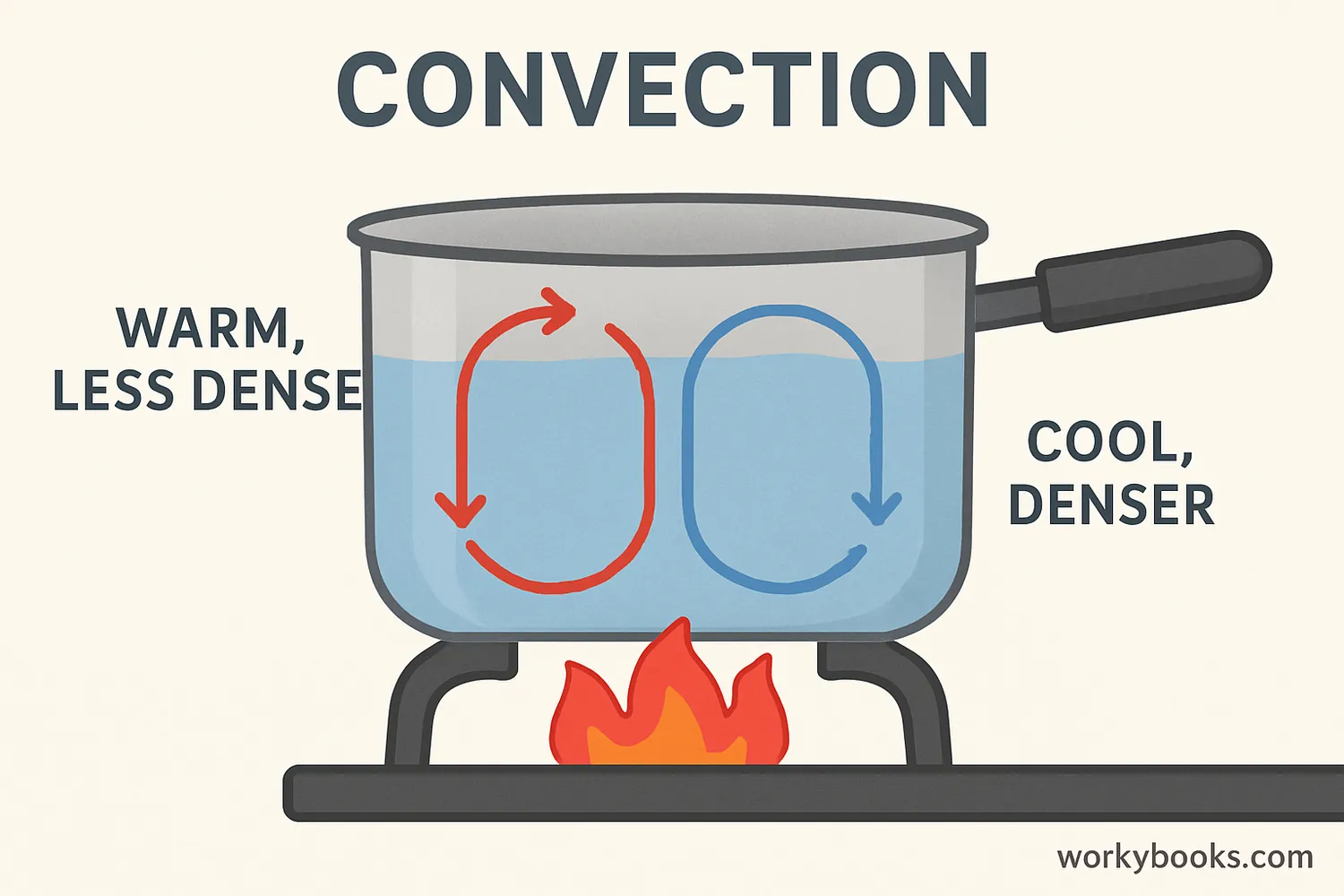
Convection currents are a fundamental process of heat transfer that occurs in fluids, such as liquids and gases. This process is driven by differences in density. When a fluid is heated, its particles gain energy, move farther apart, and the fluid becomes less dense. This lower-density, warmer fluid then rises. Conversely, cooler fluid is more dense, causing it to sink. The continuous cycle of warm fluid rising and cool fluid sinking creates a circular motion known as a convection current. This natural process is essential to many systems on Earth and beyond.
A common example of a convection current is a pot of boiling water. The water at the bottom of the pot, closest to the heat source, warms up first. It becomes less dense and rises to the surface. As it reaches the top, it cools down, becomes denser, and sinks back toward the bottom of the pot. This continuous movement circulates the heat throughout the water until it is evenly heated. This same principle applies to weather systems. The sun heats the ground, which in turn warms the air above it. The warm, less dense air rises, creating areas of low pressure, while cooler, denser air sinks, creating areas of high pressure. This movement of air masses is a major driver of global and local weather patterns.
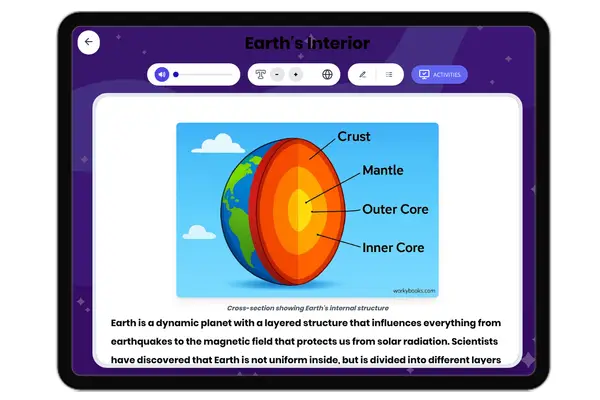
Convection currents are also responsible for the movement of Earth's tectonic plates. Deep within the Earth's mantle, molten rock, or magma, is heated by the planet's core. This hot, less dense magma slowly rises toward the crust. As it moves upward, it cools, becomes denser, and sinks back down, creating massive, slow-moving convection currents. These currents exert force on the tectonic plates above them, causing them to move, collide, and separate. This movement is what leads to geological events such as earthquakes, volcanic eruptions, and the formation of mountains.
Convection is an efficient way to distribute thermal energy through a fluid, from the air in a room to the vast scale of a planet’s mantle. Understanding this process helps explain a wide range of natural phenomena.
Fun Fact: A lava lamp works by using a small light bulb at the base to create a convection current, causing the wax inside to heat up, rise, cool down, and sink repeatedly.
What drives the movement of a convection current?
Differences in densityMagnetic forcesGravitational pullSurface tension
Which of the following best describes the process of a convection current?
Cool fluid rises and warm fluid sinks.Warm fluid rises and cool fluid sinks.Fluids only move horizontally.Heat is transferred only through direct contact.
How does heating a fluid affect its density?
It increases its density.It decreases its density.It has no effect on its density.It makes the fluid solid.
What happens to the cooled fluid in a convection current?
It becomes less dense and rises.It stays at the surface.It becomes more dense and sinks.It evaporates into gas.
What is the main idea of the reading passage?
Convection is a process of heat transfer driven by density differences in fluids.The Earth's core heats the tectonic plates, causing them to move.A lava lamp is an example of a simple machine.Weather patterns are caused by high and low-pressure systems.
If a heater is placed at the top of a room, how would the convection current be affected?
Warm air would sink, making the room warm at the bottom.Warm air would stay at the top, and the bottom would remain cool.Cool air would rise, and warm air would sink.The air would stop moving.
What is an example of a geological event caused by convection currents in the Earth's mantle?
Tidal wavesEarthquakesLightningThe formation of clouds
According to the passage, what is a key requirement for a convection current to occur?
The fluid must be a gas.There must be a heat source.The fluid must be at a constant temperature.The fluid must be moving horizontally.
Perfect For:
👩🏫 Teachers
• Reading comprehension practice
• Auto-graded assessments
• Literacy skill development
👨👩👧👦 Parents
• Reading practice at home
• Comprehension improvement
• Educational reading time
🏠 Homeschoolers
• Reading curriculum support
• Independent reading practice
• Progress monitoring
Reading Features:
📖
Reading Passage
Engaging fiction or nonfiction text
❓
Comprehension Quiz
Auto-graded questions
📊
Instant Feedback
Immediate results and scoring
📄
Printable Version
Download for offline reading
🔊
Read Aloud
Voice-over with word highlighting
Reviews & Ratings
No reviews yet. Be the first to share your experience!
Related Content
Tools and Technology in Earth Science
This middle school science reading passage explores the wide range of tools and technologies used in Earth science, from...
MS-ESS2-2MS-ESS3-2MS-ETS1-1MS-PS4-3
Scientific Inquiry in Earth Science
This passage explores scientific inquiry in Earth science for grades 6-8, aligned with NGSS standards MS-ESS1-4, MS-ESS2...
MS-ESS1-4MS-ESS2-1MS-ESS3-5SEP
What Is Earth Science?
This engaging middle school science passage introduces students to the field of Earth science, aligning with NGSS standa...
MS-ESS1MS-ESS2MS-ESS3SEP
Earth: Our Home in Space
This engaging Grade 4-5 science passage, aligned to NGSS, introduces students to Earth's special place in the solar syst...
Earth's Spheres
This middle school science passage introduces students to Earth's four major spheres: the geosphere, hydrosphere, atmosp...
MS-ESS2-4MS-ESS2-6
What Is Space Weather and How Does It Affect the Earth?
This NGSS-aligned science passage for middle school explains what space weather is and how it affects Earth. Students le...
MS-ESS2-2
Earth's Energy Balance
This engaging, NGSS-aligned science passage for grades 6–8 explores Earth's energy balance, a key process that keeps our...
MS-ESS2-6
Earth's Rotation
This middle school science passage, aligned with NGSS standard MS-ESS1-1, focuses on Earth's rotation—how Earth spins on...
MS-ESS1-1
Earth's Interior
This comprehensive passage for grades 6-8 explores Earth's layered interior, including the crust, mantle, outer core, an...
MS-ESS2-1MS-ESS2-2
Facts About Earth
This engaging science reading passage introduces Grade 4 and 5 students to Earth, our home planet. Aligned with NGSS sta...
Meteorite Impacts on Earth
This engaging science reading passage for Grades 4-5 explores meteorite impacts on Earth, aligning with NGSS standards. ...
Venus: Earth's Twin?
This comprehensive science passage for grades 6-8 examines Venus—often called Earth's twin—by exploring its similarities...
MS-ESS1-2MS-ESS1-3
Earth Changes Over Millions of Years
This engaging, audio-integrated science passage for Grade 4-5 students explores how Earth has changed over millions of y...
Earth's Quick and Slow Changes
In 'Earth's Quick and Slow Changes,' students categorize 12 Earth events by their speed of occurrence, enhancing underst...
Earth's Moon Facts
This engaging science passage, 'The Moon: Earth's Companion,' is designed for Grade 4-5 students and aligns with NGSS ge...
Earth: Our Home Planet
This comprehensive science passage for grades 6-8 explores Earth’s unique characteristics and the interconnected systems...
MS-ESS1-2
Earth's Revolution
This middle school science passage explores the science behind Earth's revolution around the Sun, closely aligned with N...
MS-ESS1-1
Earth's Seasons
This comprehensive reading passage for grades 6-8 explains why Earth has seasons, revealing the scientific mechanisms be...
MS-ESS1-1
Earth's Place in the Universe
This reading passage explains Earth's place in the universe, supporting NGSS 1-ESS1-1. It describes how Earth is one of ...
1-ESS1-1
Aphelion and Perihelion
This engaging reading passage, 'Aphelion and Perihelion,' delves into the fascinating aspects of Earth's elliptical orbi...
MS-ESS1-1: DEVELOP AND USE A MODEL OF THE EARTH-SUN-MOON SYSTEM TO DESCRIBE THE CYCLIC PATTERNS OF LUNAR PHASESECLIPSES OF THE SUN AND MOONAND SEASONS.