What Countries Border The Adriatic Sea — Reading Comprehension
Rate this
Premium Resource
Present
Present in classroom. No work saved
Assign
Classroom with student accounts, Track progress
Quick Play
No student accounts, assign with a link
Grades
6
PRINT+DIGITAL RESOURCE
This learning resource is available in interactive and printable formats. The interactive worksheet can be played online and assigned to students. The Printable PDF version can be downloaded and printed for completion by hand.
This educational passage, audio integrated for an immersive learning experience, delves into the fascinating geography of the Adriatic Sea, exploring the diverse countries that share its beautiful coastline. Aligned with NGSS Standard 2-ESS2-2, "Develop a model to represent the shapes and kinds of land and bodies of water in an area," this resource helps students understand the concept of borders and how different nations interact with a significant body of water. Readers will learn about the major countries that touch the Adriatic, including Italy, Croatia, Albania, and more, gaining insights into European geography and the importance of marine environments. The passage defines key terms like 'peninsula' and 'coastline,' making complex concepts accessible. Activities include reading comprehension questions, a glossary, and short answer questions, all designed to enhance understanding of the Adriatic Sea's unique characteristics and its surrounding nations. Perfect for students studying land and water features.
CONTENT PREVIEW
Expand content preview
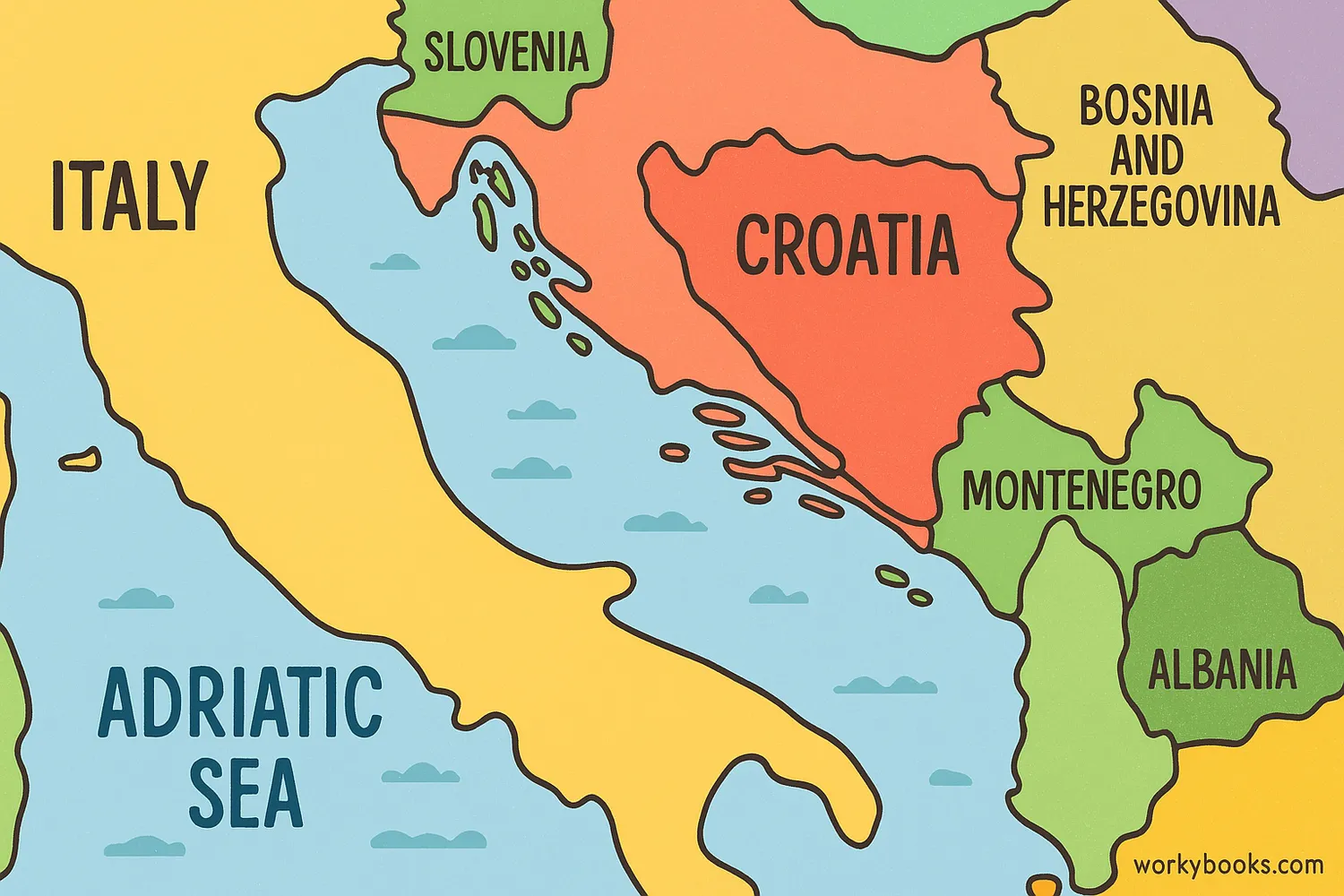
Countries bordering the Adriatic Sea: Italy, Slovenia, Croatia, Bosnia, Montenegro, Albania.
The Adriatic Sea is a beautiful, long body of water in southern Europe. It is shaped like a curved arm and is about 500 miles long. The Adriatic Sea is an arm of the larger Mediterranean Sea. If you look at a map, it sits between Italy and several other countries on the Balkan Peninsula. The Adriatic Sea is like a big swimming pool shared by six neighbors!
On the west side of the sea is Italy. Italy’s coastline runs the entire length of the sea and includes the famous city of Venice, known for its canals and boats instead of roads. At the top of the sea, there is a tiny stretch of land called Slovenia. Even though Slovenia’s coastline is very short, it touches the Adriatic Sea.
Heading south along the eastern side, you find Croatia. Croatia has a long, beautiful coastline with many islands. Cities like Dubrovnik, with its ancient stone walls, and Split, with a Roman palace, are along Croatia’s coast. Next comes Bosnia and Herzegovina. It has only a small piece of coastline, just 12 miles long!
Continuing south, you reach Montenegro. Montenegro’s coast is small but very scenic with rocky cliffs and pretty beaches. Finally, at the bottom, is Albania, which has the southeastern shore of the Adriatic Sea and many sandy beaches.
The Adriatic Sea is home to many animals. You might see dolphins, sea turtles, and many kinds of fish swimming in its blue waters. People enjoy swimming, fishing, sailing, and visiting ancient ruins along the coast. People from all six countries use and take care of the Adriatic Sea together, making rules to keep it clean and safe.
Interesting Fact: The city of Venice is built on more than 100 small islands in the Adriatic Sea and has no cars—only boats!
Which country has Venice?
ItalyCroatiaAlbaniaMontenegro
How many countries border the Adriatic Sea?
FourSixThreeEight
Which animal lives in the Adriatic Sea?
CamelDolphinPandaWolf
Why is the Adriatic Sea important to six countries?
They all share and protect itIt is a desertIt is in AfricaNo one cares about it
What do people do at the Adriatic Sea?
Swim and fishClimb mountainsGrow bananasSki
Which city is famous for its canals?
DubrovnikVeniceSplitTirana
The Adriatic Sea is in Europe. True or false?
TrueFalse
What does 'coastline' mean?
Land next to seaTop of a mountainA big cityA river
Perfect For:
👩🏫 Teachers
• Reading comprehension practice
• Auto-graded assessments
• Literacy skill development
👨👩👧👦 Parents
• Reading practice at home
• Comprehension improvement
• Educational reading time
🏠 Homeschoolers
• Reading curriculum support
• Independent reading practice
• Progress monitoring
Reading Features:
📖
Reading Passage
Engaging fiction or nonfiction text
❓
Comprehension Quiz
Auto-graded questions
📊
Instant Feedback
Immediate results and scoring
📄
Printable Version
Download for offline reading
🔊
Read Aloud
Voice-over with word highlighting
Reviews & Ratings
No reviews yet. Be the first to share your experience!
Related Content
Tools and Technology in Earth Science
This middle school science reading passage explores the wide range of tools and technologies used in Earth science, from...
MS-ESS2-2MS-ESS3-2MS-ETS1-1MS-PS4-3
Scientific Inquiry in Earth Science
This passage explores scientific inquiry in Earth science for grades 6-8, aligned with NGSS standards MS-ESS1-4, MS-ESS2...
MS-ESS1-4MS-ESS2-1MS-ESS3-5SEP
What Is Earth Science?
This engaging middle school science passage introduces students to the field of Earth science, aligning with NGSS standa...
MS-ESS1MS-ESS2MS-ESS3SEP
Earth: Our Home in Space
This engaging Grade 4-5 science passage, aligned to NGSS, introduces students to Earth's special place in the solar syst...
Earth's Spheres
This middle school science passage introduces students to Earth's four major spheres: the geosphere, hydrosphere, atmosp...
MS-ESS2-4MS-ESS2-6
What Is Space Weather and How Does It Affect the Earth?
This NGSS-aligned science passage for middle school explains what space weather is and how it affects Earth. Students le...
MS-ESS2-2
Earth's Energy Balance
This engaging, NGSS-aligned science passage for grades 6–8 explores Earth's energy balance, a key process that keeps our...
MS-ESS2-6
Earth's Rotation
This middle school science passage, aligned with NGSS standard MS-ESS1-1, focuses on Earth's rotation—how Earth spins on...
MS-ESS1-1
Earth's Interior
This comprehensive passage for grades 6-8 explores Earth's layered interior, including the crust, mantle, outer core, an...
MS-ESS2-1MS-ESS2-2
Facts About Earth
This engaging science reading passage introduces Grade 4 and 5 students to Earth, our home planet. Aligned with NGSS sta...
Meteorite Impacts on Earth
This engaging science reading passage for Grades 4-5 explores meteorite impacts on Earth, aligning with NGSS standards. ...
Venus: Earth's Twin?
This comprehensive science passage for grades 6-8 examines Venus—often called Earth's twin—by exploring its similarities...
MS-ESS1-2MS-ESS1-3
Earth Changes Over Millions of Years
This engaging, audio-integrated science passage for Grade 4-5 students explores how Earth has changed over millions of y...
Earth's Quick and Slow Changes
In 'Earth's Quick and Slow Changes,' students categorize 12 Earth events by their speed of occurrence, enhancing underst...
Earth's Moon Facts
This engaging science passage, 'The Moon: Earth's Companion,' is designed for Grade 4-5 students and aligns with NGSS ge...
Earth: Our Home Planet
This comprehensive science passage for grades 6-8 explores Earth’s unique characteristics and the interconnected systems...
MS-ESS1-2
Earth's Revolution
This middle school science passage explores the science behind Earth's revolution around the Sun, closely aligned with N...
MS-ESS1-1
Earth's Seasons
This comprehensive reading passage for grades 6-8 explains why Earth has seasons, revealing the scientific mechanisms be...
MS-ESS1-1
Earth's Place in the Universe
This reading passage explains Earth's place in the universe, supporting NGSS 1-ESS1-1. It describes how Earth is one of ...
1-ESS1-1
Aphelion and Perihelion
This engaging reading passage, 'Aphelion and Perihelion,' delves into the fascinating aspects of Earth's elliptical orbi...
MS-ESS1-1: DEVELOP AND USE A MODEL OF THE EARTH-SUN-MOON SYSTEM TO DESCRIBE THE CYCLIC PATTERNS OF LUNAR PHASESECLIPSES OF THE SUN AND MOONAND SEASONS.