What Happens To The Partial Pressure Of Oxygen In A Sample Of Air If The Temperature Is Increased? — Reading Comprehension
Rate this
Premium Resource
Present
Present in classroom. No work saved
Assign
Classroom with student accounts, Track progress
Quick Play
No student accounts, assign with a link
Grades
6
PRINT+DIGITAL RESOURCE
This learning resource is available in interactive and printable formats. The interactive worksheet can be played online and assigned to students. The Printable PDF version can be downloaded and printed for completion by hand.
This engaging and audio-integrated reading passage, designed for Grade 6, explores the fascinating relationship between temperature and the partial pressure of oxygen in an air sample. Students will learn how increasing the temperature affects the movement of gas particles and, consequently, the pressure exerted by oxygen. Key concepts like kinetic energy, atmosphere, and gas laws are introduced in simple language. This content supports an understanding of the cycling of carbon within Earth's systems, aligning with NGSS HS-ESS2-6 by providing foundational knowledge of atmospheric processes. The passage also includes relevant SEO keywords to enhance discoverability.
CONTENT PREVIEW
Expand content preview
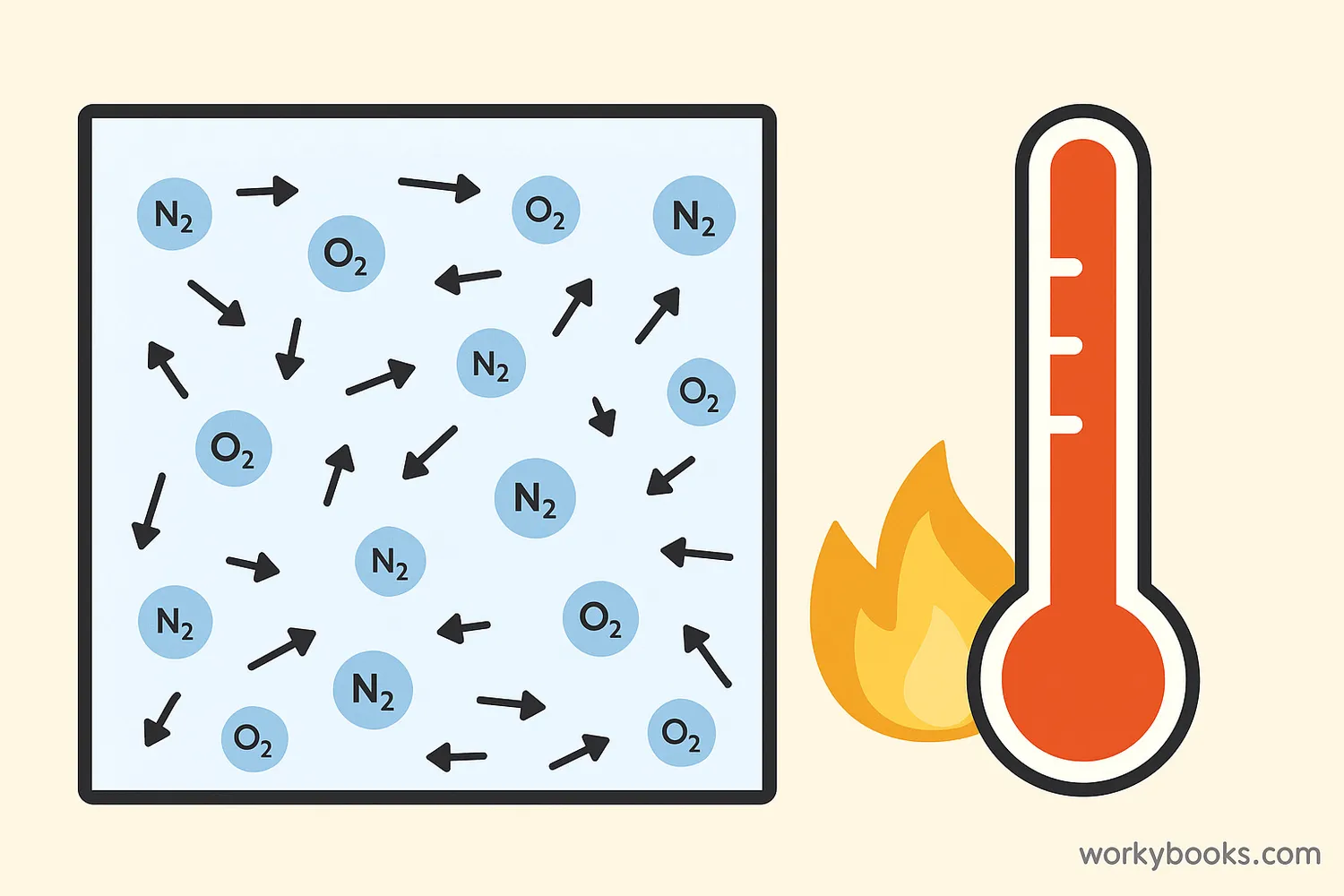
Heating boosts kinetic energy, raising partial pressures of oxygen and nitrogen in air.
Imagine you have a sealed container filled with air. This air isn't just one thing; it's a mixture of different gases. The most important gases for us are nitrogen and oxygen. Each gas in this mixture has its own pressure, almost as if it were the only gas in the container. This individual pressure is called partial pressure. So, oxygen has its own partial pressure, and nitrogen has its own.
Now, let's think about what happens when you heat up this container of air. When you increase the temperature, you're giving more energy to the tiny particles, or molecules, of gas inside. Think of these molecules as tiny bouncy balls. When they get more energy, they start moving much faster and bouncing around with more force. This extra energy that causes them to move is called kinetic energy.
As the oxygen molecules move faster, they hit the inside walls of the container more often and with greater force. Each time a molecule hits a wall, it creates a tiny push, or pressure. When these pushes happen more frequently and with more strength, the overall pressure that oxygen exerts on the container walls increases. Therefore, if the temperature is increased, the partial pressure of oxygen in the air sample will also increase. This is a fundamental concept in atmospheric science and helps us understand how gases behave in Earth's atmosphere.
This same idea applies to all the other gases in the air mixture too. So, if the temperature goes up, the partial pressure of nitrogen will also increase, and the total pressure of the air will go up because all the gases are pushing harder on the container. Understanding how temperature affects gas pressure is important for many things, like weather patterns and even how your car tires work!
Interesting Fact: Even though oxygen is crucial for us, nitrogen makes up about 78% of the air we breathe, while oxygen is only about 21%!
What is the individual pressure of a gas in a mixture called?
Total pressurePartial pressureAir pressureGas pressure
What percentage of the air we breathe is nitrogen?
21%50%78%90%
True or False: Increasing temperature makes gas molecules move slower.
TrueFalse
What happens to the oxygen molecules when temperature increases?
They slow downThey move fasterThey get largerThey disappear
Why does increased temperature lead to higher partial pressure?
Molecules get smallerFewer wall collisionsStronger wall collisionsMolecules combine
Which type of energy increases with faster molecule movement?
Potential energyChemical energyKinetic energyThermal energy
How does understanding gas pressure relate to weather patterns?
If a gas sample is cooled, what would happen to its partial pressure?
It would increaseIt would decreaseIt would stay sameIt would fluctuate
What does 'kinetic energy' mean in the passage's context?
Stored energyEnergy of motionHeat energyLight energy
In a balloon, if the air inside gets hotter, what happens to the balloon?
It shrinksIt might expandIt gets colderIt stays same
Perfect For:
👩🏫 Teachers
• Reading comprehension practice
• Auto-graded assessments
• Literacy skill development
👨👩👧👦 Parents
• Reading practice at home
• Comprehension improvement
• Educational reading time
🏠 Homeschoolers
• Reading curriculum support
• Independent reading practice
• Progress monitoring
Reading Features:
📖
Reading Passage
Engaging fiction or nonfiction text
❓
Comprehension Quiz
Auto-graded questions
📊
Instant Feedback
Immediate results and scoring
📄
Printable Version
Download for offline reading
🔊
Read Aloud
Voice-over with word highlighting
Reviews & Ratings
No reviews yet. Be the first to share your experience!
Related Content
Tools and Technology in Earth Science
This middle school science reading passage explores the wide range of tools and technologies used in Earth science, from...
MS-ESS2-2MS-ESS3-2MS-ETS1-1MS-PS4-3
Scientific Inquiry in Earth Science
This passage explores scientific inquiry in Earth science for grades 6-8, aligned with NGSS standards MS-ESS1-4, MS-ESS2...
MS-ESS1-4MS-ESS2-1MS-ESS3-5SEP
What Is Earth Science?
This engaging middle school science passage introduces students to the field of Earth science, aligning with NGSS standa...
MS-ESS1MS-ESS2MS-ESS3SEP
Earth: Our Home in Space
This engaging Grade 4-5 science passage, aligned to NGSS, introduces students to Earth's special place in the solar syst...
Earth's Spheres
This middle school science passage introduces students to Earth's four major spheres: the geosphere, hydrosphere, atmosp...
MS-ESS2-4MS-ESS2-6
What Is Space Weather and How Does It Affect the Earth?
This NGSS-aligned science passage for middle school explains what space weather is and how it affects Earth. Students le...
MS-ESS2-2
Earth's Energy Balance
This engaging, NGSS-aligned science passage for grades 6–8 explores Earth's energy balance, a key process that keeps our...
MS-ESS2-6
Earth's Rotation
This middle school science passage, aligned with NGSS standard MS-ESS1-1, focuses on Earth's rotation—how Earth spins on...
MS-ESS1-1
Earth's Interior
This comprehensive passage for grades 6-8 explores Earth's layered interior, including the crust, mantle, outer core, an...
MS-ESS2-1MS-ESS2-2
Facts About Earth
This engaging science reading passage introduces Grade 4 and 5 students to Earth, our home planet. Aligned with NGSS sta...
Meteorite Impacts on Earth
This engaging science reading passage for Grades 4-5 explores meteorite impacts on Earth, aligning with NGSS standards. ...
Venus: Earth's Twin?
This comprehensive science passage for grades 6-8 examines Venus—often called Earth's twin—by exploring its similarities...
MS-ESS1-2MS-ESS1-3
Earth Changes Over Millions of Years
This engaging, audio-integrated science passage for Grade 4-5 students explores how Earth has changed over millions of y...
Earth's Moon Facts
This engaging science passage, 'The Moon: Earth's Companion,' is designed for Grade 4-5 students and aligns with NGSS ge...
Earth's Quick and Slow Changes
In 'Earth's Quick and Slow Changes,' students categorize 12 Earth events by their speed of occurrence, enhancing underst...
Earth's Revolution
This middle school science passage explores the science behind Earth's revolution around the Sun, closely aligned with N...
MS-ESS1-1
Earth: Our Home Planet
This comprehensive science passage for grades 6-8 explores Earth’s unique characteristics and the interconnected systems...
MS-ESS1-2
Earth's Seasons
This comprehensive reading passage for grades 6-8 explains why Earth has seasons, revealing the scientific mechanisms be...
MS-ESS1-1
Earth's Place in the Universe
This reading passage explains Earth's place in the universe, supporting NGSS 1-ESS1-1. It describes how Earth is one of ...
1-ESS1-1
Aphelion and Perihelion
This engaging reading passage, 'Aphelion and Perihelion,' delves into the fascinating aspects of Earth's elliptical orbi...
MS-ESS1-1: DEVELOP AND USE A MODEL OF THE EARTH-SUN-MOON SYSTEM TO DESCRIBE THE CYCLIC PATTERNS OF LUNAR PHASESECLIPSES OF THE SUN AND MOONAND SEASONS.