Reading PassagePremium

What Happens When the Magnetic Field Weakens

Interactive passage with audio narration, comprehension questions, and printable PDF.

No ratings yet|
1
Grades 5–8ScienceElaEnglish · SpanishInteractive · Printable
Aligned toMS-ESS2-1
Just this resource
$1.50
One-time purchase
Best value
Unlock everything
$49.99$29.99/yr
40% off until Aug 1 — 10,000+ resources
Renews at $49.99/year.
Unlock above to use these actions

What's included

Reading passage
Audio narration
Comprehension quiz
Writing activity
Glossary & flashcards
Differentiated version
Spanish translation

What Happens When the Magnetic Field Weakens preview and details

About this printable What Happens When the Magnetic Field Weakens science reading passage, NGSS-aligned (Grades 5-8)

This 450-word informational science passage for grades 6-8 explores what happens when Earth's magnetic field weakens, aligned with NGSS standards MS-ESS2-1 and MS-ESS2.A. Students learn how the magnetic field protects Earth from solar particles and radiation, why measurements show recent weakening, and how this affects satellites, navigation systems, and power grids. The passage balances scientific accuracy with reassurance, explaining that field changes occur over thousands of years and life has survived many past reversals. Audio-integrated content helps students understand how scientists use satellites to monitor the geomagnetic field. Activities include comprehension questions, writing prompts, and graphic organizers that develop critical thinking about Earth's systems and the relationship between magnetic field strength and technology.
Written by Workybooks TeamPublished by Workybooks
Preview

Sample passage and quiz from What Happens When the Magnetic Field Weakens

Reading passage and comprehension quiz preview

What Happens When the Magnetic Field Weakens
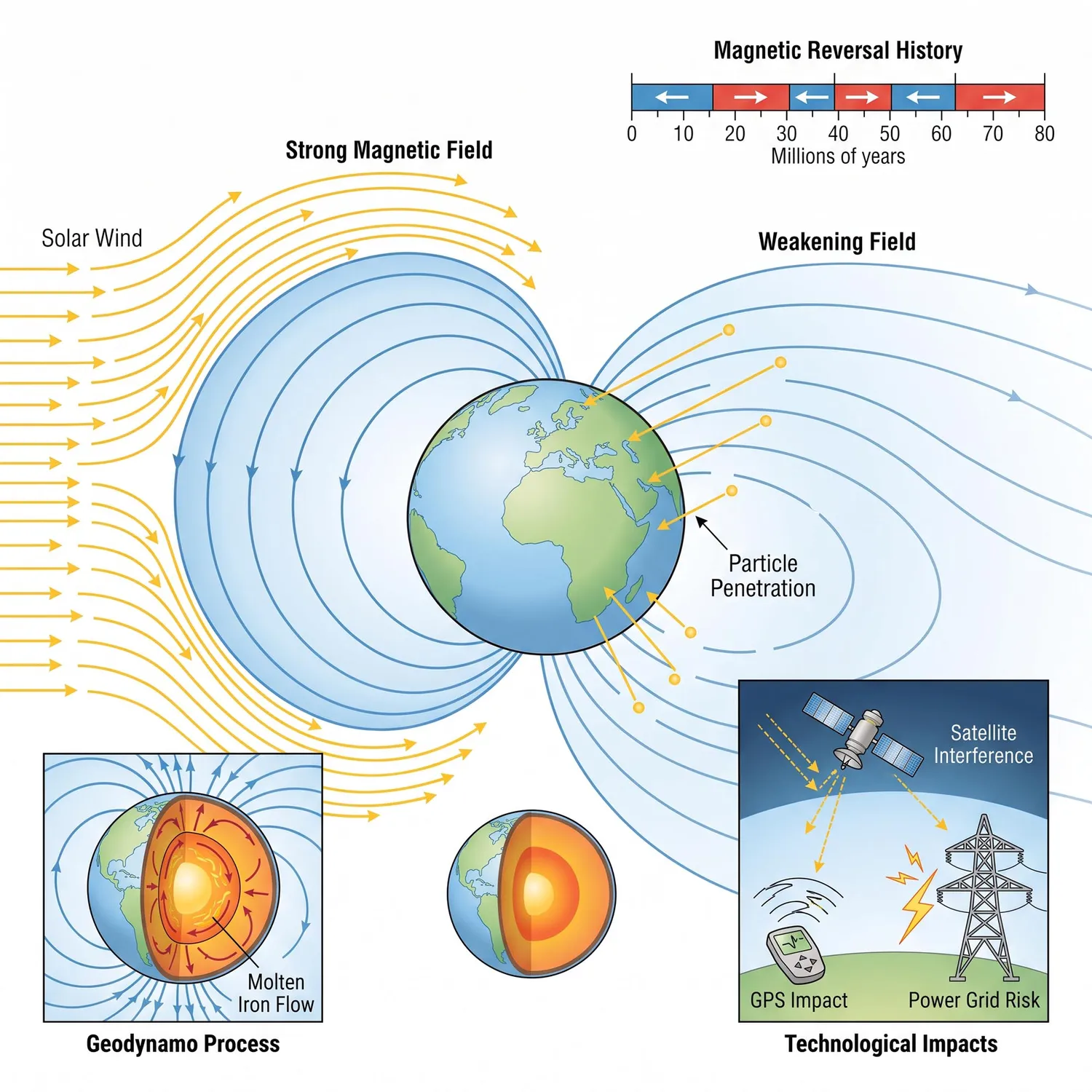
Earth's weakening magnetic field allows more solar particles toward Earth
Earth's magnetic field weakens, increasing solar particle exposure and technology risks.

Earth's magnetic field acts like an invisible shield around our planet. This field protects us from harmful solar particles and radiation streaming from the Sun. Scientists have measured the field's strength for centuries, and evidence shows it has weakened somewhat over recent years. When the field weakens, less protection exists between Earth and space.

The geomagnetic field works by deflecting charged particles away from Earth's surface. These particles come from solar wind and cosmic rays. A stronger field pushes more particles away, while a weaker field allows more to reach our atmosphere. Scientists explain that the field's strength can change over time due to movements deep inside Earth's core. Molten iron flows in the outer core, creating electric currents that generate the magnetic field. When these flows shift, the field's strength changes.

A weakening field can affect modern technology in several ways. Satellites orbiting Earth may experience more interference from solar particles. Navigation systems that rely on precise measurements can become less accurate. Power grids on Earth's surface may face disruptions during strong solar storms. In 1989, a powerful solar storm caused a blackout in Quebec, Canada, affecting millions of people. Scientists observe that such events could become more common if the field continues to weaken.

However, evidence shows no reason for alarm about the weakening field. The field has weakened and strengthened many times throughout Earth's history. Magnetic field reversals, when north and south magnetic poles switch places, have occurred hundreds of times over millions of years. These reversals unfold over thousands of years, not suddenly. Life on Earth has survived many past reversals without major disasters. Scientists use satellites and ground stations to monitor the field constantly. They track changes and can predict potential problems for technology.

Understanding magnetic field changes matters because our society depends heavily on technology. Scientists continue studying the field to protect satellites, communication systems, and power networks. The weakening field represents a natural process worth monitoring, not a crisis. Research helps us prepare for gradual changes and adapt our technology accordingly.

Interesting Fact: The magnetic north pole moves about 55 kilometers per year and has shifted hundreds of kilometers over the past century, showing that Earth's magnetic field is constantly changing.

Comprehension quiz (10 questions)

1. What is the main function of Earth's magnetic field?

To create weather patterns
To protect Earth from solar particles and radiation
To make compasses point north
To control ocean tides

2. According to the passage, what creates Earth's magnetic field?

The Sun's energy
Earth's atmosphere
Electric currents from molten iron flowing in Earth's outer core
Satellites orbiting Earth

3. What does the term 'deflecting' mean in the context of the passage?

Absorbing particles completely
Pushing particles away from their original path
Attracting particles toward Earth
Destroying particles

4. Which technology can be affected by a weakening magnetic field?

Bicycles
Wooden furniture
Navigation systems and satellites
Paper books

5. Why do scientists say there is no reason for alarm about the weakening magnetic field?

The field has stopped weakening
Changes occur over thousands of years and life has survived past reversals
The field cannot affect humans
Technology is not affected by the magnetic field

6. What happened in Quebec, Canada in 1989?

A volcanic eruption
A powerful solar storm caused a blackout
The magnetic poles reversed
A satellite crashed

7. How do scientists monitor Earth's magnetic field?

By watching the northern lights
By measuring ocean temperatures
Using satellites and ground stations
By studying ancient rocks only

8. What can be inferred about magnetic field reversals from the passage?

They happen suddenly and cause disasters
They are a natural process that occurs gradually over thousands of years
They have never happened before
They only affect satellites

9. True or False: Earth's magnetic field has always remained at the same strength throughout history.

True
False

10. True or False: The magnetic north pole moves approximately 55 kilometers per year.

True
False
Who it's for

Perfect for the way you teach

Teachers
  • Build comprehension skills
  • Auto-graded quiz
  • Differentiated reading
Parents
  • Read together at home
  • Improve fluency
  • Quiet reading time
Homeschoolers
  • Reading curriculum support
  • Independent practice
  • Track Lexile growth
Topics

Reviews & Ratings

No reviews yet. Be the first to share your experience!

More reading you might love

20 more
Passage
Frost Wedging: How Ice Splits Rock - reading educational content
Grades 5–8

Frost Wedging: How Ice Splits Rock

earth and space science · MS-ESS2-1

$1.50
Passage
Limestone Caves: Nature’s Underground Wonders - reading educational content
Grades 5–8

Limestone Caves: Nature’s Underground Wonders

science · MS-ESS2-1

Free
Passage
Chemical Weathering: The Breakdown of Rocks Through Chemical Reactions - reading educational content
Grades 5–8

Chemical Weathering: The Breakdown of Rocks Through Chemical Reactions

earth and space science · MS-ESS2-1

Free
Passage
Talus Slopes: Formation and Features - reading educational content
Grades 5–8

Talus Slopes: Formation and Features

science · MS-ESS2-1

Free
Passage
Biological Weathering: Types and Examples - reading educational content
Grades 5–8

Biological Weathering: Types and Examples

science · MS-ESS2-1

Free
Passage
The Coldest City in the World: Yakutsk - reading educational content
Grades 5–8

The Coldest City in the World: Yakutsk

weather and climate · MS-ESS2-1

$1.50
Passage
Igneous Rocks - reading educational content
Grades 5–8

Igneous Rocks

earth and space science · MS-ESS2-1

$1.50
Passage
Sedimentary Rocks - reading educational content
Grades 5–8

Sedimentary Rocks

earth and space science · MS-ESS2-1

$1.50
Passage
Metamorphic Rocks - reading educational content
Grades 5–8

Metamorphic Rocks

earth and space science · MS-ESS2-1

Free
Passage
Scientific Inquiry in Earth Science - reading educational content
Grades 5–8

Scientific Inquiry in Earth Science

earth and space science · MS-ESS1-4

$1.50
Passage
Contour Lines and Elevation - reading educational content
Grades 5–8

Contour Lines and Elevation

earth and space science · MS-ESS2-2

$1.50
Passage
Weathering - reading educational content
Grades 5–8

Weathering

earth and space science · MS-ESS2-1

$1.50
Passage
Erosion - reading educational content
Grades 5–8

Erosion

earth and space science · MS-ESS2-1

$1.50
Passage
Stream Erosion and Deposition - reading educational content
Grades 5–8

Stream Erosion and Deposition

earth and space science · MS-ESS2-1

$1.50
Passage
Wind Erosion and Deposition - reading educational content
Grades 5–8

Wind Erosion and Deposition

earth and space science · MS-ESS2-1

$1.50
Passage
Glacial Erosion and Deposition - reading educational content
Grades 5–8

Glacial Erosion and Deposition

earth and space science · MS-ESS2-1

$1.50
Passage
Mass Movements - reading educational content
Grades 5–8

Mass Movements

science · MS-ESS2-1

$1.50
Passage
Soil Formation and Composition - reading educational content
Grades 5–8

Soil Formation and Composition

earth and space science · MS-ESS2-1

$1.50
Passage
Constructive and Destructive Forces - reading educational content
Grades 5–8

Constructive and Destructive Forces

earth and space science · MS-ESS2-1

Free
Passage
Mountains and Mountain Building - reading educational content
Grades 5–8

Mountains and Mountain Building

earth and space science · MS-ESS2-1

$1.50
Copyright © 2026 Workybooks. Made with ♥ in California.