This learning resource is available in interactive and printable formats. The interactive worksheet can be played online and assigned to students. The Printable PDF version can be downloaded and printed for completion by hand.
This Grade 4-5 science passage, aligned with NGSS standards, introduces students to dwarf planets—a new category in our solar system. Students will learn how dwarf planets differ from regular planets, why Pluto was reclassified, and the meaning of important terms like 'orbit' and 'gravity.' Real-world examples, such as Ceres and Eris, make the topic engaging and relatable. The passage features a glossary, Spanish translation, an interactive multiple-choice quiz, and writing prompts that encourage deeper understanding and connections with everyday life. Audio integration supports diverse learning styles, making this resource ideal for classroom or home use. Students will explore why scientists created the dwarf planet category and how it helps us better understand our solar system. Key vocabulary, fun facts, and critical thinking activities ensure a comprehensive and enjoyable learning experience for young scientists.
The solar system has many objects, including the Sun, planets, moons, and asteroids. In 2006, scientists created a new group called dwarf planets. These objects are smaller than regular planets, but bigger than most asteroids.
A dwarf planet is a round object that orbits the Sun, just like a planet. However, it is not big enough to clear its path of other space rocks. This means it might share its orbit with other objects. A regular planet, like Earth, is large enough to pull in or push away nearby objects using its gravity. Dwarf planets do not have enough gravity to do this.
One famous dwarf planet is Pluto. For many years, Pluto was called the ninth planet. Scientists discovered that Pluto is much smaller than the other planets and shares its orbit with other icy objects. Because of this, Pluto is now called a dwarf planet.
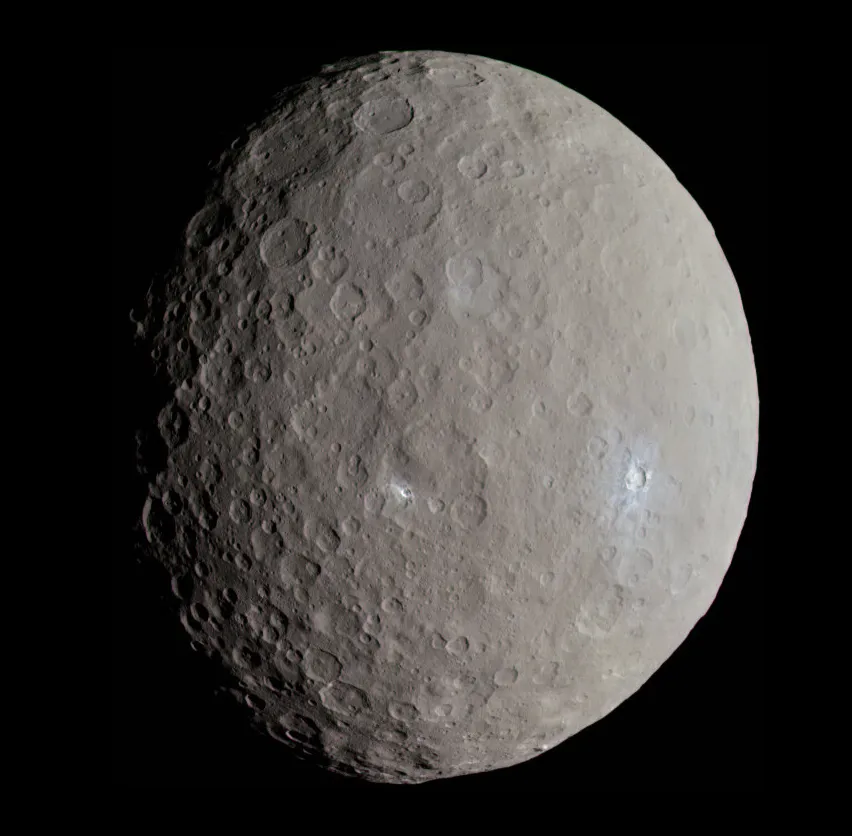
There are other dwarf planets in our solar system. Ceres is found in the asteroid belt between Mars and Jupiter. Eris is another dwarf planet that is even farther from the Sun than Pluto. Scientists have found more dwarf planets and think there may be hundreds more waiting to be discovered.
Dwarf planets help us understand how the solar system formed. By studying them, scientists learn about the history of space and how planets grow and change over time. New technology, like powerful telescopes, helps us find and study these distant worlds.
Interesting Fact: The largest dwarf planet in our solar system is called Eris, and it is even farther from the Sun than Pluto!
What is a dwarf planet?
A small round object orbiting the SunA large star in spaceA type of asteroidA moon of Jupiter
Which planet was reclassified as a dwarf planet?
MarsCeresPlutoEris
Where is Ceres located?
Between Mars and JupiterBeyond ErisNext to EarthNear the Sun
Why can't dwarf planets clear their orbits?
They are too smallThey are too hotThey spin too fastThey are too close to Earth
How do scientists find dwarf planets?
With powerful telescopesWith carsBy visiting themWith fishing nets
What happens if a planet has strong gravity?
It clears its orbitIt becomes a starIt turns into an asteroidIt shrinks
Pluto is still called a planet. True or false?
TrueFalse
What does 'orbit' mean?
The path around the SunA type of moonA small asteroidA strong wind
Perfect For:
👩🏫 Teachers
• Reading comprehension practice
• Auto-graded assessments
• Literacy skill development
👨👩👧👦 Parents
• Reading practice at home
• Comprehension improvement
• Educational reading time
🏠 Homeschoolers
• Reading curriculum support
• Independent reading practice
• Progress monitoring
Reading Features:
📖
Reading Passage
Engaging fiction or nonfiction text
❓
Comprehension Quiz
Auto-graded questions
📊
Instant Feedback
Immediate results and scoring
📄
Printable Version
Download for offline reading
🔊
Read Aloud
Voice-over with word highlighting
Reviews & Ratings
No reviews yet. Be the first to share your experience!
Related Content
Earth: Our Home in Space
This engaging Grade 4-5 science passage, aligned to NGSS, introduces students to Earth's special place in the solar syst...
Tools and Technology in Earth Science
This middle school science reading passage explores the wide range of tools and technologies used in Earth science, from...
MS-ESS2-2MS-ESS3-2MS-ETS1-1MS-PS4-3
Earth's Place in the Universe
This reading passage explains Earth's place in the universe, supporting NGSS 1-ESS1-1. It describes how Earth is one of ...
1-ESS1-1
Scientific Inquiry in Earth Science
This passage explores scientific inquiry in Earth science for grades 6-8, aligned with NGSS standards MS-ESS1-4, MS-ESS2...
MS-ESS1-4MS-ESS2-1MS-ESS3-5SEP
What Is Space Weather and How Does It Affect the Earth?
This NGSS-aligned science passage for middle school explains what space weather is and how it affects Earth. Students le...
MS-ESS2-2
Escape Velocity and Space Travel
This middle school science passage introduces students to the concept of escape velocity—the minimum speed required to b...
MS-ESS1-2MS-PS2-4
Space Stations
This informational science reading passage for grades 6-8 explores the complex systems and technology behind space stati...
MS-ESS1-3MS-ETS1-1
What Is Earth Science?
This engaging middle school science passage introduces students to the field of Earth science, aligning with NGSS standa...
MS-ESS1MS-ESS2MS-ESS3SEP
The Space Garden
This innovative passage combines plant science with space exploration, aligning with NGSS standards for life sciences an...
RL.3.1RL.2.1RL.4.9
Measuring Distances in Space
This middle school science passage explores how astronomers measure the vast distances in space, aligning with NGSS stan...
MS-ESS1-3
Earth: Our Home Planet
This comprehensive science passage for grades 6-8 explores Earth’s unique characteristics and the interconnected systems...
MS-ESS1-2
Meteorite Impacts on Earth
This engaging science reading passage for Grades 4-5 explores meteorite impacts on Earth, aligning with NGSS standards. ...
Exploring Space: Rockets and Spacecraft
Space exploration has been one of humanity's greatest achievements, made possible by rockets and spacecraft. Rockets act...
RI.4.4RI.4.2
Earth's Rotation
This middle school science passage, aligned with NGSS standard MS-ESS1-1, focuses on Earth's rotation—how Earth spins on...
MS-ESS1-1
Facts About Earth
This engaging science reading passage introduces Grade 4 and 5 students to Earth, our home planet. Aligned with NGSS sta...
Earth's Moon Facts
This engaging science passage, 'The Moon: Earth's Companion,' is designed for Grade 4-5 students and aligns with NGSS ge...
International Space Station
Discover the wonders of the International Space Station with this informative coloring page showcasing the orbiting outpost where astronauts live and work in space. As children color the complex modul...
Earth's Seasons
This comprehensive reading passage for grades 6-8 explains why Earth has seasons, revealing the scientific mechanisms be...
MS-ESS1-1
Venus: Earth's Twin?
This comprehensive science passage for grades 6-8 examines Venus—often called Earth's twin—by exploring its similarities...
MS-ESS1-2MS-ESS1-3
The Space Needle
Students read a passage about the history and features of Seattle's Space Needle, then answer comprehension questions to...