What is a Globular Cluster? — Reading Comprehension
Rate this
Premium Resource
Present
Present in classroom. No work saved
Assign
Classroom with student accounts, Track progress
Quick Play
No student accounts, assign with a link
Grades
6
PRINT+DIGITAL RESOURCE
This learning resource is available in interactive and printable formats. The interactive worksheet can be played online and assigned to students. The Printable PDF version can be downloaded and printed for completion by hand.
This passage explores what a globular cluster is, focusing on their characteristics, formation, and the powerful role of gravity in holding them together. Students will learn about these ancient, dense groups of stars, often found in the halos of galaxies like the Milky Way. The content aligns with NGSS MS-ESS1-2, helping students develop and use a model to describe the role of gravity in the motions within galaxies. This engaging reading material, complete with relevant SEO keywords, is audio-integrated to enhance accessibility and learning for Grade 6 students. Activities include comprehension questions, a glossary, and short answer prompts.
CONTENT PREVIEW
Expand content preview
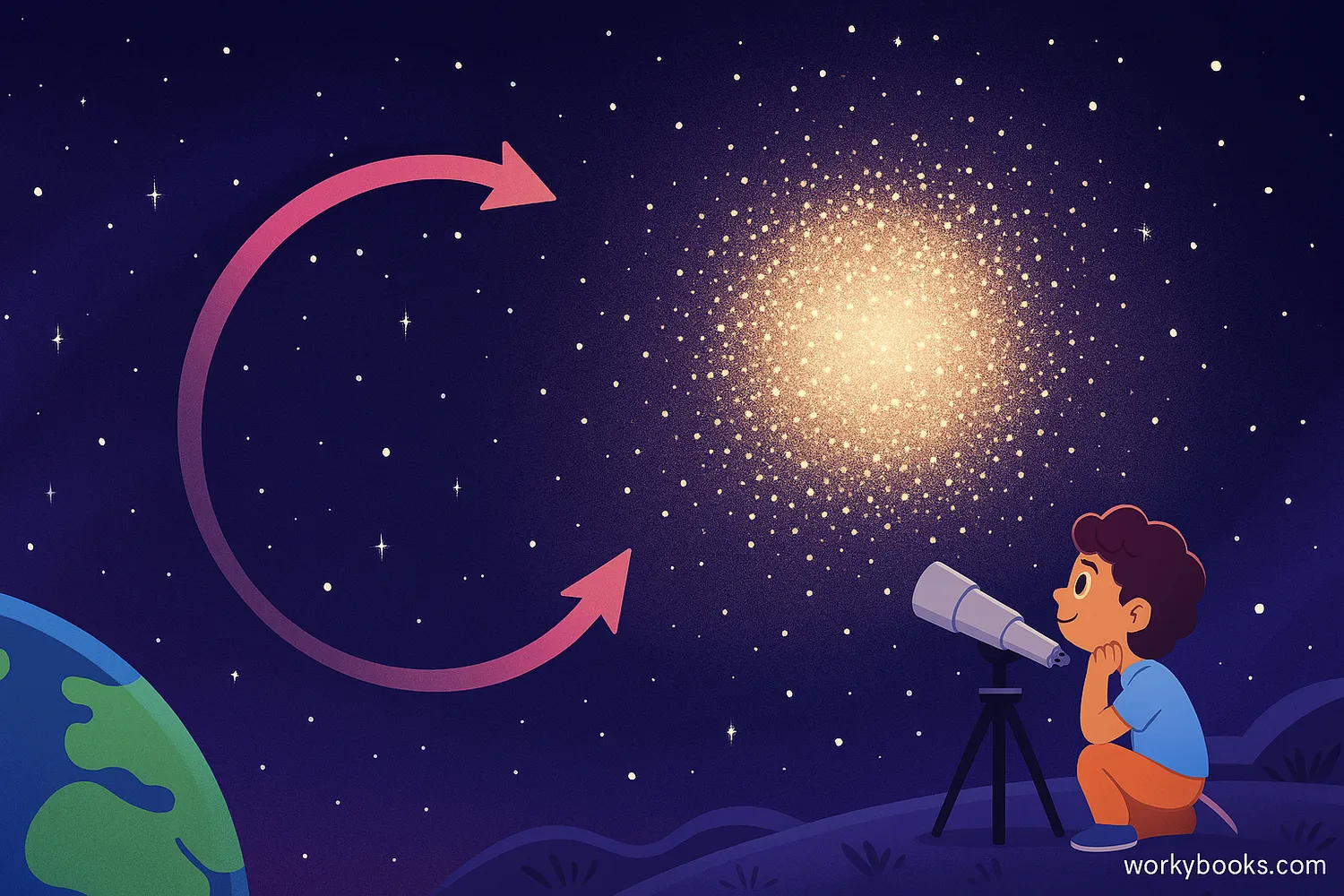
Globular cluster held by gravity, viewed from Earth by a curious young stargazer.
Have you ever looked up at the night sky and wondered about the incredible things out there? Beyond our own solar system, there are countless wonders, and one of the most fascinating is a globular cluster. Imagine a giant, sparkling ball made of hundreds of thousands, or even millions, of stars! That's essentially what a globular cluster is.
These amazing structures are very old, often as old as the galaxy they belong to. For example, our own Milky Way galaxy has about 150 known globular clusters! They are usually found in the outer regions, or halo, of a galaxy, rather than in the flat, spinning disk where our Sun is located. Globular clusters are extremely dense, meaning the stars inside them are packed very closely together. If you lived on a planet in a globular cluster, the night sky would be filled with many more bright stars than what we see from Earth!
So, what holds all these stars together in such a tight ball? The answer is gravity. Gravity is a natural force that pulls objects toward each other. The more mass an object has, the stronger its gravitational pull. In a globular cluster, the combined gravity of all the millions of stars is incredibly strong. This powerful gravitational force keeps the cluster in its spherical shape and prevents the stars from drifting away into space. It's like a cosmic tug-of-war where gravity wins, keeping everything neatly bundled up.
Globular clusters are an important part of understanding the universe. Scientists study them to learn more about how galaxies form and evolve over billions of years. Because these clusters are so old, they give us clues about the early universe. Each star within a globular cluster is constantly moving, but gravity ensures they all stay bound together, swirling and orbiting within their communal home. These stellar cities are truly incredible examples of gravity's powerful role in the cosmos.
Interesting Fact: Some globular clusters contain a type of star called a "blue straggler" that appears younger than its neighbors, baffling astronomers!
What is a globular cluster?
A single, very bright starA dense ball of starsA type of planetA large comet
Where are globular clusters usually found in a galaxy?
In the very centerIn the flat, spinning diskIn the outer haloOutside the galaxy
What force holds a globular cluster together?
Electromagnetic forceWindGravityMagnetic fields
Why are globular clusters important for scientists?
They create new starsThey hide alien lifeClues about early universeThey are the brightest objects
The Milky Way galaxy has only a few globular clusters. True or False?
TrueFalse
If you lived in a globular cluster, what would the night sky look like?
Darker than EarthFewer visible starsFilled with more bright starsAlways daytime
Why are globular clusters described as 'dense'?
They are made of gasStars are far apartStars are packed closelyThey are very cold
Which term describes the outer region of a galaxy where globular clusters are found?
CoreDiskHaloArm
Which statement best describes the role of gravity in a globular cluster?
It pushes stars apartIt makes stars explodeIt keeps stars bundledIt creates new galaxies
What does the passage mean by "cosmic tug-of-war"?
No reviews yet. Be the first to share your experience!
Related Content
Earth: Our Home in Space
This engaging Grade 4-5 science passage, aligned to NGSS, introduces students to Earth's special place in the solar syst...
Tools and Technology in Earth Science
This middle school science reading passage explores the wide range of tools and technologies used in Earth science, from...
MS-ESS2-2MS-ESS3-2MS-ETS1-1MS-PS4-3
Earth's Place in the Universe
This reading passage explains Earth's place in the universe, supporting NGSS 1-ESS1-1. It describes how Earth is one of ...
1-ESS1-1
Scientific Inquiry in Earth Science
This passage explores scientific inquiry in Earth science for grades 6-8, aligned with NGSS standards MS-ESS1-4, MS-ESS2...
MS-ESS1-4MS-ESS2-1MS-ESS3-5SEP
What Is Space Weather and How Does It Affect the Earth?
This NGSS-aligned science passage for middle school explains what space weather is and how it affects Earth. Students le...
MS-ESS2-2
Escape Velocity and Space Travel
This middle school science passage introduces students to the concept of escape velocity—the minimum speed required to b...
MS-ESS1-2MS-PS2-4
Space Stations
This informational science reading passage for grades 6-8 explores the complex systems and technology behind space stati...
MS-ESS1-3MS-ETS1-1
What Is Earth Science?
This engaging middle school science passage introduces students to the field of Earth science, aligning with NGSS standa...
MS-ESS1MS-ESS2MS-ESS3SEP
The Space Garden
This innovative passage combines plant science with space exploration, aligning with NGSS standards for life sciences an...
RL.3.1RL.2.1RL.4.9
Measuring Distances in Space
This middle school science passage explores how astronomers measure the vast distances in space, aligning with NGSS stan...
MS-ESS1-3
Earth: Our Home Planet
This comprehensive science passage for grades 6-8 explores Earth’s unique characteristics and the interconnected systems...
MS-ESS1-2
Meteorite Impacts on Earth
This engaging science reading passage for Grades 4-5 explores meteorite impacts on Earth, aligning with NGSS standards. ...
Exploring Space: Rockets and Spacecraft
Space exploration has been one of humanity's greatest achievements, made possible by rockets and spacecraft. Rockets act...
RI.4.4RI.4.2
Earth's Rotation
This middle school science passage, aligned with NGSS standard MS-ESS1-1, focuses on Earth's rotation—how Earth spins on...
MS-ESS1-1
Facts About Earth
This engaging science reading passage introduces Grade 4 and 5 students to Earth, our home planet. Aligned with NGSS sta...
Earth's Moon Facts
This engaging science passage, 'The Moon: Earth's Companion,' is designed for Grade 4-5 students and aligns with NGSS ge...
Earth's Seasons
This comprehensive reading passage for grades 6-8 explains why Earth has seasons, revealing the scientific mechanisms be...
MS-ESS1-1
International Space Station
Discover the wonders of the International Space Station with this informative coloring page showcasing the orbiting outpost where astronauts live and work in space. As children color the complex modul...
Venus: Earth's Twin?
This comprehensive science passage for grades 6-8 examines Venus—often called Earth's twin—by exploring its similarities...
MS-ESS1-2MS-ESS1-3
What Makes Earth Perfect for Life?
This Grade 4-5 science passage, aligned with NGSS standards, explores the essential features that make Earth the perfect...