Reading PassagePremium

What Is a Mantle Plume

Interactive passage with audio narration, comprehension questions, and printable PDF.

No ratings yet|
1
Grades 5–8ScienceElaEnglish · SpanishInteractive · Printable
Aligned toMS-ESS2-1
Just this resource
$1.50
One-time purchase
Best value
Unlock everything
$49.99$29.99/yr
40% off until Aug 1 — 10,000+ resources
Renews at $49.99/year.
Unlock above to use these actions

What's included

Reading passage
Audio narration
Comprehension quiz
Writing activity
Glossary & flashcards
Differentiated version
Spanish translation

What Is a Mantle Plume preview and details

About this printable What Is a Mantle Plume science reading passage, NGSS-aligned (Grades 5-8)

science,ela
Written by Workybooks TeamPublished by Workybooks
Preview

Sample passage and quiz from What Is a Mantle Plume

Reading passage and comprehension quiz preview

What Is a Mantle Plume?
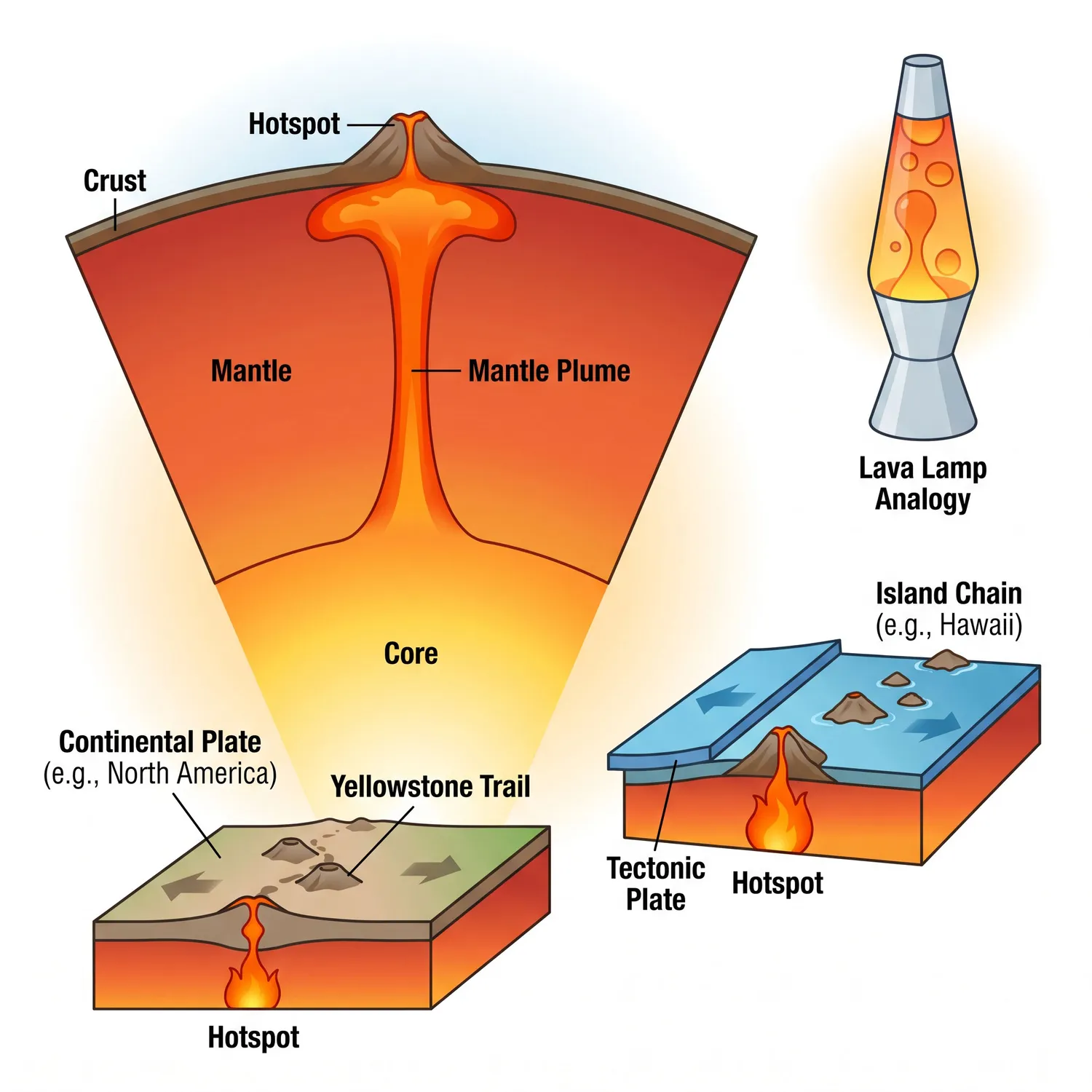
Mantle plume creates hotspot volcanoes beneath moving tectonic plates forming island chains
Mantle plumes create hotspots forming Hawaii and Yellowstone volcanic features

Most volcanoes form where tectonic plates meet at their edges. However, some volcanoes appear in surprising places, far from any plate boundary. Scientists explain these unusual volcanoes using the concept of a mantle plume. A mantle plume is a narrow column of extremely hot rock that rises from deep within Earth's mantle. The mantle is the thick layer of rock between Earth's crust and core.

Evidence shows that mantle plumes work like rising blobs in a lava lamp. Deep in the mantle, rock becomes much hotter than surrounding material. This extra-hot rock is less dense, so it begins to rise upward. The hot rock moves slowly through the solid mantle, forming a narrow column. Scientists observe that this column can extend hundreds of miles upward. When the plume reaches the base of Earth's crust, it creates a hotspot. A hotspot is a location where volcanic activity occurs in the middle of a tectonic plate.

The Hawaiian Islands provide the classic example of hotspot volcanism. The Pacific Plate moves slowly over a fixed mantle plume beneath the ocean floor. As the plate drifts, the hotspot melts rock and creates volcanoes. Over millions of years, this process forms a chain of volcanic islands. Each island represents a volcano that formed directly above the hotspot. The Big Island of Hawaii sits over the hotspot today and remains volcanically active. Older islands in the chain have moved away from the hotspot. These islands no longer experience volcanic eruptions because they are no longer positioned above the rising plume.

Yellowstone National Park represents another famous hotspot location. The Yellowstone hotspot lies beneath the North American Plate. This hotspot powers geysers, hot springs, and other geothermal features. Evidence from rock layers shows that the North American Plate has moved over this hotspot for millions of years. The hotspot has created a trail of ancient volcanic features across Idaho and Wyoming.

Mantle plumes matter because they show that plate boundaries are not the only source of volcanic activity. Understanding plumes helps scientists explain volcanic features in unexpected locations. Plumes also provide evidence about heat flow and movement deep within Earth. This knowledge improves our understanding of how Earth's interior works. Studying hotspots can help scientists predict future volcanic activity and understand how tectonic plates move over time.

Interesting Fact: The mantle plume beneath Hawaii may extend more than 1,800 miles deep, reaching nearly to Earth's core-mantle boundary. This makes it one of the deepest and most powerful plumes on our planet.

Comprehension quiz (10 questions)

1. What is a mantle plume?

A crack in Earth's crust where plates meet
A narrow column of extremely hot rock rising from deep in the mantle
A type of volcano found only at plate boundaries
The outermost layer of Earth's surface

2. Why does hot rock in a mantle plume rise upward?

It is pushed up by tectonic plate movement
It is pulled upward by ocean currents
It is less dense than the surrounding cooler rock
It is forced up by pressure from Earth's core

3. What is a hotspot?

A location where two tectonic plates collide
The hottest part of Earth's core
A place where volcanic activity occurs in the middle of a tectonic plate
A region where earthquakes frequently happen

4. In the passage, the word 'dense' most closely means:

Having particles packed tightly together
Very hot and melted
Moving quickly through space
Located deep underground

5. What does 'geothermal' mean in the context of Yellowstone?

Related to cold water springs
Related to heat from inside Earth
Related to surface weather patterns
Related to ancient volcanic rock

6. How do the Hawaiian Islands demonstrate hotspot volcanism?

They all formed at the same time when two plates collided
They formed as the Pacific Plate moved over a fixed mantle plume
They formed along a plate boundary in the Pacific Ocean
They were created by underwater earthquakes

7. Why are older Hawaiian Islands no longer volcanically active?

They have moved away from the hotspot as the plate drifted
The mantle plume beneath them has cooled down
They sank too deep into the ocean
Their volcanoes used up all the available magma

8. Based on the passage, what can scientists learn from studying mantle plumes?

How to prevent all volcanic eruptions
How heat flows and moves deep within Earth
How to create new islands in the ocean
How to stop tectonic plates from moving

9. All volcanoes form only at the edges of tectonic plates.

True
False

10. The mantle plume beneath Hawaii may extend nearly to Earth's core-mantle boundary.

True
False
Who it's for

Perfect for the way you teach

Teachers
  • Build comprehension skills
  • Auto-graded quiz
  • Differentiated reading
Parents
  • Read together at home
  • Improve fluency
  • Quiet reading time
Homeschoolers
  • Reading curriculum support
  • Independent practice
  • Track Lexile growth
Topics

Reviews & Ratings

No reviews yet. Be the first to share your experience!

More reading you might love

20 more
Passage
Frost Wedging: How Ice Splits Rock - reading educational content
Grades 5–8

Frost Wedging: How Ice Splits Rock

earth and space science · MS-ESS2-1

$1.50
Passage
Limestone Caves: Nature’s Underground Wonders - reading educational content
Grades 5–8

Limestone Caves: Nature’s Underground Wonders

science · MS-ESS2-1

Free
Passage
Chemical Weathering: The Breakdown of Rocks Through Chemical Reactions - reading educational content
Grades 5–8

Chemical Weathering: The Breakdown of Rocks Through Chemical Reactions

earth and space science · MS-ESS2-1

Free
Passage
Talus Slopes: Formation and Features - reading educational content
Grades 5–8

Talus Slopes: Formation and Features

science · MS-ESS2-1

Free
Passage
Biological Weathering: Types and Examples - reading educational content
Grades 5–8

Biological Weathering: Types and Examples

science · MS-ESS2-1

Free
Passage
The Coldest City in the World: Yakutsk - reading educational content
Grades 5–8

The Coldest City in the World: Yakutsk

weather and climate · MS-ESS2-1

$1.50
Passage
Igneous Rocks - reading educational content
Grades 5–8

Igneous Rocks

earth and space science · MS-ESS2-1

$1.50
Passage
Sedimentary Rocks - reading educational content
Grades 5–8

Sedimentary Rocks

earth and space science · MS-ESS2-1

$1.50
Passage
Metamorphic Rocks - reading educational content
Grades 5–8

Metamorphic Rocks

earth and space science · MS-ESS2-1

Free
Passage
Scientific Inquiry in Earth Science - reading educational content
Grades 5–8

Scientific Inquiry in Earth Science

earth and space science · MS-ESS1-4

$1.50
Passage
Contour Lines and Elevation - reading educational content
Grades 5–8

Contour Lines and Elevation

earth and space science · MS-ESS2-2

$1.50
Passage
Weathering - reading educational content
Grades 5–8

Weathering

earth and space science · MS-ESS2-1

$1.50
Passage
Erosion - reading educational content
Grades 5–8

Erosion

earth and space science · MS-ESS2-1

$1.50
Passage
Stream Erosion and Deposition - reading educational content
Grades 5–8

Stream Erosion and Deposition

earth and space science · MS-ESS2-1

$1.50
Passage
Wind Erosion and Deposition - reading educational content
Grades 5–8

Wind Erosion and Deposition

earth and space science · MS-ESS2-1

$1.50
Passage
Glacial Erosion and Deposition - reading educational content
Grades 5–8

Glacial Erosion and Deposition

earth and space science · MS-ESS2-1

$1.50
Passage
Mass Movements - reading educational content
Grades 5–8

Mass Movements

science · MS-ESS2-1

$1.50
Passage
Soil Formation and Composition - reading educational content
Grades 5–8

Soil Formation and Composition

earth and space science · MS-ESS2-1

$1.50
Passage
Constructive and Destructive Forces - reading educational content
Grades 5–8

Constructive and Destructive Forces

earth and space science · MS-ESS2-1

Free
Passage
Mountains and Mountain Building - reading educational content
Grades 5–8

Mountains and Mountain Building

earth and space science · MS-ESS2-1

$1.50
Copyright © 2026 Workybooks. Made with ♥ in California.