This informational reading passage explains what a total solar eclipse is and how it occurs. Students in grades 6-8 will learn about the Earth-Sun-Moon system and understand the mechanism behind this rare astronomical event. The passage covers key vocabulary including eclipse, umbra, corona, totality, and alignment. It describes how the Moon's shadow creates darkness on Earth and why totality lasts only a few minutes. The April 2024 total solar eclipse that crossed the United States serves as a real-world example. This passage aligns with NGSS standards MS-ESS1-1 and MS-ESS1.B, focusing on Earth's place in the universe. Audio integration supports diverse learners, including English Language Learners and students with reading difficulties. The content includes comprehension questions, writing activities, and graphic organizers to reinforce understanding of this fascinating celestial phenomenon.
Written by Workybooks TeamPublished by Workybooks
Preview
Sample passage and quiz content
CONTENT PREVIEW
Expand content preview
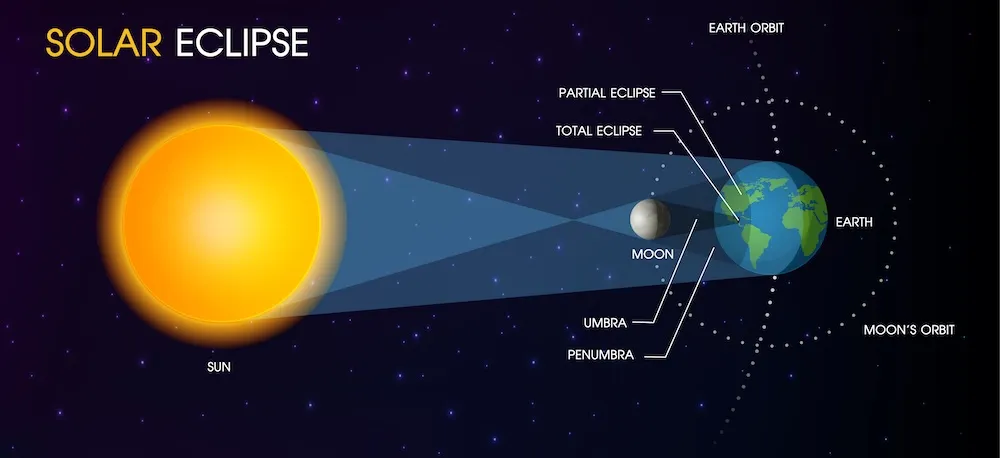
A total solar eclipse occurs when the Moon passes directly between Earth and the Sun. The Moon completely blocks the Sun's bright surface from view. This alignment must be precise for a total eclipse to happen. The Moon casts a dark shadow called the umbra onto Earth's surface. People standing in this shadow experience totality.
Scientists explain that the Moon and Sun appear nearly the same size in our sky. This happens because the Sun is about 400 times larger than the Moon. However, the Sun is also about 400 times farther away from Earth. This cosmic coincidence makes total solar eclipses possible. When the Moon covers the Sun exactly, darkness falls in the middle of the day.
During totality, the Sun's outer atmosphere becomes visible. This glowing region is called the corona. The corona appears as white streamers of hot gas extending into space. Temperatures on Earth can drop by 10 to 15 degrees Fahrenheit during totality. The sky darkens enough that stars and planets may become visible. Birds and other animals often behave as if night has arrived.
Evidence shows that totality lasts only a few minutes at any location. The Moon's shadow moves across Earth's surface at more than 1,000 miles per hour. The path where totality occurs is called the path of totality. This path is usually about 70 to 100 miles wide. On April 8, 2024, a total solar eclipse crossed the United States. The path stretched from Texas to Maine. Millions of people traveled to witness this rare event.
Total solar eclipses matter because they help scientists study the Sun's corona. The corona is usually too faint to see against the Sun's bright surface. During an eclipse, researchers can observe the corona's structure and temperature. These observations help us understand solar activity and space weather. Total solar eclipses also remind us of the predictable motions in our solar system.
Interesting Fact: The Moon is slowly moving away from Earth at about 1.5 inches per year. In about 600 million years, the Moon will be too far away to completely cover the Sun, making total solar eclipses impossible.
What causes a total solar eclipse to occur?
The Moon passes directly between Earth and the SunThe Sun moves behind the MoonEarth moves between the Sun and MoonThe Sun's corona expands outward
What is the umbra?
The outer atmosphere of the SunThe bright surface of the SunThe dark shadow cast by the Moon onto EarthThe path where partial eclipses occur
Why do the Moon and Sun appear nearly the same size in Earth's sky?
They are actually the same sizeThe Sun is larger but much farther awayThe Moon is larger but farther awayEarth's atmosphere makes them look similar
What becomes visible during totality that is usually hidden?
The Moon's dark sideEarth's shadowThe Sun's coronaSolar flares
In the passage, what does the word 'corona' refer to?
The Moon's shadow on EarthThe outer atmosphere of the SunThe path where totality occursThe darkest part of an eclipse
Based on the passage, why do temperatures drop during a total solar eclipse?
The Moon absorbs heat from EarthThe Sun stops producing energyThe Moon blocks sunlight from reaching EarthThe corona cools the atmosphere
How do scientists benefit from studying total solar eclipses?
They can measure the Moon's distance more accuratelyThey can observe the Sun's corona that is usually too faint to seeThey can predict when night will occurThey can determine Earth's rotation speed
If the Moon continues moving away from Earth, what will eventually happen to total solar eclipses?
They will occur more frequentlyThey will last longerThey will become impossibleThey will be visible from more locations
True or False: The path of totality is usually about 70 to 100 miles wide.
TrueFalse
True or False: Totality can last for several hours at any given location.
TrueFalse
Who it's for
Perfect for the way you teach
Teachers
Build comprehension skills
Auto-graded quiz
Differentiated reading
Parents
Read together at home
Improve fluency
Quiet reading time
Homeschoolers
Reading curriculum support
Independent practice
Track Lexile growth
Topics
total solar eclipseMoonSuncoronaumbratotalityNGSS MS-ESS1-1Earth-Sun-Moon systemmiddle school science
Reviews & Ratings
No reviews yet. Be the first to share your experience!
More reading you might love
20 more
What is Solar Radiation
This NGSS-aligned science reading passage for middle school students explores the concept of solar radiation. Solar radi...
MS-ESS1-1
How Incoming Solar Radiation Changes with Latitude
This NGSS-aligned science reading passage helps middle school students understand how solar radiation, or insolation, ch...
MS-ESS1-1
Tides and Tidal Forces
This middle school science passage explores the mechanisms of tides and tidal forces, aligning with NGSS standards MS-ES...
MS-ESS1-1MS-ESS1-2
The Night Sky
This comprehensive science reading passage for grades 6-8 aligns with NGSS standard MS-ESS1-1 and explores the systems a...
MS-ESS1-1
Ancient Astronomy
This engaging passage for grades 6-8 explores the history of astronomy through the lens of ancient observations. Student...
MS-ESS1-1
Tools of Modern Astronomy
This passage introduces middle school students to modern astronomy, aligning with NGSS standard MS-ESS1-1. It explains h...
MS-ESS1-1
How Astronomy Became a Science
This passage explores the transformative period known as the Scientific Revolution, with a special focus on the history ...
MS-ESS1-1
Earth's Rotation
This middle school science passage, aligned with NGSS standard MS-ESS1-1, focuses on Earth's rotation—how Earth spins on...
MS-ESS1-1
Earth's Revolution
This middle school science passage explores the science behind Earth's revolution around the Sun, closely aligned with N...
MS-ESS1-1
Why We Have Seasons
This comprehensive middle school science reading passage explains the mechanisms behind Earth's seasons, directly addres...
MS-ESS1-1
Earth's Seasons
This comprehensive reading passage for grades 6-8 explains why Earth has seasons, revealing the scientific mechanisms be...
MS-ESS1-1
Phases of the Moon
This comprehensive middle school science passage explains the phases of the Moon, focusing on the mechanisms behind the ...
MS-ESS1-1
Tides
This comprehensive middle school science reading passage explores the phenomenon of ocean tides, aligned to NGSS standar...
MS-ESS1-1MS-ESS1-2
Eclipses
This comprehensive passage for grades 6-8 explores the science behind eclipses, including solar and lunar eclipses, thei...
MS-ESS1-1
The Moon's Characteristics
This comprehensive science reading passage for grades 6-8 examines the Moon's physical characteristics, including its si...
MS-ESS1-1MS-ESS1-2
Lunar Eclipses
This passage introduces middle school students to the phenomenon of lunar eclipses, connecting observable events to the ...
MS-ESS1-1
The Sun's Characteristics
This engaging science passage introduces middle school students to the Sun’s key characteristics, such as its classifica...
MS-ESS1-1MS-ESS1-2
What Is a Galaxy?
This comprehensive middle school science passage answers the question: What is a galaxy? Aligned to NGSS standard MS-ESS...
MS-ESS1-1
The Milky Way: Our Home Galaxy
This comprehensive science passage introduces middle school students to the Milky Way, the barred spiral galaxy that is ...
MS-ESS1-1
Types of Galaxies
This comprehensive middle school science passage introduces students to the classification and characteristics of galaxi...