This learning resource is available in interactive and printable formats. The interactive worksheet can be played online and assigned to students. The Printable PDF version can be downloaded and printed for completion by hand.
"This science passage provides a clear and concise explanation of air masses for a middle school audience. It defines what an air mass is, how it acquires its properties from its source region, and the key characteristics used for classification (temperature and humidity). The passage details the four main types of air masses (maritime polar, continental polar, maritime tropical, and continental tropical) and connects their movement to real-world weather phenomena. It also explains the concept of a weather 'front' as the boundary between two air masses. The accompanying multiple-choice questions assess students' understanding of key vocabulary, factual recall, and the cause-and-effect relationship between air masses and local weather. This resource is designed to align with NGSS standards related to weather and climate systems, offering a foundational understanding of atmospheric science."
CONTENT PREVIEW
Expand content preview
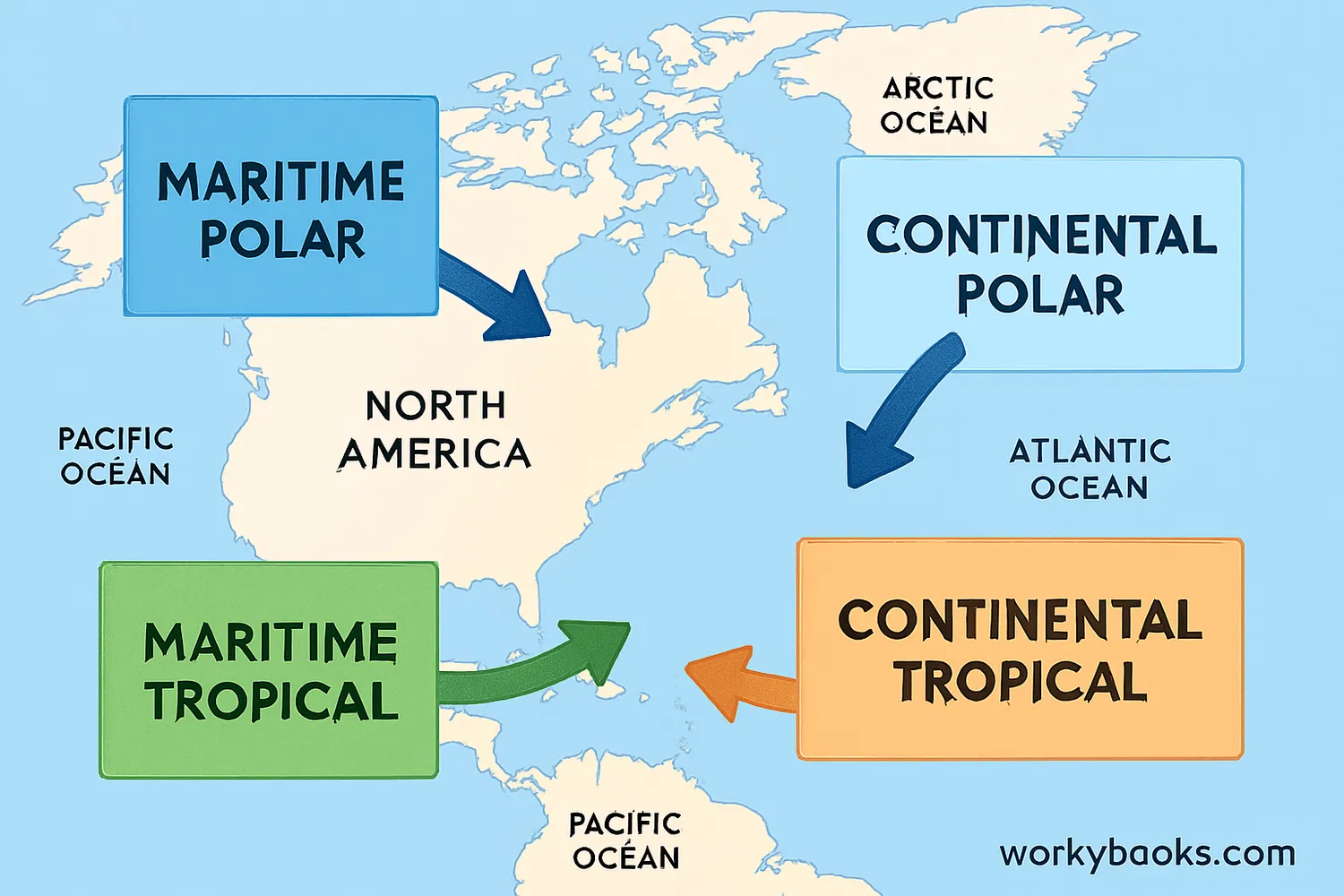
An air mass is a vast body of air that has consistent temperature and moisture characteristics throughout. These massive air parcels can be hundreds or even thousands of kilometers wide and several kilometers thick. The characteristics of an air mass are determined by the source region where it forms. A source region must be a large, flat area of land or water where air can remain stationary for an extended period, allowing it to take on the properties of the surface below. For example, an air mass forming over a warm, tropical ocean will become warm and humid, while one forming over a cold, snow-covered landmass will become cold and dry.
Air masses are categorized based on two main properties: temperature and humidity. Their temperature is designated as either polar (cold) or tropical (warm), depending on whether they originate from high or low latitudes. Their humidity is classified as either continental (dry) or maritime (moist), indicating if they formed over land or water, respectively. By combining these characteristics, we get four major types of air masses: maritime polar (cool and moist), continental polar (cold and dry), maritime tropical (warm and moist), and continental tropical (hot and dry).
The movement of these air masses is a primary driver of weather changes. As an air mass moves away from its source region, it carries its temperature and moisture with it, influencing the weather of the areas it travels over. When two different air masses meet, they do not mix easily. Instead, they form a boundary known as a front. The interaction at these fronts—where one air mass pushes another—causes changes in weather, often leading to clouds, precipitation, and storms.
Understanding air masses helps meteorologists predict weather patterns. For instance, a continental polar air mass moving southward into the United States during winter can bring a sudden drop in temperature and clear, dry conditions. Conversely, a maritime tropical air mass moving northward from the Gulf of Mexico often brings warm temperatures, high humidity, and the potential for heavy rain and thunderstorms.
Fun Fact: The world's largest air mass, the Siberian High, is a massive continental polar air mass that forms over Siberia in the winter and can influence weather across the entire northern hemisphere.
What two characteristics are used to classify air masses?
Temperature and wind speedHumidity and air pressureTemperature and humidityWind direction and cloud cover
What is a "source region" for an air mass?
A mountain range where air pressure is high.A large, uniform area where an air mass forms.An area with frequent thunderstorms.The boundary where two air masses meet.
What kind of air mass would form over a cold, snowy continent?
Why do different air masses not mix easily when they meet?
They have different air pressure.They have different densities.They move in different directions.They are blocked by global winds.
Which statement best summarizes the main idea of the passage?
Air masses are classified by their temperature.Air masses are large bodies of air that influence weather patterns.Air masses are the primary cause of all major storms.Air masses are defined by the global winds that push them.
A weather forecast predicts a "cold front moving in." Based on the passage, what type of air mass is likely arriving?
A warm air massA humid air massA high-pressure air massA cold air mass
Perfect For:
👩🏫 Teachers
• Reading comprehension practice
• Auto-graded assessments
• Literacy skill development
👨👩👧👦 Parents
• Reading practice at home
• Comprehension improvement
• Educational reading time
🏠 Homeschoolers
• Reading curriculum support
• Independent reading practice
• Progress monitoring
Reading Features:
📖
Reading Passage
Engaging fiction or nonfiction text
❓
Comprehension Quiz
Auto-graded questions
📊
Instant Feedback
Immediate results and scoring
📄
Printable Version
Download for offline reading
🔊
Read Aloud
Voice-over with word highlighting
Reviews & Ratings
No reviews yet. Be the first to share your experience!
Related Content
Tools and Technology in Earth Science
This middle school science reading passage explores the wide range of tools and technologies used in Earth science, from...
MS-ESS2-2MS-ESS3-2MS-ETS1-1MS-PS4-3
Scientific Inquiry in Earth Science
This passage explores scientific inquiry in Earth science for grades 6-8, aligned with NGSS standards MS-ESS1-4, MS-ESS2...
MS-ESS1-4MS-ESS2-1MS-ESS3-5SEP
What Is Earth Science?
This engaging middle school science passage introduces students to the field of Earth science, aligning with NGSS standa...
MS-ESS1MS-ESS2MS-ESS3SEP
Earth: Our Home in Space
This engaging Grade 4-5 science passage, aligned to NGSS, introduces students to Earth's special place in the solar syst...
Earth's Spheres
This middle school science passage introduces students to Earth's four major spheres: the geosphere, hydrosphere, atmosp...
MS-ESS2-4MS-ESS2-6
What Is Space Weather and How Does It Affect the Earth?
This NGSS-aligned science passage for middle school explains what space weather is and how it affects Earth. Students le...
MS-ESS2-2
Earth's Energy Balance
This engaging, NGSS-aligned science passage for grades 6–8 explores Earth's energy balance, a key process that keeps our...
MS-ESS2-6
Earth's Rotation
This middle school science passage, aligned with NGSS standard MS-ESS1-1, focuses on Earth's rotation—how Earth spins on...
MS-ESS1-1
Earth's Interior
This comprehensive passage for grades 6-8 explores Earth's layered interior, including the crust, mantle, outer core, an...
MS-ESS2-1MS-ESS2-2
Facts About Earth
This engaging science reading passage introduces Grade 4 and 5 students to Earth, our home planet. Aligned with NGSS sta...
Meteorite Impacts on Earth
This engaging science reading passage for Grades 4-5 explores meteorite impacts on Earth, aligning with NGSS standards. ...
Venus: Earth's Twin?
This comprehensive science passage for grades 6-8 examines Venus—often called Earth's twin—by exploring its similarities...
MS-ESS1-2MS-ESS1-3
Earth Changes Over Millions of Years
This engaging, audio-integrated science passage for Grade 4-5 students explores how Earth has changed over millions of y...
Earth's Moon Facts
This engaging science passage, 'The Moon: Earth's Companion,' is designed for Grade 4-5 students and aligns with NGSS ge...
Earth's Quick and Slow Changes
In 'Earth's Quick and Slow Changes,' students categorize 12 Earth events by their speed of occurrence, enhancing underst...
Earth: Our Home Planet
This comprehensive science passage for grades 6-8 explores Earth’s unique characteristics and the interconnected systems...
MS-ESS1-2
Earth's Revolution
This middle school science passage explores the science behind Earth's revolution around the Sun, closely aligned with N...
MS-ESS1-1
Earth's Seasons
This comprehensive reading passage for grades 6-8 explains why Earth has seasons, revealing the scientific mechanisms be...
MS-ESS1-1
Earth's Place in the Universe
This reading passage explains Earth's place in the universe, supporting NGSS 1-ESS1-1. It describes how Earth is one of ...
1-ESS1-1
Aphelion and Perihelion
This engaging reading passage, 'Aphelion and Perihelion,' delves into the fascinating aspects of Earth's elliptical orbi...
MS-ESS1-1: DEVELOP AND USE A MODEL OF THE EARTH-SUN-MOON SYSTEM TO DESCRIBE THE CYCLIC PATTERNS OF LUNAR PHASESECLIPSES OF THE SUN AND MOONAND SEASONS.