This learning resource is available in interactive and printable formats. The interactive worksheet can be played online and assigned to students. The Printable PDF version can be downloaded and printed for completion by hand.
This reading passage delves into the concept of altitude, defining it as the height above a reference point, typically sea level. It explores how altitude affects key environmental factors like air pressure and temperature, providing a foundational understanding for students. The passage explains the importance of altitude in various fields, from aviation and meteorology to geography, and provides real-world examples like mountain climbing and air travel. This text is designed to align with the Next Generation Science Standards (NGSS), specifically connecting to the Disciplinary Core Idea of ESS2: Earth's Systems. It helps students understand the interconnections between Earth's systems and human activity. This passage is also audio-integrated, making it accessible for diverse learners and an excellent resource for classroom instruction and independent study. The content is suitable for elementary and middle school science curricula, introducing core concepts in a clear and engaging manner.
CONTENT PREVIEW
Expand content preview
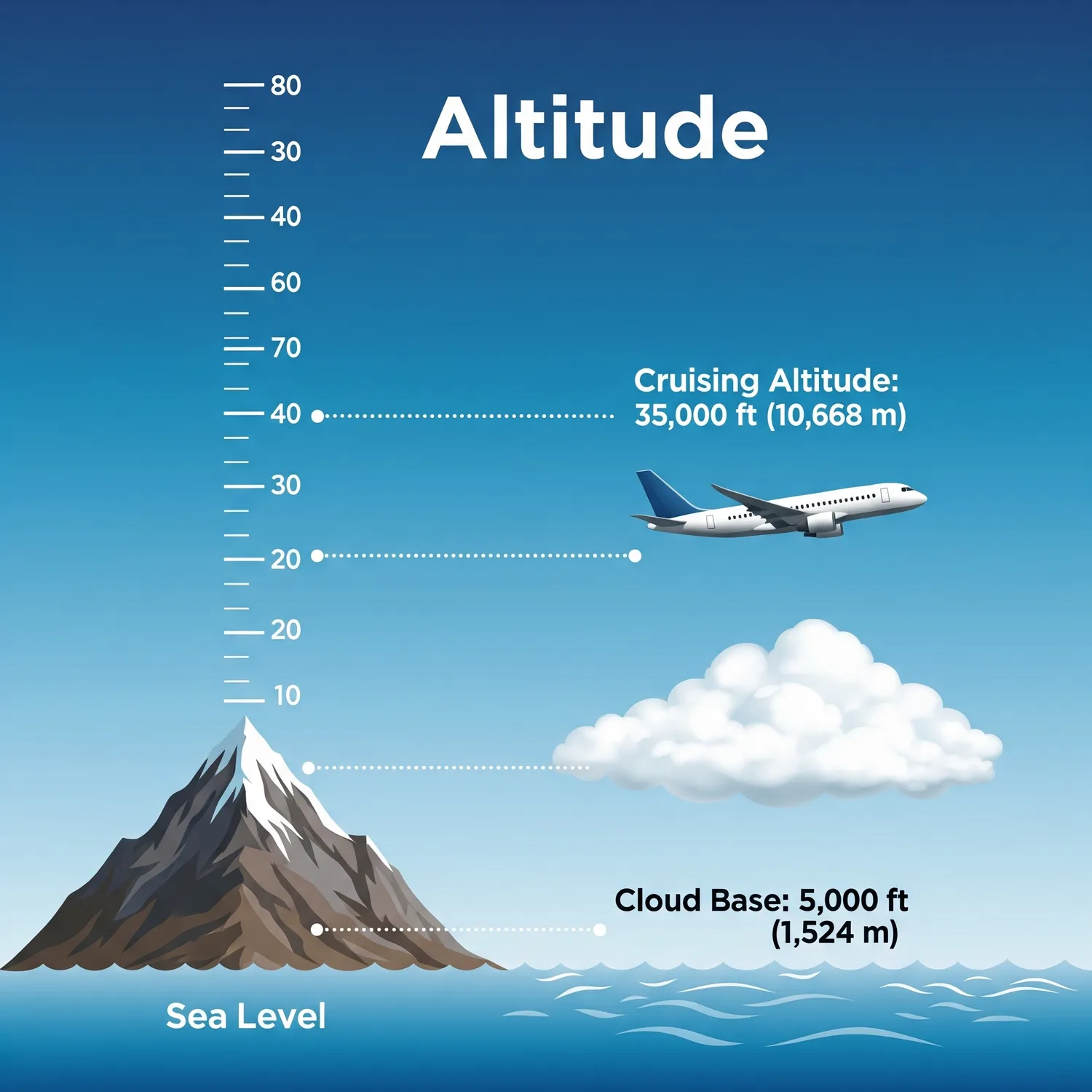
Altitude is measured from sea level up a mountain and into the atmosphere.
What Is Altitude?
Altitude is the height of a place or object above sea level. Sea level is the place where the ocean meets the land. It is used as the starting point for measuring how high something is, because the ocean’s surface is almost the same height everywhere in the world.
For example, the beach is at 0 feet altitude because it is right at sea level. Your town might be a few hundred feet above sea level. Denver, Colorado is called the “Mile High City” because it is 5,280 feet above sea level! Mount Everest, the tallest mountain on Earth, rises to a huge altitude of 29,032 feet. Even higher, airplanes often fly at 35,000 feet above sea level.
How Does Altitude Affect Us?
As altitude increases, the air gets thinner. This means there is less air pressure, and it is harder to breathe or run. That’s why people and animals can feel tired more quickly on high mountains. Also, the higher you go, the colder it gets. Mountain tops often have snow, even in summer, because the temperature drops as altitude goes up.
At high places, air pressure is lower. That’s why your ears might pop when you drive up a mountain. Water also boils at a lower temperature, so cooking takes longer the higher you go.
Measuring Altitude and Life at High Altitudes
Special tools called altimeters are used in airplanes and hiking watches to measure altitude. Some animals, like mountain goats, yaks, and condors, have special adaptations to live high up where there is less air and it’s much colder.
Altitude is like counting steps on an imaginary staircase from the ocean up toward space. The higher you go, the more things change!
Interesting Fact: Climbers on Mount Everest need oxygen tanks because the air is so thin, it is difficult to breathe without extra oxygen!
What is altitude?
Height above sea levelDepth below the oceanTemperature on a mountainDistance across a city
Why do we use sea level?
Same height everywhereIt is warmerIt is saferIt is easier to swim
What happens as altitude increases?
Air gets thinnerAir gets thickerIt gets warmerWater boils slower
Why do your ears pop on mountains?
Lower air pressureMore windHigh humiditySun is brighter
Which animal lives at high altitude?
Mountain goatSharkCamelDolphin
What tool measures altitude?
AltimeterThermometerBarometerTelescope
Altitude is height above sea level. True or false?
TrueFalse
What does 'air pressure' mean?
Force of air on usAmount of waterMountain heightTemperature of air
Perfect For:
👩🏫 Teachers
• Reading comprehension practice
• Auto-graded assessments
• Literacy skill development
👨👩👧👦 Parents
• Reading practice at home
• Comprehension improvement
• Educational reading time
🏠 Homeschoolers
• Reading curriculum support
• Independent reading practice
• Progress monitoring
Reading Features:
📖
Reading Passage
Engaging fiction or nonfiction text
❓
Comprehension Quiz
Auto-graded questions
📊
Instant Feedback
Immediate results and scoring
📄
Printable Version
Download for offline reading
🔊
Read Aloud
Voice-over with word highlighting
Reviews & Ratings
No reviews yet. Be the first to share your experience!
Related Content
Tools and Technology in Earth Science
This middle school science reading passage explores the wide range of tools and technologies used in Earth science, from...
MS-ESS2-2MS-ESS3-2MS-ETS1-1MS-PS4-3
Scientific Inquiry in Earth Science
This passage explores scientific inquiry in Earth science for grades 6-8, aligned with NGSS standards MS-ESS1-4, MS-ESS2...
MS-ESS1-4MS-ESS2-1MS-ESS3-5SEP
What Is Earth Science?
This engaging middle school science passage introduces students to the field of Earth science, aligning with NGSS standa...
MS-ESS1MS-ESS2MS-ESS3SEP
Earth: Our Home in Space
This engaging Grade 4-5 science passage, aligned to NGSS, introduces students to Earth's special place in the solar syst...
Earth's Spheres
This middle school science passage introduces students to Earth's four major spheres: the geosphere, hydrosphere, atmosp...
MS-ESS2-4MS-ESS2-6
What Is Space Weather and How Does It Affect the Earth?
This NGSS-aligned science passage for middle school explains what space weather is and how it affects Earth. Students le...
MS-ESS2-2
Earth's Energy Balance
This engaging, NGSS-aligned science passage for grades 6–8 explores Earth's energy balance, a key process that keeps our...
MS-ESS2-6
Earth's Rotation
This middle school science passage, aligned with NGSS standard MS-ESS1-1, focuses on Earth's rotation—how Earth spins on...
MS-ESS1-1
Earth's Interior
This comprehensive passage for grades 6-8 explores Earth's layered interior, including the crust, mantle, outer core, an...
MS-ESS2-1MS-ESS2-2
Facts About Earth
This engaging science reading passage introduces Grade 4 and 5 students to Earth, our home planet. Aligned with NGSS sta...
Meteorite Impacts on Earth
This engaging science reading passage for Grades 4-5 explores meteorite impacts on Earth, aligning with NGSS standards. ...
Venus: Earth's Twin?
This comprehensive science passage for grades 6-8 examines Venus—often called Earth's twin—by exploring its similarities...
MS-ESS1-2MS-ESS1-3
Earth Changes Over Millions of Years
This engaging, audio-integrated science passage for Grade 4-5 students explores how Earth has changed over millions of y...
Earth's Moon Facts
This engaging science passage, 'The Moon: Earth's Companion,' is designed for Grade 4-5 students and aligns with NGSS ge...
Earth's Quick and Slow Changes
In 'Earth's Quick and Slow Changes,' students categorize 12 Earth events by their speed of occurrence, enhancing underst...
Earth: Our Home Planet
This comprehensive science passage for grades 6-8 explores Earth’s unique characteristics and the interconnected systems...
MS-ESS1-2
Earth's Revolution
This middle school science passage explores the science behind Earth's revolution around the Sun, closely aligned with N...
MS-ESS1-1
Earth's Seasons
This comprehensive reading passage for grades 6-8 explains why Earth has seasons, revealing the scientific mechanisms be...
MS-ESS1-1
Earth's Place in the Universe
This reading passage explains Earth's place in the universe, supporting NGSS 1-ESS1-1. It describes how Earth is one of ...
1-ESS1-1
Aphelion and Perihelion
This engaging reading passage, 'Aphelion and Perihelion,' delves into the fascinating aspects of Earth's elliptical orbi...
MS-ESS1-1: DEVELOP AND USE A MODEL OF THE EARTH-SUN-MOON SYSTEM TO DESCRIBE THE CYCLIC PATTERNS OF LUNAR PHASESECLIPSES OF THE SUN AND MOONAND SEASONS.