This learning resource is available in interactive and printable formats. The interactive worksheet can be played online and assigned to students. The Printable PDF version can be downloaded and printed for completion by hand.
This educational content package provides an engaging, audio-integrated reading passage titled "What Is Astronomy?" for Grade 6 students. It introduces fundamental concepts of astronomy, covering celestial objects like planets, stars, and galaxies, as well as the solar system and space exploration. The passage is designed to align with NGSS standard MS-ESS1-1, encouraging students to develop an understanding of the Earth-sun-moon system and its cyclic patterns. Accompanying activities include multiple-choice questions for comprehension, a glossary of key terms, and short answer questions to deepen learning. Keywords such as astronomy, solar system, celestial objects, and space exploration are integrated throughout to enhance educational value and SEO.
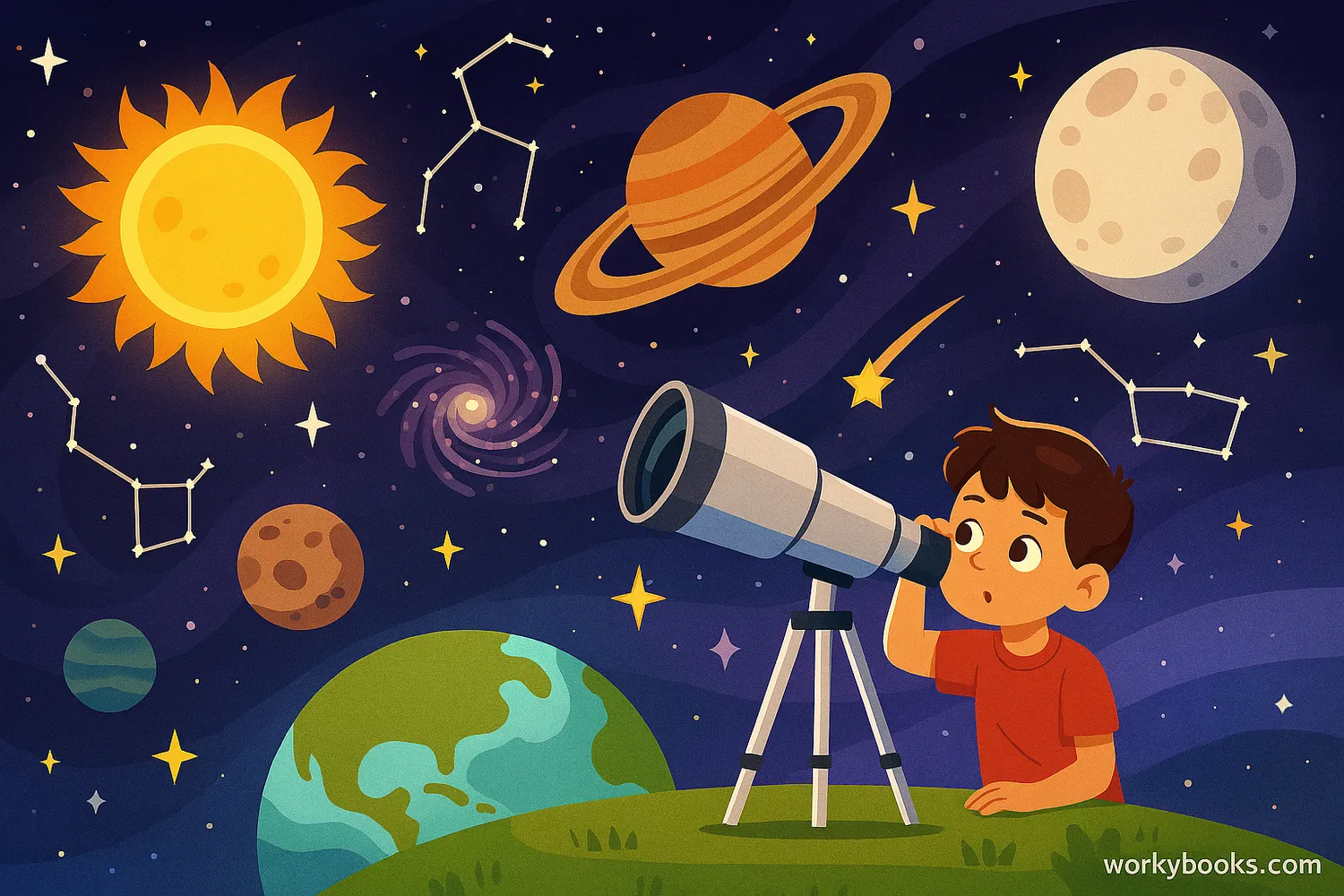
Have you ever looked up at the night sky and wondered about the twinkling stars, the bright moon, or distant planets? If so, you're already thinking like an astronomer! Astronomy is the scientific study of everything beyond Earth's atmosphere. This includes the Sun, Moon, planets, stars, galaxies, and all the other fascinating celestial bodies in the universe. It's one of the oldest sciences, with people observing the sky for thousands of years.
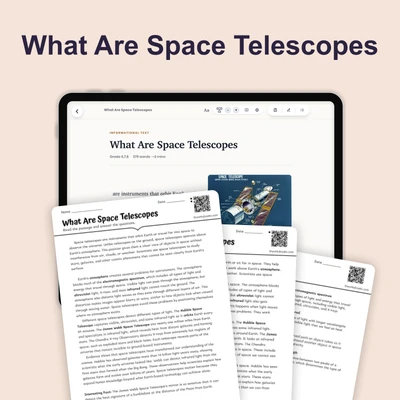
Astronomers are like cosmic detectives. They use special tools, especially telescopes, to gather light from far-off objects. Telescopes make distant objects appear closer and brighter, allowing scientists to study them in detail. Some telescopes are on Earth, while others are launched into space to get clearer views without Earth's atmosphere getting in the way. These powerful instruments help us understand how stars are born, how planets form, and even how the universe itself began.
One of the basic things astronomers study are stars. Our own Sun is a star, a giant ball of hot gas that produces its own light and heat. Other stars are much farther away, appearing as tiny points of light. People have grouped stars into patterns called constellations, like the Big Dipper or Orion. These constellations helped ancient navigators find their way and continue to inspire wonder.
Planets are another big part of astronomy. Unlike stars, planets do not produce their own light; instead, they reflect light from their star. Our solar system has eight planets, including Earth, all orbiting our Sun. Beyond our solar system, astronomers have discovered thousands of exoplanets, which are planets orbiting other stars. Finding exoplanets is exciting because it raises questions about whether life could exist elsewhere in the universe.
Beyond individual stars and planets, astronomers study much larger structures. A galaxy is a huge collection of gas, dust, and billions of stars, all held together by gravity. Our solar system is part of the Milky Way galaxy. There are billions of galaxies in the observable universe, each with its own unique shape and features. Studying these vast structures helps us understand the large-scale organization and evolution of the universe.
Astronomy isn't just about looking at pretty lights; it's about understanding our place in the cosmos. It helps us answer fundamental questions about where we came from and where we are going. From observing the changing phases of the Moon to tracking the paths of comets, astronomy continues to expand our knowledge of the amazing universe around us. It's a field that combines physics, chemistry, and mathematics to unlock the secrets of space.
Fun Fact: The largest known structure in the universe is the Hercules-Corona Borealis Great Wall, a massive filament of galaxies stretching over 10 billion light-years!
What is astronomy the study of?
Earth's weather patternsEverything beyond Earth's atmosphereAncient civilizationsOcean life
Planets are hotter than starsStars are smaller than planetsPlanets reflect light, stars produce itStars only exist in our solar system
Why are some telescopes in space?
To be closer to the SunTo avoid Earth's atmosphereTo study Earth's gravityTo send signals to aliens
What does studying exoplanets help us with?
Predicting Earth's weatherUnderstanding Earth's historyFinding life beyond EarthImproving space travel speed
How do constellations help us?
Predicting earthquakesNavigating and inspiring wonderGrowing plants fasterMaking accurate maps
What holds galaxies together?
MagnetsAir pressureGravityChemical bonds
Why is astronomy considered an old science?
It uses old equipmentPeople observed skies for millenniaIts discoveries are outdatedIt only studies ancient stars
How might learning astronomy benefit humanity?
Help us build faster carsUnderstand our cosmic originsCreate new types of foodImprove athletic performance
If a new object is found far away, what might astronomers do?
Ignore itStudy it with telescopesTry to touch it immediatelySend a postcard
Perfect For:
👩🏫 Teachers
• Reading comprehension practice
• Auto-graded assessments
• Literacy skill development
👨👩👧👦 Parents
• Reading practice at home
• Comprehension improvement
• Educational reading time
🏠 Homeschoolers
• Reading curriculum support
• Independent reading practice
• Progress monitoring
Reading Features:
📖
Reading Passage
Engaging fiction or nonfiction text
❓
Comprehension Quiz
Auto-graded questions
📊
Instant Feedback
Immediate results and scoring
📄
Printable Version
Download for offline reading
🔊
Read Aloud
Voice-over with word highlighting
Reviews & Ratings
No reviews yet. Be the first to share your experience!
Related Content
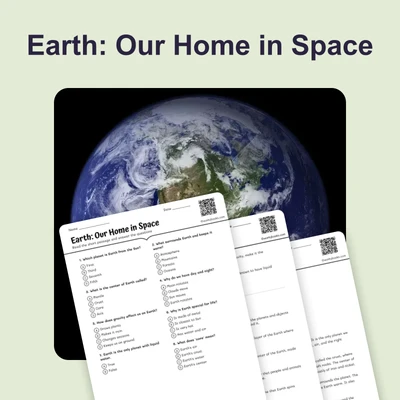
Earth: Our Home in Space
This engaging Grade 4-5 science passage, aligned to NGSS, introduces students to Earth's special place in the solar syst...
Tools and Technology in Earth Science
This middle school science reading passage explores the wide range of tools and technologies used in Earth science, from...
MS-ESS2-2MS-ESS3-2MS-ETS1-1MS-PS4-3
Earth's Place in the Universe
This reading passage explains Earth's place in the universe, supporting NGSS 1-ESS1-1. It describes how Earth is one of ...
1-ESS1-1
Scientific Inquiry in Earth Science
This passage explores scientific inquiry in Earth science for grades 6-8, aligned with NGSS standards MS-ESS1-4, MS-ESS2...
MS-ESS1-4MS-ESS2-1MS-ESS3-5SEP
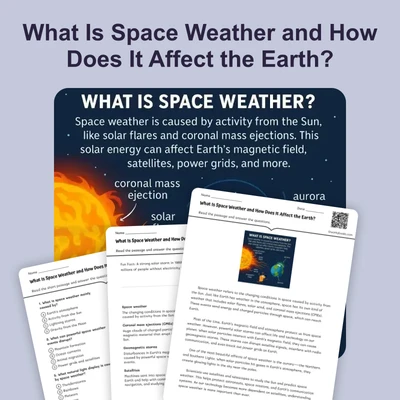
What Is Space Weather and How Does It Affect the Earth?
This NGSS-aligned science passage for middle school explains what space weather is and how it affects Earth. Students le...
MS-ESS2-2
Escape Velocity and Space Travel
This middle school science passage introduces students to the concept of escape velocity—the minimum speed required to b...
MS-ESS1-2MS-PS2-4
Space Stations
This informational science reading passage for grades 6-8 explores the complex systems and technology behind space stati...
MS-ESS1-3MS-ETS1-1
What Is Earth Science?
This engaging middle school science passage introduces students to the field of Earth science, aligning with NGSS standa...
MS-ESS1MS-ESS2MS-ESS3SEP
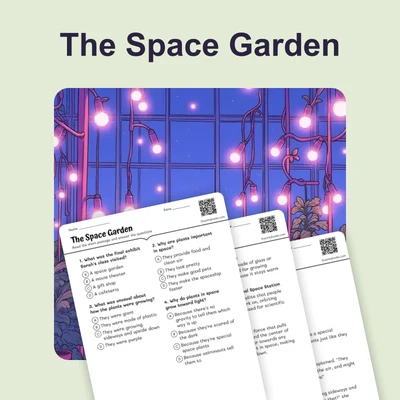
The Space Garden
This innovative passage combines plant science with space exploration, aligning with NGSS standards for life sciences an...
RL.3.1RL.2.1RL.4.9
Measuring Distances in Space
This middle school science passage explores how astronomers measure the vast distances in space, aligning with NGSS stan...
MS-ESS1-3
Earth: Our Home Planet
This comprehensive science passage for grades 6-8 explores Earth’s unique characteristics and the interconnected systems...
MS-ESS1-2
Meteorite Impacts on Earth
This engaging science reading passage for Grades 4-5 explores meteorite impacts on Earth, aligning with NGSS standards. ...
Exploring Space: Rockets and Spacecraft
Space exploration has been one of humanity's greatest achievements, made possible by rockets and spacecraft. Rockets act...
RI.4.4RI.4.2
Earth's Rotation
This middle school science passage, aligned with NGSS standard MS-ESS1-1, focuses on Earth's rotation—how Earth spins on...
MS-ESS1-1
Facts About Earth
This engaging science reading passage introduces Grade 4 and 5 students to Earth, our home planet. Aligned with NGSS sta...
Earth's Moon Facts
This engaging science passage, 'The Moon: Earth's Companion,' is designed for Grade 4-5 students and aligns with NGSS ge...
Earth's Seasons
This comprehensive reading passage for grades 6-8 explains why Earth has seasons, revealing the scientific mechanisms be...
MS-ESS1-1
International Space Station
Discover the wonders of the International Space Station with this informative coloring page showcasing the orbiting outpost where astronauts live and work in space. As children color the complex modul...
Venus: Earth's Twin?
This comprehensive science passage for grades 6-8 examines Venus—often called Earth's twin—by exploring its similarities...
MS-ESS1-2MS-ESS1-3
What Makes Earth Perfect for Life?
This Grade 4-5 science passage, aligned with NGSS standards, explores the essential features that make Earth the perfect...