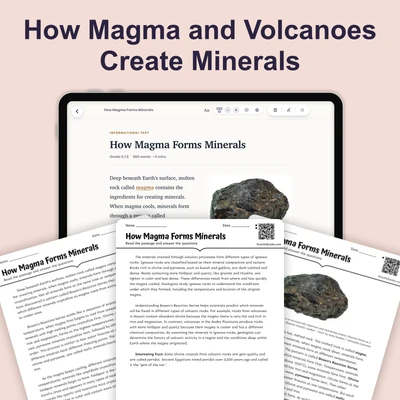
This learning resource is available in interactive and printable formats. The interactive worksheet can be played online and assigned to students. The Printable PDF version can be downloaded and printed for completion by hand.
This educational passage, audio integrated, delves into the fascinating world of basalt, a common igneous rock formed from volcanic activity. Students will explore how this durable mineral resource is created through geoscience processes and its diverse applications in construction, roads, and even as a source for rock wool. The content aligns with NGSS MS-ESS3-1, helping students understand how the uneven distribution of Earth's mineral resources is a result of past and current geological processes. Key terms like 'igneous rock,' 'magma,' and 'erosion' are defined, making complex concepts accessible for a Grade 6 reading level. The passage also highlights basalt's importance as a sustainable and widely available resource.
CONTENT PREVIEW
Expand content preview
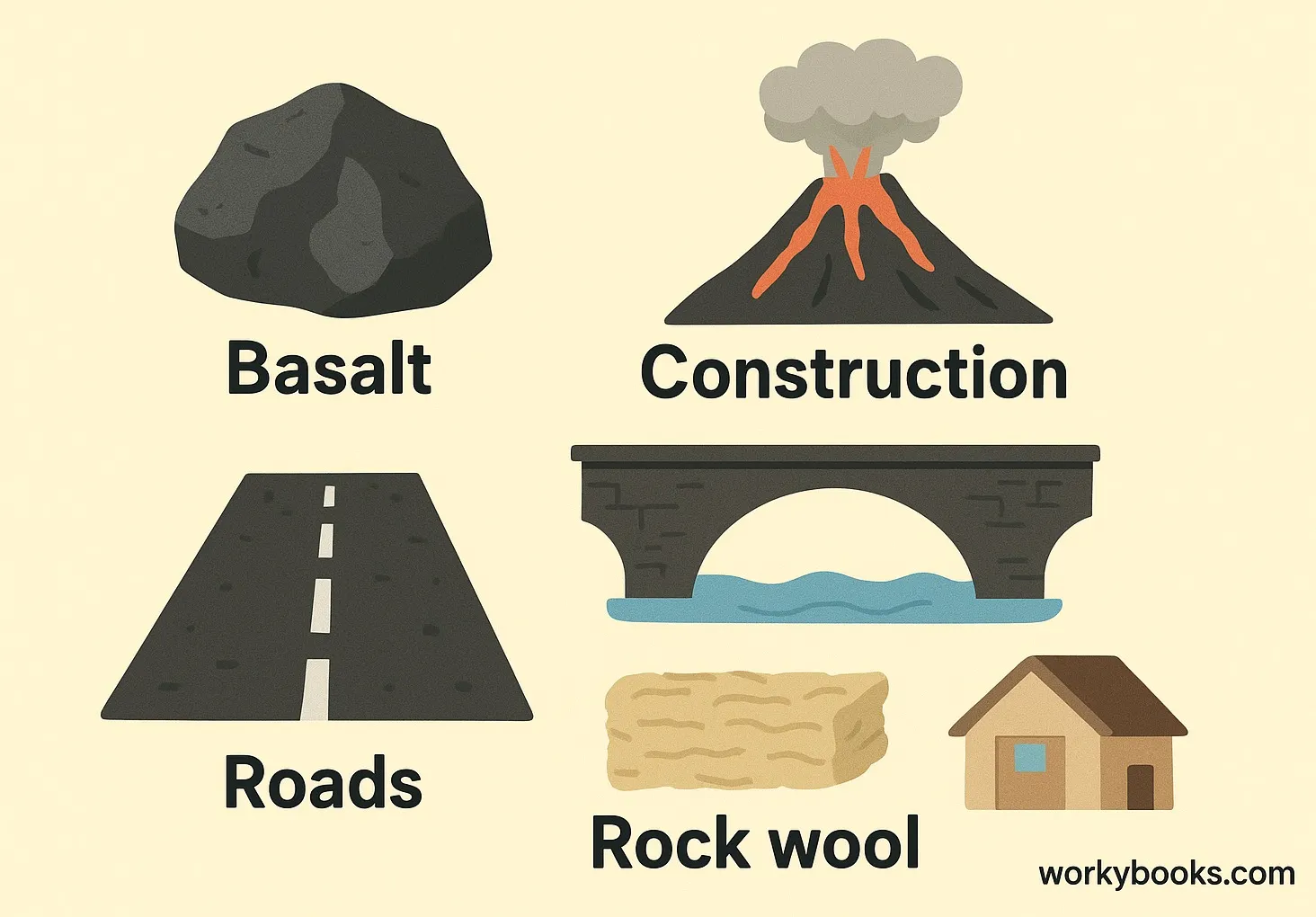
Basalt used for roads, construction, bridges, and rock wool insulation.
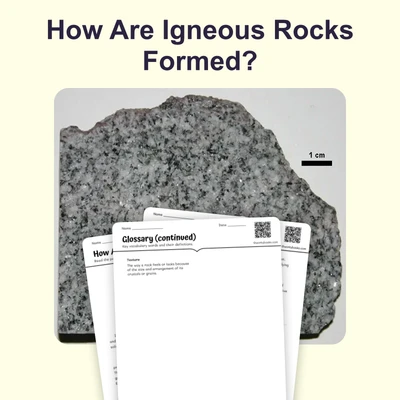
One very common and important type of rock is called basalt. Basalt is an igneous rock, which means it forms when hot, molten rock cools and hardens. This molten rock can be magma, found deep inside the Earth, or lava, which erupts from volcanoes onto the Earth's surface. Basalt is often dark-colored and has a fine-grained texture because it cools quickly.
Basalt is one of Earth's most abundant rocks, especially on the ocean floor and in areas with a history of volcanic activity. The uneven distribution of Earth's mineral resources, like basalt, is a direct result of past and current geoscience processes. Volcanoes, through their eruptions, spread lava across vast areas, creating large deposits of basalt. Over millions of years, these geological processes, including erosion and tectonic plate movements, continue to shape where we find these valuable resources.
So, what makes basalt so useful? Its strength and durability make it perfect for construction. Many roads are built with basalt because it can withstand heavy traffic and harsh weather. It's crushed and used as aggregate in concrete and asphalt. Think of all the roads, bridges, and buildings around you – many of them likely contain basalt! Its dark color also helps roads absorb heat, which can be useful in colder climates to melt ice.
Beyond construction, basalt has other surprising uses. When basalt rock is melted down and spun into fibers, it creates something called rock wool. Rock wool is an excellent insulator, used in homes and buildings to keep them warm in winter and cool in summer. This saves energy and makes homes more comfortable. It's also used in hydroponics, a method of growing plants without soil, because it holds water and air well.
The widespread availability and versatile properties of basalt make it a very valuable mineral resource. From the foundations of our homes to the roads we drive on, basalt plays a crucial role in our daily lives, all thanks to Earth's dynamic geological processes.
Interesting Fact: The largest known basaltic lava flow on Earth is the Columbia River Basalt Group in the Pacific Northwest of the United States, which covers an area larger than the state of Oregon!
What is basalt?
A type of plantAn igneous rockA kind of metalA living organism
Rocks that floatRocks formed by fireRocks that are softRocks found in water
Why is basalt suitable for roads?
It is lightIt is colorfulIt is strong and durableIt grows quickly
How does basalt's dark color help roads?
Makes them prettierHelps absorb heatMakes them softerReflects sunlight
What property of rock wool makes it useful for insulation?
It is very heavyIt is a good conductorIt traps heat wellIt is easy to paint
Where is basalt most commonly found on Earth?
High mountain peaksDeep desert cavesOcean floor, volcanic areasInside ancient forests
If a new volcanic island forms, what rock type would you expect to be abundant?
SandstoneLimestoneBasaltMarble
Which scenario best describes basalt's formation?
Sand piling upMolten rock coolingShells compressingPlants decaying
Perfect For:
👩🏫 Teachers
• Reading comprehension practice
• Auto-graded assessments
• Literacy skill development
👨👩👧👦 Parents
• Reading practice at home
• Comprehension improvement
• Educational reading time
🏠 Homeschoolers
• Reading curriculum support
• Independent reading practice
• Progress monitoring
Reading Features:
📖
Reading Passage
Engaging fiction or nonfiction text
❓
Comprehension Quiz
Auto-graded questions
📊
Instant Feedback
Immediate results and scoring
📄
Printable Version
Download for offline reading
🔊
Read Aloud
Voice-over with word highlighting
Reviews & Ratings
No reviews yet. Be the first to share your experience!
Related Content
Tools and Technology in Earth Science
This middle school science reading passage explores the wide range of tools and technologies used in Earth science, from...
MS-ESS2-2MS-ESS3-2MS-ETS1-1MS-PS4-3
Scientific Inquiry in Earth Science
This passage explores scientific inquiry in Earth science for grades 6-8, aligned with NGSS standards MS-ESS1-4, MS-ESS2...
MS-ESS1-4MS-ESS2-1MS-ESS3-5SEP
What Is Earth Science?
This engaging middle school science passage introduces students to the field of Earth science, aligning with NGSS standa...
MS-ESS1MS-ESS2MS-ESS3SEP
Earth: Our Home in Space
This engaging Grade 4-5 science passage, aligned to NGSS, introduces students to Earth's special place in the solar syst...
Earth's Spheres
This middle school science passage introduces students to Earth's four major spheres: the geosphere, hydrosphere, atmosp...
MS-ESS2-4MS-ESS2-6
What Is Space Weather and How Does It Affect the Earth?
This NGSS-aligned science passage for middle school explains what space weather is and how it affects Earth. Students le...
MS-ESS2-2
Earth's Energy Balance
This engaging, NGSS-aligned science passage for grades 6–8 explores Earth's energy balance, a key process that keeps our...
MS-ESS2-6
Earth's Rotation
This middle school science passage, aligned with NGSS standard MS-ESS1-1, focuses on Earth's rotation—how Earth spins on...
MS-ESS1-1
Earth's Interior
This comprehensive passage for grades 6-8 explores Earth's layered interior, including the crust, mantle, outer core, an...
MS-ESS2-1MS-ESS2-2
Facts About Earth
This engaging science reading passage introduces Grade 4 and 5 students to Earth, our home planet. Aligned with NGSS sta...
Meteorite Impacts on Earth
This engaging science reading passage for Grades 4-5 explores meteorite impacts on Earth, aligning with NGSS standards. ...
Venus: Earth's Twin?
This comprehensive science passage for grades 6-8 examines Venus—often called Earth's twin—by exploring its similarities...
MS-ESS1-2MS-ESS1-3
Earth Changes Over Millions of Years
This engaging, audio-integrated science passage for Grade 4-5 students explores how Earth has changed over millions of y...
Earth's Moon Facts
This engaging science passage, 'The Moon: Earth's Companion,' is designed for Grade 4-5 students and aligns with NGSS ge...
Earth's Quick and Slow Changes
In 'Earth's Quick and Slow Changes,' students categorize 12 Earth events by their speed of occurrence, enhancing underst...
Earth: Our Home Planet
This comprehensive science passage for grades 6-8 explores Earth’s unique characteristics and the interconnected systems...
MS-ESS1-2
Earth's Revolution
This middle school science passage explores the science behind Earth's revolution around the Sun, closely aligned with N...
MS-ESS1-1
Earth's Seasons
This comprehensive reading passage for grades 6-8 explains why Earth has seasons, revealing the scientific mechanisms be...
MS-ESS1-1
Earth's Place in the Universe
This reading passage explains Earth's place in the universe, supporting NGSS 1-ESS1-1. It describes how Earth is one of ...
1-ESS1-1
Aphelion and Perihelion
This engaging reading passage, 'Aphelion and Perihelion,' delves into the fascinating aspects of Earth's elliptical orbi...
MS-ESS1-1: DEVELOP AND USE A MODEL OF THE EARTH-SUN-MOON SYSTEM TO DESCRIBE THE CYCLIC PATTERNS OF LUNAR PHASESECLIPSES OF THE SUN AND MOONAND SEASONS.