This comprehensive middle school science passage explores the fundamental concept of climate and how it differs from daily weather. Aligned with NGSS standard MS-ESS2-6, students learn that climate represents the average pattern of weather a place experiences over many years, typically measured across decades. The passage uses relatable comparisons between different climate types, such as hot, dry deserts versus cool, rainy regions, to help students understand that every place has its own climate personality. Students discover how climate is shaped by long-term patterns in the atmosphere, oceans, and geography working together as interconnected Earth systems. The audio-integrated passage includes vocabulary development with key science terms, real-world examples, and engaging activities including multiple-choice questions, writing prompts, and graphic organizers to reinforce understanding of climate concepts and their importance to life on Earth.
Written by Workybooks TeamPublished by Workybooks
Preview
Sample passage and quiz content
CONTENT PREVIEW
Expand content preview
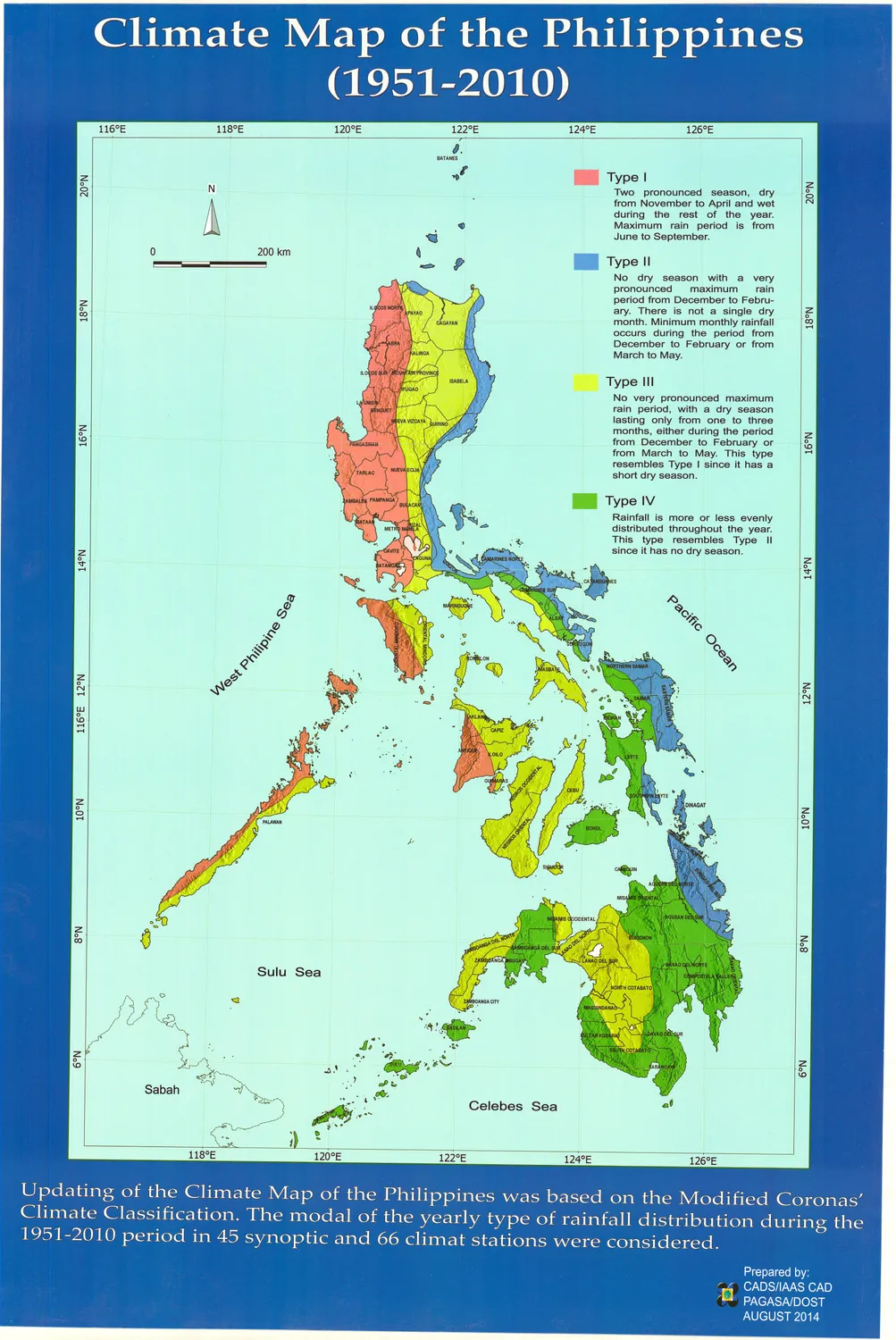
"Climate Map of the Philippines (1951-2010)" by Impact Assessment and Applications Section, Climatology and Agrometeorology Division, Philippine Atmospheric, Geophysical and Astronomical Services Administration (PAGASA) / Wikimedia Commons
Climate is the average pattern of weather a place experiences over many years. Scientists usually measure climate across at least 30 years. If weather is what's happening outside your window today, climate is what a place is generally like throughout the year. Think of it this way: weather is your mood right now, but climate is your personality.
Every region on Earth has its own climate. Some places have hot, dry climates like deserts in Arizona. Other regions have cool, rainy climates like the Pacific Northwest. Climate includes typical temperatures, seasonal patterns, and how much precipitation falls as rain or snow. Scientists observe these patterns over decades to understand what is normal for each location.
Climate forms through interactions among Earth's major systems. The atmosphere carries heat and moisture around the planet. Oceans absorb and release heat slowly, which affects nearby land temperatures. A region's geography also matters. Mountains can block rain clouds, creating dry areas on one side. Distance from the ocean influences how much moisture reaches an area. These factors work together over long periods to create each region's climate.
Evidence shows that climate affects nearly everything in a region. Plants and animals adapt to their local climate over many generations. Humans build homes and grow crops based on expected climate conditions. For example, the Midwest has a climate with warm summers and cold winters. Farmers there plant corn in spring because they can predict when frost will end. Understanding climate helps communities plan for the future and prepare for typical weather patterns.
Interesting Fact: Scientists have found evidence that Earth's climate has changed many times over millions of years. Ice core samples from Antarctica contain tiny air bubbles that reveal what the atmosphere was like up to 800,000 years ago.
What is climate?
The weather happening right nowThe average pattern of weather over many yearsThe temperature on a single dayOnly the amount of rain that falls
How long do scientists typically measure climate patterns?
One weekOne yearAt least 30 yearsFive years
What does the word 'precipitation' mean in the passage?
The temperature of the airThe speed of the windWater that falls as rain or snowThe amount of sunlight
According to the passage, what does the word 'geography' refer to?
The study of rocks onlyThe physical features of a placeThe types of animals in an areaThe history of a region
Why can mountains affect climate?
They make the air warmerThey produce their own rainThey can block rain cloudsThey attract more sunlight
Based on the passage, how does understanding climate help farmers in the Midwest?
It helps them predict when frost will end so they can plant cropsIt tells them exactly what the weather will be tomorrowIt helps them change the temperatureIt allows them to control precipitation
Which Earth systems work together to create climate?
Only the atmosphereThe atmosphere, oceans, and geographyOnly the oceansOnly mountains and rivers
What can scientists learn from ice core samples in Antarctica?
What the atmosphere was like hundreds of thousands of years agoWhat tomorrow's weather will beHow to create more iceThe exact temperature today
True or False: Weather and climate are exactly the same thing.
TrueFalse
True or False: Every region on Earth has its own climate pattern.
TrueFalse
Who it's for
Perfect for the way you teach
Teachers
Build comprehension skills
Auto-graded quiz
Differentiated reading
Parents
Read together at home
Improve fluency
Quiet reading time
Homeschoolers
Reading curriculum support
Independent practice
Track Lexile growth
Topics
climateweather patternsprecipitationtemperatureatmosphereNGSS MS-ESS2-6middle school scienceEarth systemsclimate zones
Reviews & Ratings
No reviews yet. Be the first to share your experience!
More reading you might love
20 more
Understanding the Koppen Climate Classification System
This NGSS-aligned science reading passage explains the Köppen Climate Classification System, a scientific method used to...
MS-ESS2-6MS-LS2-5
What Is a Temperate Climate?
This NGSS-aligned science reading passage introduces middle school students to temperate climates, which have moderate t...
MS-ESS2-6
What Is the Temperate Zone?
This NGSS-aligned reading passage explains the location and characteristics of the temperate zone. Students learn that t...
MS-ESS2-6
Humid Continental Climate Characteristics
This NGSS-aligned reading passage introduces middle school students to the humid continental climate zone. It explains t...
MS-ESS2-6
Humid Continental Climate Countries
This NGSS-aligned reading passage introduces students to countries that have a humid continental climate, including part...
MS-ESS2-6
How Do Highland Climates Differ from Polar Climates?
This NGSS-aligned reading passage helps middle school students compare and contrast highland and polar climates. It expl...
MS-ESS2-6
Which Factor Controls the Water Cycle?
This NGSS-aligned science reading passage explores the question: Which factor controls the water cycle? Students will le...
MS-ESS2-6
What Is Condensation in the Water Cycle?
This NGSS-aligned reading passage introduces students to the role of condensation in the water cycle. Written for middle...
MS-ESS2-6
What Are Natural Causes That Lead to Increased CO₂ Levels in the Carbon Cycle?
This NGSS-aligned middle school science passage explains natural causes that increase carbon dioxide levels in the carbo...
MS-ESS2-6
Earth's Spheres
This middle school science passage introduces students to Earth's four major spheres: the geosphere, hydrosphere, atmosp...
MS-ESS2-4MS-ESS2-6
Weather vs. Climate
This comprehensive passage for grades 6-8 explores the difference between weather and climate, aligning with NGSS standa...
MS-ESS2-6
Factors Affecting Climate
This informative science passage for grades 6-8 explains the main factors that determine climate in different regions of...
MS-ESS2-6
Climate Zones
This passage provides an in-depth look at Earth’s climate zones using the Köppen classification system, covering tropica...
MS-ESS2-6
The Greenhouse Effect
This comprehensive middle school science passage explores the greenhouse effect, a process essential to maintaining Eart...
MS-ESS2-6MS-ESS3-5
Global Wind Patterns
This comprehensive passage introduces middle school students to global wind patterns and atmospheric circulation, aligni...
MS-ESS2-6
Wind
This comprehensive science passage introduces middle school students to the mechanisms of wind formation, focusing on ai...
MS-ESS2-5MS-ESS2-6
El Niño
This middle school science passage provides an in-depth exploration of El Niño, the warm phase of the El Niño-Southern O...
MS-ESS2-6MS-ESS3-5
Hurricanes and Ocean Heat
This middle school science passage explores the relationship between hurricanes and ocean heat, aligning with NGSS stand...
MS-ESS2-6MS-ESS3-2
ENSO and Global Climate
This comprehensive passage explores the El Niño-Southern Oscillation (ENSO), a crucial driver of global climate variabil...
MS-ESS2-6MS-ESS3-5
Earth's Energy Balance
This engaging, NGSS-aligned science passage for grades 6–8 explores Earth's energy balance, a key process that keeps our...