Reading PassagePremium

What Is Earth's Crust

Interactive passage with audio narration, comprehension questions, and printable PDF.

No ratings yet|
1
Grades 5–8ScienceElaEnglish · SpanishInteractive · Printable
Aligned toMS-ESS2-1
Just this resource
$1.50
One-time purchase
Best value
Unlock everything
$49.99$29.99/yr
40% off until Aug 1 — 10,000+ resources
Renews at $49.99/year.
Unlock above to use these actions

What's included

Reading passage
Audio narration
Comprehension quiz
Writing activity
Glossary & flashcards
Differentiated version
Spanish translation

What Is Earth's Crust preview and details

About this printable What Is Earth's Crust science reading passage, NGSS-aligned (Grades 5-8)

science,ela
Written by Workybooks TeamPublished by Workybooks
Preview

Sample passage and quiz from What Is Earth's Crust

Reading passage and comprehension quiz preview

What Is Earth's Crust
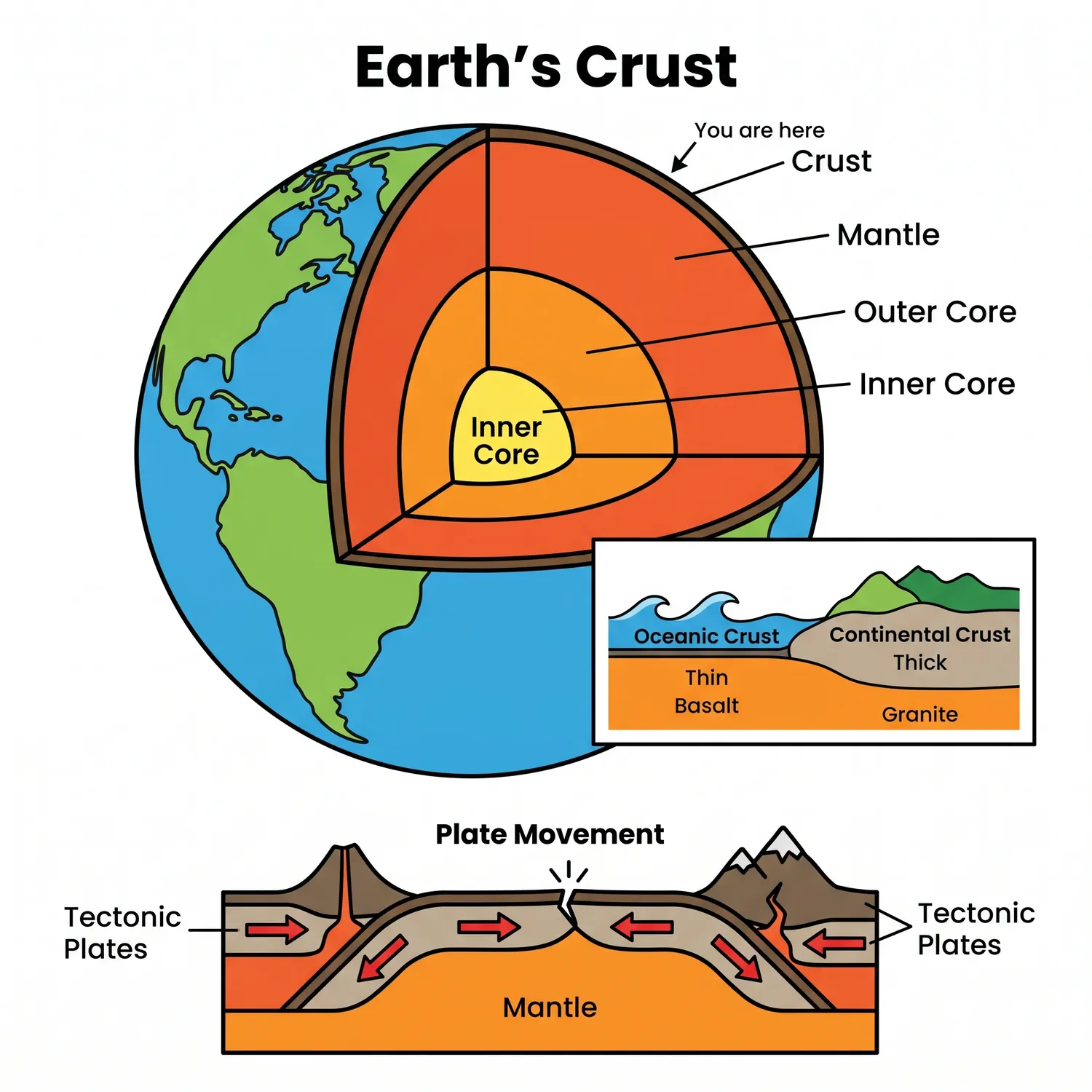
Earth's crust diagram showing layers, tectonic plates, oceanic and continental crust.
Earth's crust, tectonic plates, and crust types explained with simple diagrams.

Earth's crust is the outermost layer of our planet. It is the thin, rocky shell we live on, walk on, and build on every day. The crust may seem thick and solid beneath our feet, but compared to the whole planet, it is incredibly thin. Scientists often compare the crust to the skin on an apple. Just as the apple's skin is a tiny fraction of the whole fruit, Earth's crust is only a small part of the entire planet.

There are two main types of crust on Earth. Oceanic crust lies beneath the oceans and is thinner than the other type. It measures about 5 to 10 kilometers thick. Oceanic crust is also denser, meaning it is heavier for its size. It is made largely of dark, heavy rock called basalt. Continental crust, on the other hand, forms the land where we live. It is much thicker, ranging from 30 to 50 kilometers deep. Continental crust is lighter and less dense than oceanic crust. It is made mostly of rock like granite, which is lighter in color and weight.

The crust is cool and brittle compared to the layers below it. Deep inside Earth, temperatures are extremely high, and the rock behaves differently. The hot layers beneath the crust can flow slowly over time. The crust, however, stays solid and rigid. Because it is brittle, the crust can crack and break when forces push or pull on it. This breaking is an important idea for understanding earthquakes and plate boundaries, where pieces of crust meet and interact.

Evidence shows that the crust is not one continuous piece. Instead, it is broken into large sections called tectonic plates. These plates move slowly over the hotter, softer layer beneath them. Scientists observe that the movement of these plates causes many geological events. Mountains form, volcanoes erupt, and earthquakes occur at the edges of these plates. The crust is the part of Earth we know best, but understanding it in context helps us see how dynamic our planet truly is.

Interesting Fact: The thinnest part of Earth's crust is found at the bottom of the ocean, where it can be as thin as 5 kilometers. The thickest part is beneath mountain ranges like the Himalayas, where it can reach 70 kilometers deep.

Comprehension quiz (10 questions)

1. What is Earth's crust?

The outermost rocky layer of Earth
The hottest layer inside Earth
The liquid layer beneath the oceans
The center core of the planet

2. Which type of crust is thinner and denser?

Continental crust
Oceanic crust
Mountain crust
Granite crust

3. What does the word 'brittle' mean in the passage?

Very hot and flowing
Able to crack or break easily
Thick and heavy
Smooth and flat

4. What rock makes up most of the oceanic crust?

Granite
Limestone
Basalt
Marble

5. Why can the crust crack and break?

Because it is hot and flows like liquid
Because it is cool and brittle
Because it is made only of granite
Because it is the thickest layer of Earth

6. Based on the passage, what can you infer about tectonic plates?

They never move or change position
They are found only in the ocean
Their movement can cause earthquakes and volcanoes
They are all the same size and shape

7. How does the passage compare Earth's crust to an apple?

Both are red and round
The crust is thin like the skin on an apple
Both are made of the same materials
The crust is sweet like an apple

8. If you were building a house, which type of crust would you most likely be building on?

Oceanic crust
Continental crust
Basalt crust
Liquid crust

9. True or False: Continental crust is denser than oceanic crust.

True
False

10. True or False: The crust is broken into large sections called tectonic plates.

True
False
Who it's for

Perfect for the way you teach

Teachers
  • Build comprehension skills
  • Auto-graded quiz
  • Differentiated reading
Parents
  • Read together at home
  • Improve fluency
  • Quiet reading time
Homeschoolers
  • Reading curriculum support
  • Independent practice
  • Track Lexile growth
Topics

Reviews & Ratings

No reviews yet. Be the first to share your experience!

More reading you might love

20 more
Passage
Frost Wedging: How Ice Splits Rock - reading educational content
Grades 5–8

Frost Wedging: How Ice Splits Rock

earth and space science · MS-ESS2-1

$1.50
Passage
Limestone Caves: Nature’s Underground Wonders - reading educational content
Grades 5–8

Limestone Caves: Nature’s Underground Wonders

science · MS-ESS2-1

Free
Passage
Chemical Weathering: The Breakdown of Rocks Through Chemical Reactions - reading educational content
Grades 5–8

Chemical Weathering: The Breakdown of Rocks Through Chemical Reactions

earth and space science · MS-ESS2-1

Free
Passage
Talus Slopes: Formation and Features - reading educational content
Grades 5–8

Talus Slopes: Formation and Features

science · MS-ESS2-1

Free
Passage
Biological Weathering: Types and Examples - reading educational content
Grades 5–8

Biological Weathering: Types and Examples

science · MS-ESS2-1

Free
Passage
The Coldest City in the World: Yakutsk - reading educational content
Grades 5–8

The Coldest City in the World: Yakutsk

weather and climate · MS-ESS2-1

$1.50
Passage
Igneous Rocks - reading educational content
Grades 5–8

Igneous Rocks

earth and space science · MS-ESS2-1

$1.50
Passage
Sedimentary Rocks - reading educational content
Grades 5–8

Sedimentary Rocks

earth and space science · MS-ESS2-1

$1.50
Passage
Metamorphic Rocks - reading educational content
Grades 5–8

Metamorphic Rocks

earth and space science · MS-ESS2-1

Free
Passage
Scientific Inquiry in Earth Science - reading educational content
Grades 5–8

Scientific Inquiry in Earth Science

earth and space science · MS-ESS1-4

$1.50
Passage
Contour Lines and Elevation - reading educational content
Grades 5–8

Contour Lines and Elevation

earth and space science · MS-ESS2-2

$1.50
Passage
Weathering - reading educational content
Grades 5–8

Weathering

earth and space science · MS-ESS2-1

$1.50
Passage
Erosion - reading educational content
Grades 5–8

Erosion

earth and space science · MS-ESS2-1

$1.50
Passage
Stream Erosion and Deposition - reading educational content
Grades 5–8

Stream Erosion and Deposition

earth and space science · MS-ESS2-1

$1.50
Passage
Wind Erosion and Deposition - reading educational content
Grades 5–8

Wind Erosion and Deposition

earth and space science · MS-ESS2-1

$1.50
Passage
Glacial Erosion and Deposition - reading educational content
Grades 5–8

Glacial Erosion and Deposition

earth and space science · MS-ESS2-1

$1.50
Passage
Mass Movements - reading educational content
Grades 5–8

Mass Movements

science · MS-ESS2-1

$1.50
Passage
Soil Formation and Composition - reading educational content
Grades 5–8

Soil Formation and Composition

earth and space science · MS-ESS2-1

$1.50
Passage
Constructive and Destructive Forces - reading educational content
Grades 5–8

Constructive and Destructive Forces

earth and space science · MS-ESS2-1

Free
Passage
Mountains and Mountain Building - reading educational content
Grades 5–8

Mountains and Mountain Building

earth and space science · MS-ESS2-1

$1.50
Copyright © 2026 Workybooks. Made with ♥ in California.