What Is Earth's Inner Core
Interactive passage with audio narration, comprehension questions, and printable PDF.
By completing this purchase you agree to our Terms of Use and Privacy Policy. Your subscription renews automatically until you cancel. You can cancel anytime from your account settings. All sales are final and non-refundable. Digital content is available for download in your account immediately upon purchase.
What's included
What Is Earth's Inner Core preview and details
About this printable What Is Earth's Inner Core science reading passage, NGSS-aligned (Grades 5-8)
Sample passage and quiz from What Is Earth's Inner Core
Reading passage and comprehension quiz preview
What Is Earth's Inner Core
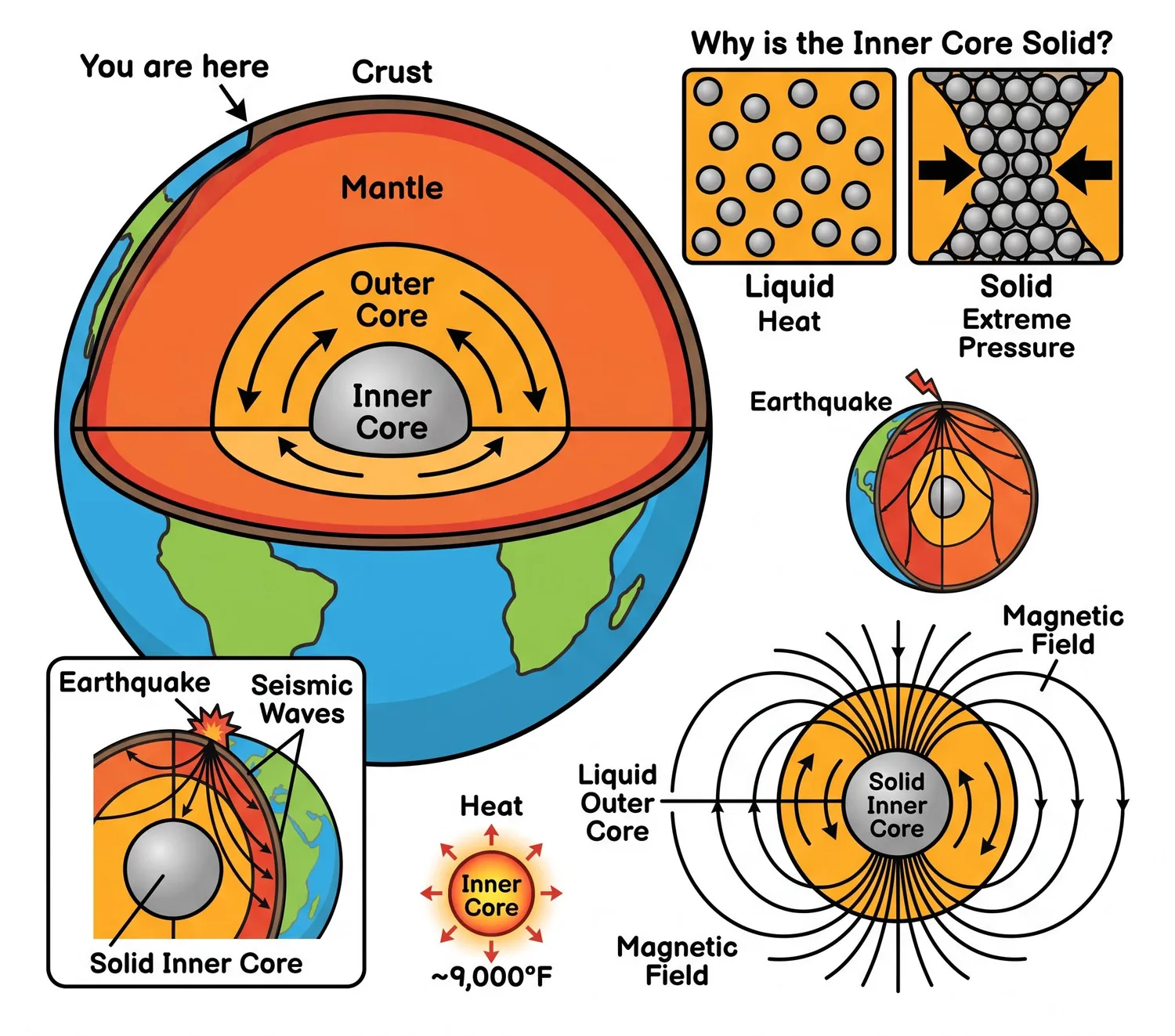
At the very center of our planet sits a solid ball of metal called the inner core. This sphere measures about 1,500 miles across and consists mainly of iron and nickel. Scientists explain that the inner core is the hottest part of Earth, with temperatures reaching about 9,000 degrees Fahrenheit. That's roughly as hot as the surface of the Sun.
Here's the puzzle: if the inner core is so incredibly hot, why isn't it liquid? Heat usually causes materials to melt and flow. The outer core, which surrounds the inner core, contains the same metals but exists as a liquid. Evidence shows that pressure makes the difference. The weight of all the rock and metal above the inner core creates crushing force. This extreme pressure squeezes the iron and nickel atoms so tightly together that they cannot spread apart into a liquid state. Scientists observe that pressure can overcome temperature when conditions become extreme enough.
Researchers study the inner core by analyzing seismic waves from earthquakes. These waves travel through Earth's layers at different speeds depending on whether material is solid or liquid. In 1936, scientist Inge Lehmann analyzed earthquake data and discovered evidence for a solid inner core. Her work showed that certain waves could pass through the center of Earth, which would only happen if that region was solid.
Understanding the inner core matters because it influences Earth's magnetic field. The liquid outer core flows around the solid inner core, generating electrical currents that create our planet's magnetic field. This field protects Earth from harmful solar radiation and helps compasses point north. The inner core may also affect how heat moves through our planet, influencing geological processes at the surface over millions of years.
Interesting Fact: The inner core may be growing very slowly as the outer core cools and solidifies. Scientists estimate it grows about one millimeter per year, adding a thin layer of solid metal to its surface.
Comprehension quiz (10 questions)
1. What two metals make up most of Earth's inner core?
2. Approximately how hot is Earth's inner core?
3. What does the term 'pressure' mean in the context of Earth's inner core?
4. What are seismic waves in this passage?
5. Why does the inner core remain solid despite being extremely hot?
6. Who discovered evidence for Earth's solid inner core in 1936?
7. How does the inner core affect life on Earth's surface?
8. What can scientists infer from studying how seismic waves travel through Earth?
9. True or False: The outer core is liquid even though it contains the same metals as the inner core.
10. True or False: Temperature is the only factor that determines whether a material is solid or liquid.
Perfect for the way you teach
- Build comprehension skills
- Auto-graded quiz
- Differentiated reading
- Read together at home
- Improve fluency
- Quiet reading time
- Reading curriculum support
- Independent practice
- Track Lexile growth