Reading PassagePremium

What Is Earth's Mantle

Interactive passage with audio narration, comprehension questions, and printable PDF.

No ratings yet|
1
Grades 5–8ScienceElaEnglish · SpanishInteractive · Printable
Aligned toMS-ESS2-1
Just this resource
$1.50
One-time purchase
Best value
Unlock everything
$49.99$29.99/yr
40% off until Aug 1 — 10,000+ resources
Renews at $49.99/year.
Unlock above to use these actions

What's included

Reading passage
Audio narration
Comprehension quiz
Writing activity
Glossary & flashcards
Differentiated version
Spanish translation

What Is Earth's Mantle preview and details

About this printable What Is Earth's Mantle science reading passage, NGSS-aligned (Grades 5-8)

science,ela
Written by Workybooks TeamPublished by Workybooks
Preview

Sample passage and quiz from What Is Earth's Mantle

Reading passage and comprehension quiz preview

What Is Earth's Mantle
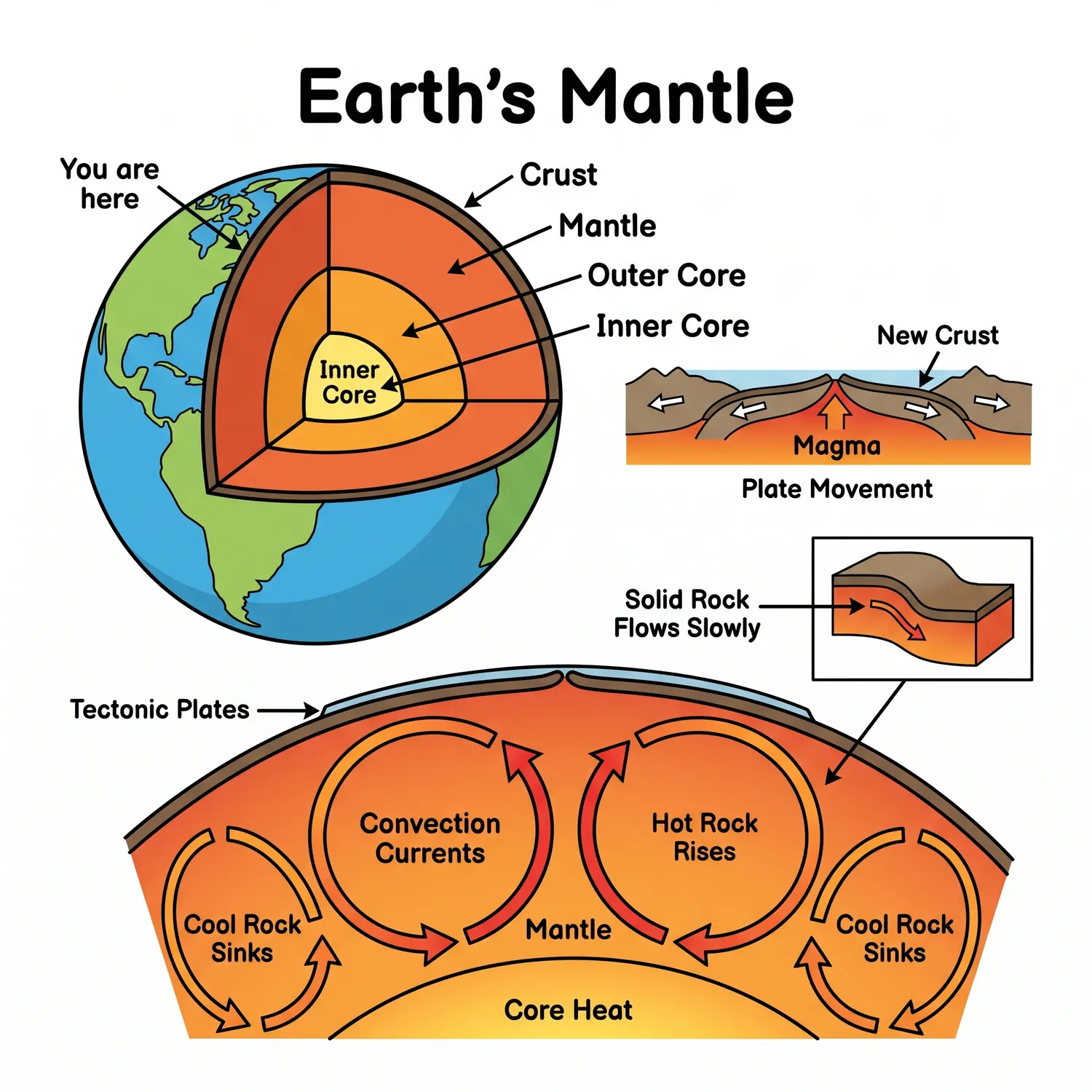
Earth's mantle diagram showing convection currents, tectonic plates, and Earth's interior layers.
Mantle convection drives tectonic plates, volcanoes, and Earth's continuous surface changes.

Earth's mantle is the planet's thickest and most massive layer. It sits between the thin outer crust and the super-hot core at the center. The mantle makes up about 84 percent of Earth's total volume. Scientists explain that this layer extends nearly 2,900 kilometers below the surface. Understanding the mantle helps us explain earthquakes, volcanoes, and mountain formation.

The mantle consists of hot, solid rock that can slowly flow over very long time periods. This may seem strange because we think of solid rock as hard and unchanging. However, the intense heat and pressure deep inside Earth cause mantle rock to behave like extremely thick putty or honey. Scientists observe that mantle rock moves only a few centimeters per year. This slow movement is called plastic deformation. The rock remains solid but flows gradually, much like a glacier moves down a mountain.

Heat from Earth's core keeps the mantle in constant motion through convection currents. Convection works like a pot of thick soup heating on a stove. Hot mantle rock near the core becomes less dense and rises toward the surface. As it rises, the rock cools and becomes denser. The cooler rock then sinks back down toward the core, where it heats up again. This creates giant loops of moving rock that cycle continuously over millions of years. Evidence shows these convection currents are the hidden engine powering Earth's surface changes.

These slow-moving currents in the mantle drag Earth's tectonic plates across the surface. The plates carry continents and ocean floors with them as they move. Scientists have measured that plates move at rates similar to fingernail growth, about 2 to 10 centimeters per year. At the Mid-Atlantic Ridge, for example, convection currents push the North American and Eurasian plates apart. This spreading creates new ocean floor and causes the Atlantic Ocean to widen slightly each year. The mantle's movement drives the rock cycle, builds mountains, and triggers volcanic eruptions.

The mantle matters because it connects Earth's hot interior to the surface where we live. Without mantle convection, our planet would be geologically dead. There would be no earthquakes, no volcanoes, and no plate movement. The continents would not shift, and mountains would not form. The mantle's churning motion recycles Earth's materials and helps regulate the planet's temperature over geological time. This massive layer truly powers the dynamic Earth system.

Interesting Fact: The mantle contains a mineral called bridgmanite, which scientists estimate is the most abundant mineral on Earth. However, it only exists under the extreme pressure found deep in the mantle.

Comprehension quiz (10 questions)

1. What percentage of Earth's total volume does the mantle make up?

50 percent
84 percent
25 percent
95 percent

2. How does mantle rock behave despite being solid?

It breaks into small pieces
It melts completely into liquid
It flows slowly like thick putty
It stays completely still

3. What does the term 'convection currents' mean in the context of Earth's mantle?

Electric currents that flow through rocks
Circular movements where hot rock rises and cool rock sinks
Water currents that flow underground
Magnetic fields inside the Earth

4. What does 'plastic deformation' refer to in the passage?

Rock breaking apart into fragments
Rock melting into liquid magma
Solid rock flowing slowly under heat and pressure
Rock turning into plastic material

5. Why do convection currents form in the mantle?

Because Earth rotates on its axis
Because the moon pulls on Earth's rocks
Because heat from the core causes hot rock to rise and cool rock to sink
Because ocean water seeps into the mantle

6. How does mantle convection affect Earth's tectonic plates?

It keeps the plates completely still
It drags the plates across Earth's surface
It melts the plates into liquid
It makes the plates float in the ocean

7. At approximately what rate do tectonic plates move each year?

Several meters per year
About 2 to 10 centimeters per year
About 100 kilometers per year
Less than 1 millimeter per year

8. What would happen to Earth without mantle convection?

The planet would become geologically active with more volcanoes
The oceans would disappear
The planet would be geologically dead with no earthquakes or volcanoes
The continents would move faster

9. The mantle is located between Earth's crust and core.

True
False

10. Bridgmanite can exist anywhere on Earth's surface.

True
False
Who it's for

Perfect for the way you teach

Teachers
  • Build comprehension skills
  • Auto-graded quiz
  • Differentiated reading
Parents
  • Read together at home
  • Improve fluency
  • Quiet reading time
Homeschoolers
  • Reading curriculum support
  • Independent practice
  • Track Lexile growth
Topics

Reviews & Ratings

No reviews yet. Be the first to share your experience!

More reading you might love

20 more
Passage
Frost Wedging: How Ice Splits Rock - reading educational content
Grades 5–8

Frost Wedging: How Ice Splits Rock

earth and space science · MS-ESS2-1

$1.50
Passage
Limestone Caves: Nature’s Underground Wonders - reading educational content
Grades 5–8

Limestone Caves: Nature’s Underground Wonders

science · MS-ESS2-1

Free
Passage
Chemical Weathering: The Breakdown of Rocks Through Chemical Reactions - reading educational content
Grades 5–8

Chemical Weathering: The Breakdown of Rocks Through Chemical Reactions

earth and space science · MS-ESS2-1

Free
Passage
Talus Slopes: Formation and Features - reading educational content
Grades 5–8

Talus Slopes: Formation and Features

science · MS-ESS2-1

Free
Passage
Biological Weathering: Types and Examples - reading educational content
Grades 5–8

Biological Weathering: Types and Examples

science · MS-ESS2-1

Free
Passage
The Coldest City in the World: Yakutsk - reading educational content
Grades 5–8

The Coldest City in the World: Yakutsk

weather and climate · MS-ESS2-1

$1.50
Passage
Igneous Rocks - reading educational content
Grades 5–8

Igneous Rocks

earth and space science · MS-ESS2-1

$1.50
Passage
Sedimentary Rocks - reading educational content
Grades 5–8

Sedimentary Rocks

earth and space science · MS-ESS2-1

$1.50
Passage
Metamorphic Rocks - reading educational content
Grades 5–8

Metamorphic Rocks

earth and space science · MS-ESS2-1

Free
Passage
Scientific Inquiry in Earth Science - reading educational content
Grades 5–8

Scientific Inquiry in Earth Science

earth and space science · MS-ESS1-4

$1.50
Passage
Contour Lines and Elevation - reading educational content
Grades 5–8

Contour Lines and Elevation

earth and space science · MS-ESS2-2

$1.50
Passage
Weathering - reading educational content
Grades 5–8

Weathering

earth and space science · MS-ESS2-1

$1.50
Passage
Erosion - reading educational content
Grades 5–8

Erosion

earth and space science · MS-ESS2-1

$1.50
Passage
Stream Erosion and Deposition - reading educational content
Grades 5–8

Stream Erosion and Deposition

earth and space science · MS-ESS2-1

$1.50
Passage
Wind Erosion and Deposition - reading educational content
Grades 5–8

Wind Erosion and Deposition

earth and space science · MS-ESS2-1

$1.50
Passage
Glacial Erosion and Deposition - reading educational content
Grades 5–8

Glacial Erosion and Deposition

earth and space science · MS-ESS2-1

$1.50
Passage
Mass Movements - reading educational content
Grades 5–8

Mass Movements

science · MS-ESS2-1

$1.50
Passage
Soil Formation and Composition - reading educational content
Grades 5–8

Soil Formation and Composition

earth and space science · MS-ESS2-1

$1.50
Passage
Constructive and Destructive Forces - reading educational content
Grades 5–8

Constructive and Destructive Forces

earth and space science · MS-ESS2-1

Free
Passage
Mountains and Mountain Building - reading educational content
Grades 5–8

Mountains and Mountain Building

earth and space science · MS-ESS2-1

$1.50
Copyright © 2026 Workybooks. Made with ♥ in California.