What Is Earth's Outer Core
Interactive passage with audio narration, comprehension questions, and printable PDF.
By completing this purchase you agree to our Terms of Use and Privacy Policy. Your subscription renews automatically until you cancel. You can cancel anytime from your account settings. All sales are final and non-refundable. Digital content is available for download in your account immediately upon purchase.
What's included
What Is Earth's Outer Core preview and details
About this printable What Is Earth's Outer Core science reading passage, NGSS-aligned (Grades 5-8)
Sample passage and quiz from What Is Earth's Outer Core
Reading passage and comprehension quiz preview
What Is Earth's Outer Core
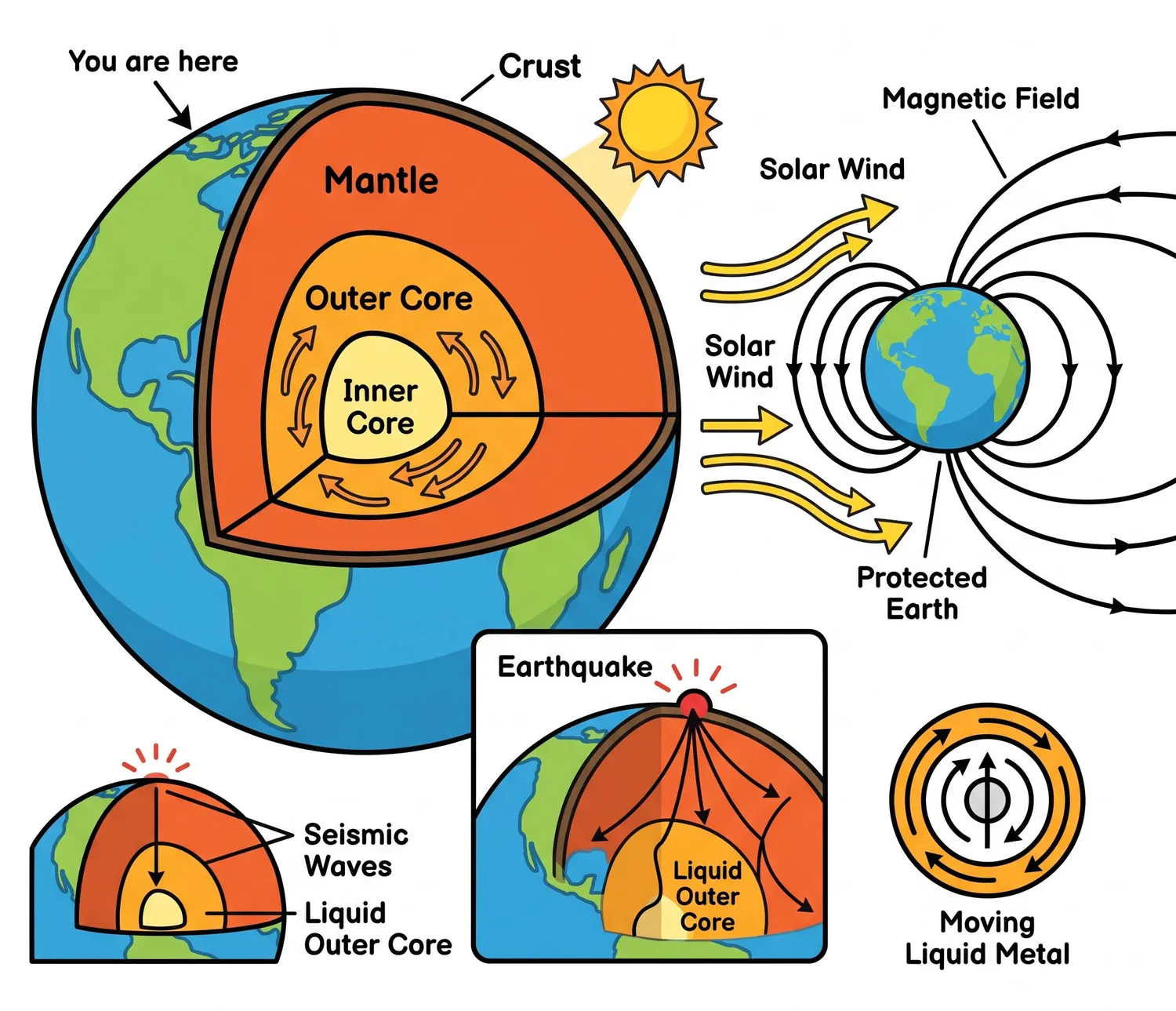
Earth's outer core is a layer of liquid metal located beneath the mantle. This layer extends from about 2,900 kilometers below the surface to a depth of 5,150 kilometers. The outer core consists mostly of iron and nickel, two metals that are solid at Earth's surface but behave very differently under extreme conditions deep inside the planet.
The outer core remains liquid because of incredibly high temperatures that reach between 4,000 and 5,000 degrees Celsius. Even though the pressure at this depth is enormous, the heat is intense enough to keep the metal melted. Scientists explain that this creates a vast ocean of molten metal, constantly moving and flowing. Evidence shows that as Earth rotates, the liquid metal in the outer core swirls in complex patterns, somewhat like water stirring in a spinning bucket.
This swirling motion of liquid metal produces Earth's magnetic field through a process called the geodynamo. Moving liquid metal acts like a giant electrical generator deep inside the planet. The magnetic field extends far beyond Earth's surface into space, creating an invisible shield called the magnetosphere. This protective barrier deflects harmful solar radiation and charged particles from the sun that could damage living things.
Scientists observe the outer core indirectly because no one can travel that deep into Earth. They study seismic waves from earthquakes that travel through the planet. Certain waves cannot pass through liquids, and when these waves stop at the outer core boundary, scientists can determine that this layer must be liquid. In 1906, British scientist Richard Dixon Oldham first identified evidence of Earth's liquid outer core by analyzing how earthquake waves behaved.
The outer core matters because it creates the magnetic field that makes compasses work and protects Earth from dangerous space weather. Without this liquid metal layer constantly moving and generating magnetism, solar wind could strip away the atmosphere over time. The outer core connects to systems we observe every day, even though it lies thousands of kilometers beneath our feet.
Interesting Fact: Earth's magnetic field flips direction every few hundred thousand years, with the north and south magnetic poles switching places. Evidence from ancient rocks shows this has happened at least 183 times in the last 83 million years.
Comprehension quiz (10 questions)
1. What two metals make up most of Earth's outer core?
2. Why does the outer core remain liquid despite the enormous pressure?
3. What is the geodynamo?
4. How do scientists study the outer core if they cannot travel there?
5. What does the magnetosphere do for Earth?
6. In the passage, what does the word 'deflects' mean when describing how the magnetic field protects Earth?
7. Based on the passage, why would Earth be less protected without the outer core?
8. If another planet had a solid metal core instead of a liquid one, what would likely be different?
9. The outer core is located directly beneath Earth's mantle.
10. Earth's magnetic field has never changed direction throughout the planet's history.
Perfect for the way you teach
- Build comprehension skills
- Auto-graded quiz
- Differentiated reading
- Read together at home
- Improve fluency
- Quiet reading time
- Reading curriculum support
- Independent practice
- Track Lexile growth