What is Halley's Comet Made Of? — Reading Comprehension
Rate this
Premium Resource
Present
Present in classroom. No work saved
Assign
Classroom with student accounts, Track progress
Quick Play
No student accounts, assign with a link
Grades
6
PRINT+DIGITAL RESOURCE
This learning resource is available in interactive and printable formats. The interactive worksheet can be played online and assigned to students. The Printable PDF version can be downloaded and printed for completion by hand.
This educational reading passage, 'What is Halley's Comet Made Of?', delves into the fascinating composition of one of the most famous celestial bodies. Designed for a Grade 6 reading level, it explains the 'dirty snowball' theory, describing how comets like Halley's Comet are primarily made of ice, dust, and rock. Students will learn about the different parts of a comet, such as its nucleus, coma, and tail, and how they interact with the sun. The passage incorporates relevant SEO keywords like 'comet composition,' 'solar system objects,' and 'celestial bodies' to enhance discoverability. It directly supports the NGSS Disciplinary Core Idea MS-ESS1-3, which focuses on analyzing and interpreting data to determine scale properties of objects in the solar system. This audio-integrated resource provides an engaging way for students to understand the characteristics and properties of comets.
CONTENT PREVIEW
Expand content preview
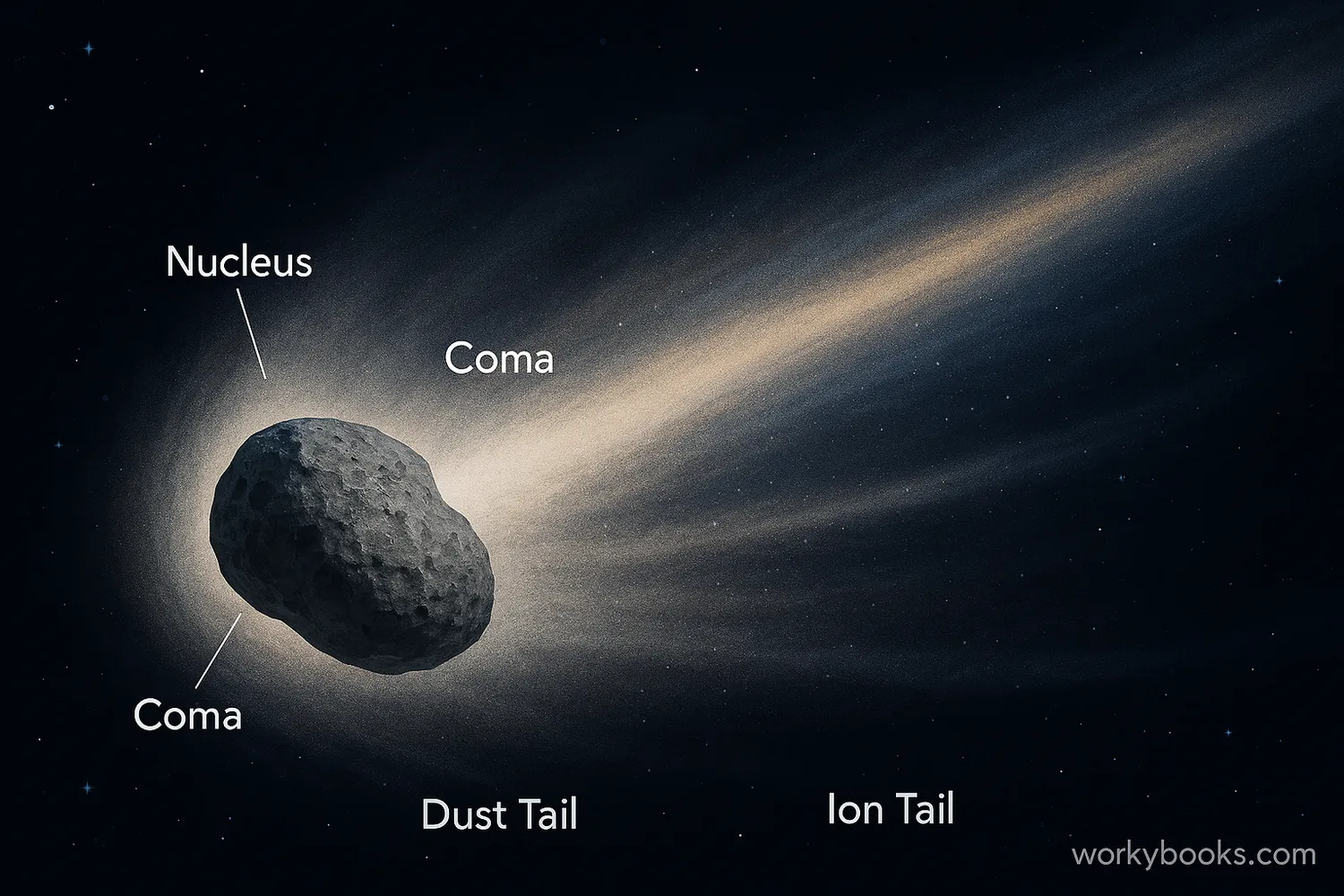
Halley's Comet showing its nucleus, coma, and two tails as it nears the Sun.
Have you ever heard of a "dirty snowball" in space? That's one way scientists describe comets, especially famous ones like Halley's Comet. This incredible celestial traveler has been observed for thousands of years, captivating people on Earth as it journeys through our solar system.
So, what exactly is Halley's Comet made of? At its heart is the nucleus. Think of the nucleus as the main body of the comet. For Halley's Comet, this nucleus is not perfectly round; it's shaped more like a potato, about 15 kilometers (9 miles) long and 8 kilometers (5 miles) wide. It's a mix of frozen gases, ice, rock, and dust. The ice isn't just water ice; it also includes frozen carbon dioxide, methane, and ammonia. These are the main ingredients of the "snowball" part.
The "dirty" part comes from the dust and rocky materials mixed in with the ice. This dust is incredibly fine, like talcum powder. Scientists believe that comets are leftover materials from when our solar system first formed, billions of years ago. Studying their composition helps us understand the early universe.
As Halley's Comet gets closer to the Sun during its orbit, the Sun's heat causes the ice in its nucleus to turn directly into gas. This process is called sublimation. As the gases escape, they carry small particles of dust with them, forming a huge cloud around the nucleus called the coma. This coma can be hundreds of thousands of kilometers across! The pressure from sunlight and solar wind then pushes these gases and dust away from the Sun, creating the comet's spectacular tail. Comets often have two tails: a dust tail and an ion (gas) tail, which point in slightly different directions.
Halley's Comet is a periodic comet, meaning it returns to our inner solar system on a regular schedule, roughly every 75-76 years. Its next visit is expected in 2061. Understanding its makeup helps astronomers learn about the scale properties of objects in the solar system.
Interesting Fact: Halley's Comet is named after astronomer Edmond Halley, who was the first to realize that comets seen in 1531, 1607, and 1682 were actually the same object returning.
What is the primary shape of Halley's Comet's nucleus?
Potato-likePerfectly roundSquareStar-shaped
What is the process called when ice turns directly into gas?
SublimationMeltingFreezingEvaporation
What can scientists learn by studying comet composition?
Early universePlanet colorsStar distancesMoon phases
How often does Halley's Comet return?
Every 75-76 yearsEvery 10 yearsEvery 200 yearsEvery 5 years
What part of a comet is a huge cloud around the nucleus?
ComaTailCoreOrbit
Why is a comet called a 'dirty snowball'?
Ice, dust, rockMud and snowWet and darkOnly ice
The coma forms before the tail becomes visible.
TrueFalse
If a comet never got close to the Sun, it would likely never develop a visible tail.
TrueFalse
What does 'periodic comet' mean?
Returns regularlyAlways visibleOne-time visitorHas no tail
How does solar wind affect a comet's tail?
Pushes it awayPulls it closerMakes it brighterMakes it spin
Perfect For:
👩🏫 Teachers
• Reading comprehension practice
• Auto-graded assessments
• Literacy skill development
👨👩👧👦 Parents
• Reading practice at home
• Comprehension improvement
• Educational reading time
🏠 Homeschoolers
• Reading curriculum support
• Independent reading practice
• Progress monitoring
Reading Features:
📖
Reading Passage
Engaging fiction or nonfiction text
❓
Comprehension Quiz
Auto-graded questions
📊
Instant Feedback
Immediate results and scoring
📄
Printable Version
Download for offline reading
🔊
Read Aloud
Voice-over with word highlighting
Reviews & Ratings
No reviews yet. Be the first to share your experience!
Related Content
Earth: Our Home in Space
This engaging Grade 4-5 science passage, aligned to NGSS, introduces students to Earth's special place in the solar syst...
Tools and Technology in Earth Science
This middle school science reading passage explores the wide range of tools and technologies used in Earth science, from...
MS-ESS2-2MS-ESS3-2MS-ETS1-1MS-PS4-3
Earth's Place in the Universe
This reading passage explains Earth's place in the universe, supporting NGSS 1-ESS1-1. It describes how Earth is one of ...
1-ESS1-1
Scientific Inquiry in Earth Science
This passage explores scientific inquiry in Earth science for grades 6-8, aligned with NGSS standards MS-ESS1-4, MS-ESS2...
MS-ESS1-4MS-ESS2-1MS-ESS3-5SEP
What Is Space Weather and How Does It Affect the Earth?
This NGSS-aligned science passage for middle school explains what space weather is and how it affects Earth. Students le...
MS-ESS2-2
Escape Velocity and Space Travel
This middle school science passage introduces students to the concept of escape velocity—the minimum speed required to b...
MS-ESS1-2MS-PS2-4
Space Stations
This informational science reading passage for grades 6-8 explores the complex systems and technology behind space stati...
MS-ESS1-3MS-ETS1-1
What Is Earth Science?
This engaging middle school science passage introduces students to the field of Earth science, aligning with NGSS standa...
MS-ESS1MS-ESS2MS-ESS3SEP
The Space Garden
This innovative passage combines plant science with space exploration, aligning with NGSS standards for life sciences an...
RL.3.1RL.2.1RL.4.9
Measuring Distances in Space
This middle school science passage explores how astronomers measure the vast distances in space, aligning with NGSS stan...
MS-ESS1-3
Earth: Our Home Planet
This comprehensive science passage for grades 6-8 explores Earth’s unique characteristics and the interconnected systems...
MS-ESS1-2
Meteorite Impacts on Earth
This engaging science reading passage for Grades 4-5 explores meteorite impacts on Earth, aligning with NGSS standards. ...
Earth's Rotation
This middle school science passage, aligned with NGSS standard MS-ESS1-1, focuses on Earth's rotation—how Earth spins on...
MS-ESS1-1
Exploring Space: Rockets and Spacecraft
Space exploration has been one of humanity's greatest achievements, made possible by rockets and spacecraft. Rockets act...
RI.4.4RI.4.2
Facts About Earth
This engaging science reading passage introduces Grade 4 and 5 students to Earth, our home planet. Aligned with NGSS sta...
Earth's Moon Facts
This engaging science passage, 'The Moon: Earth's Companion,' is designed for Grade 4-5 students and aligns with NGSS ge...
International Space Station
Discover the wonders of the International Space Station with this informative coloring page showcasing the orbiting outpost where astronauts live and work in space. As children color the complex modul...
Venus: Earth's Twin?
This comprehensive science passage for grades 6-8 examines Venus—often called Earth's twin—by exploring its similarities...
MS-ESS1-2MS-ESS1-3
Earth's Seasons
This comprehensive reading passage for grades 6-8 explains why Earth has seasons, revealing the scientific mechanisms be...
MS-ESS1-1
What Makes Earth Perfect for Life?
This Grade 4-5 science passage, aligned with NGSS standards, explores the essential features that make Earth the perfect...