What Is The Difference Between Melting Sea Ice And Land Ice? — Reading Comprehension
Rate this
Premium Resource
Present
Present in classroom. No work saved
Assign
Classroom with student accounts, Track progress
Quick Play
No student accounts, assign with a link
Grades
6
PRINT+DIGITAL RESOURCE
This learning resource is available in interactive and printable formats. The interactive worksheet can be played online and assigned to students. The Printable PDF version can be downloaded and printed for completion by hand.
This educational passage, audio integrated for an enhanced learning experience, explores the crucial differences between melting sea ice and land ice. It delves into how each type of melting ice impacts Earth's systems, specifically focusing on global sea levels and climate patterns. Students will learn about the **polar regions**, the **cryosphere**, and the concept of **thermal expansion**, which are vital for understanding **climate change** and **global warming**. The content is tailored for a 6th-grade reading level, using simple language to explain complex scientific concepts related to **Earth's energy balance** and how variations in energy flow lead to climate changes, directly aligning with NGSS standard HS-ESS2-4. The activities reinforce comprehension and critical thinking.
CONTENT PREVIEW
Expand content preview
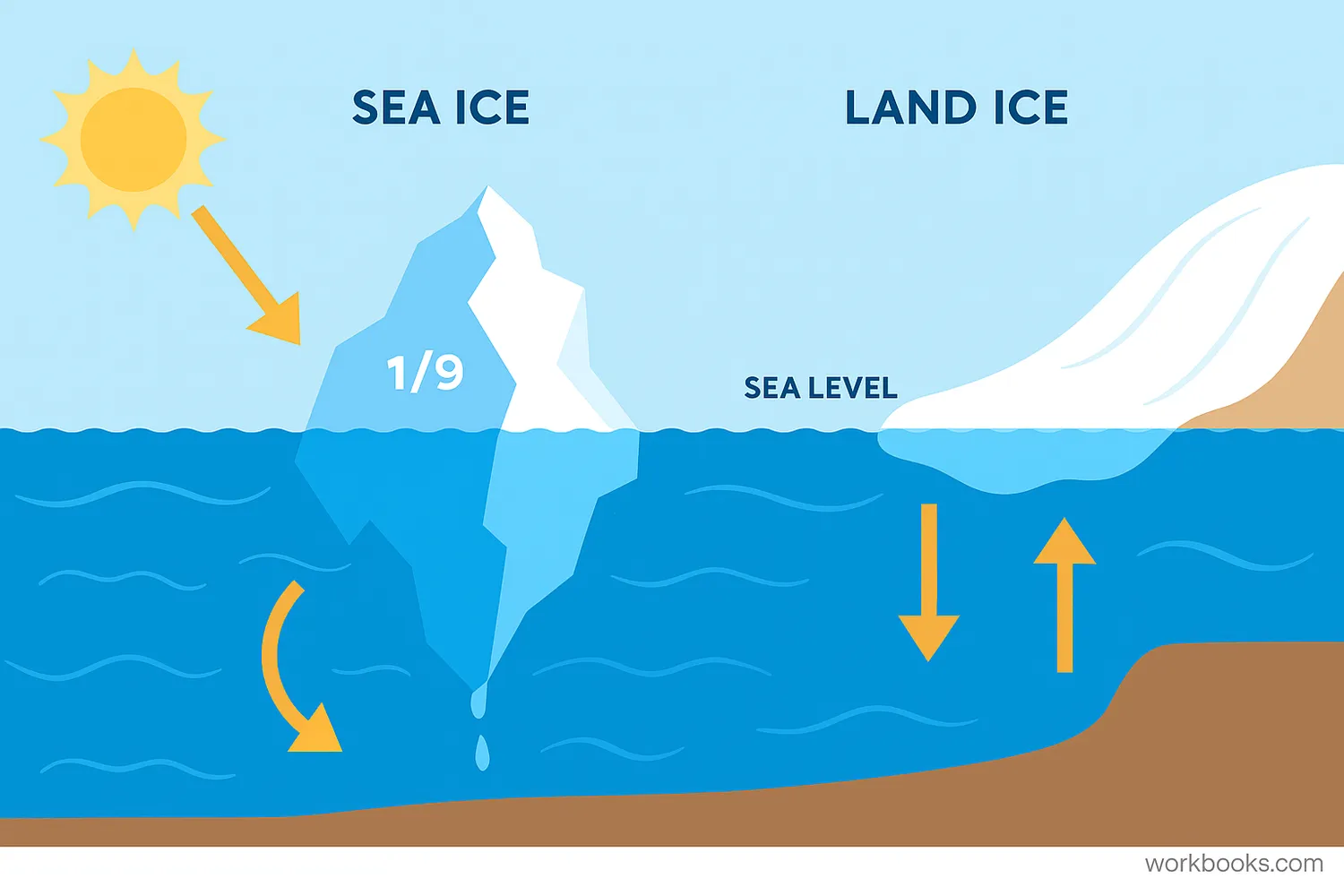
Sea ice floats; land ice melts into oceans, raising sea levels and warming Earth.
When we talk about climate change and global warming, melting ice is a big topic. But did you know there's a huge difference between melting sea ice and melting land ice? Understanding this difference is key to understanding how Earth's systems are changing.
First, let's talk about sea ice. Sea ice forms when the ocean's surface water freezes. Think of it like ice cubes in a glass of water. When these ice cubes melt, the water level in the glass doesn't really change because the ice was already part of the water. Similarly, when sea ice melts, it doesn't cause a significant rise in global sea levels. This is because the ice was already floating in the ocean and its mass was already displacing water. Sea ice is found in the Arctic Ocean and around Antarctica. While melting sea ice doesn't directly raise sea levels, it does impact Earth's climate. White sea ice reflects a lot of sunlight, helping to keep the polar regions cool. When it melts, darker ocean water is exposed, which absorbs more sunlight. This absorption leads to warmer oceans, which then melts more ice, creating a cycle known as the ice-albedo feedback loop.
Now, let's look at land ice. Land ice includes glaciers and ice sheets that sit on land, like those in Greenland and Antarctica. Imagine dropping new ice cubes into an empty glass. When those ice cubes melt, they add new water to the glass, making the water level rise. This is exactly what happens with melting land ice. As glaciers and ice sheets melt, the water flows into the oceans, adding new water and causing global sea levels to rise. This is a major concern for coastal communities around the world. The cryosphere, which includes all the frozen parts of Earth, is losing a lot of its land ice.
Another factor contributing to sea level rise is thermal expansion. As ocean water gets warmer from climate change, it expands, taking up more space. So, it's not just the added water from melting land ice, but also the expanding water that causes sea levels to climb. Both melting sea ice and land ice are strong indicators of how the flow of energy into and out of Earth's systems is changing, leading to significant climate changes.
Interesting Fact: The largest ice sheet on Earth is the Antarctic Ice Sheet, which covers about 98% of the Antarctic continent and contains about 90% of the world's freshwater ice.
Which type of ice causes global sea levels to rise directly when it melts?
Land iceSea iceIce cubesOcean water
What does white sea ice do to sunlight?
Absorbs itReflects itCreates itIgnores it
If a large glacier melts, what happens to the ocean?
Gets colderLevel dropsLevel risesGets saltier
Why does melting sea ice not significantly raise sea levels?
It's too smallIt's already in waterIt evaporatesIt refreezes
What is the 'ice-albedo feedback loop'?
Ice forming fasterMore reflectionMelting leads to warmingWater getting colder
How does warmer ocean water contribute to sea level rise?
Melting land ice and sea ice both indicate changes in Earth's energy.
TrueFalse
What is another name for all frozen parts of Earth?
HydrosphereCryosphereAtmosphereBiosphere
Why is melting land ice a major concern?
Makes land wetterRaises global sea levelsChanges ocean colorMakes rivers dry
Perfect For:
👩🏫 Teachers
• Reading comprehension practice
• Auto-graded assessments
• Literacy skill development
👨👩👧👦 Parents
• Reading practice at home
• Comprehension improvement
• Educational reading time
🏠 Homeschoolers
• Reading curriculum support
• Independent reading practice
• Progress monitoring
Reading Features:
📖
Reading Passage
Engaging fiction or nonfiction text
❓
Comprehension Quiz
Auto-graded questions
📊
Instant Feedback
Immediate results and scoring
📄
Printable Version
Download for offline reading
🔊
Read Aloud
Voice-over with word highlighting
Reviews & Ratings
No reviews yet. Be the first to share your experience!
Related Content
Tools and Technology in Earth Science
This middle school science reading passage explores the wide range of tools and technologies used in Earth science, from...
MS-ESS2-2MS-ESS3-2MS-ETS1-1MS-PS4-3
Scientific Inquiry in Earth Science
This passage explores scientific inquiry in Earth science for grades 6-8, aligned with NGSS standards MS-ESS1-4, MS-ESS2...
MS-ESS1-4MS-ESS2-1MS-ESS3-5SEP
What Is Earth Science?
This engaging middle school science passage introduces students to the field of Earth science, aligning with NGSS standa...
MS-ESS1MS-ESS2MS-ESS3SEP
Earth: Our Home in Space
This engaging Grade 4-5 science passage, aligned to NGSS, introduces students to Earth's special place in the solar syst...
Earth's Spheres
This middle school science passage introduces students to Earth's four major spheres: the geosphere, hydrosphere, atmosp...
MS-ESS2-4MS-ESS2-6
What Is Space Weather and How Does It Affect the Earth?
This NGSS-aligned science passage for middle school explains what space weather is and how it affects Earth. Students le...
MS-ESS2-2
Earth's Energy Balance
This engaging, NGSS-aligned science passage for grades 6–8 explores Earth's energy balance, a key process that keeps our...
MS-ESS2-6
Earth's Rotation
This middle school science passage, aligned with NGSS standard MS-ESS1-1, focuses on Earth's rotation—how Earth spins on...
MS-ESS1-1
Earth's Interior
This comprehensive passage for grades 6-8 explores Earth's layered interior, including the crust, mantle, outer core, an...
MS-ESS2-1MS-ESS2-2
Facts About Earth
This engaging science reading passage introduces Grade 4 and 5 students to Earth, our home planet. Aligned with NGSS sta...
Meteorite Impacts on Earth
This engaging science reading passage for Grades 4-5 explores meteorite impacts on Earth, aligning with NGSS standards. ...
Venus: Earth's Twin?
This comprehensive science passage for grades 6-8 examines Venus—often called Earth's twin—by exploring its similarities...
MS-ESS1-2MS-ESS1-3
Earth Changes Over Millions of Years
This engaging, audio-integrated science passage for Grade 4-5 students explores how Earth has changed over millions of y...
Earth's Quick and Slow Changes
In 'Earth's Quick and Slow Changes,' students categorize 12 Earth events by their speed of occurrence, enhancing underst...
Earth's Moon Facts
This engaging science passage, 'The Moon: Earth's Companion,' is designed for Grade 4-5 students and aligns with NGSS ge...
Earth: Our Home Planet
This comprehensive science passage for grades 6-8 explores Earth’s unique characteristics and the interconnected systems...
MS-ESS1-2
Earth's Revolution
This middle school science passage explores the science behind Earth's revolution around the Sun, closely aligned with N...
MS-ESS1-1
Earth's Seasons
This comprehensive reading passage for grades 6-8 explains why Earth has seasons, revealing the scientific mechanisms be...
MS-ESS1-1
Earth's Place in the Universe
This reading passage explains Earth's place in the universe, supporting NGSS 1-ESS1-1. It describes how Earth is one of ...
1-ESS1-1
Aphelion and Perihelion
This engaging reading passage, 'Aphelion and Perihelion,' delves into the fascinating aspects of Earth's elliptical orbi...
MS-ESS1-1: DEVELOP AND USE A MODEL OF THE EARTH-SUN-MOON SYSTEM TO DESCRIBE THE CYCLIC PATTERNS OF LUNAR PHASESECLIPSES OF THE SUN AND MOONAND SEASONS.