What is the Hottest Layer of the Atmosphere — Reading Comprehension
Rate this|
11
Present
Present in classroom. No work saved
Assign
Classroom with student accounts, Track progress
Quick Play
No student accounts, assign with a link
Grades
3
4
5
6
7
8
PRINT+DIGITAL RESOURCE
This learning resource is available in interactive and printable formats. The interactive worksheet can be played online and assigned to students. The Printable PDF version can be downloaded and printed for completion by hand.
This reading passage delves into the thermosphere, the hottest layer of Earth's atmosphere, and its fascinating characteristics. It is designed for middle school students (grades 6-8) and aligns with the NGSS standards related to Earth's systems. The passage explains why the thermosphere reaches extreme temperatures, the role of the ionosphere in radio communication, and the cause of the aurora. It also connects the thermosphere to real-world applications like the orbit of the International Space Station. The content uses clear, factual language, bolding key terms, and is structured to aid comprehension for self-study. The passage includes engaging examples and a fun fact to reinforce key concepts, making it a valuable educational resource for students studying atmospheric science.
CONTENT PREVIEW
Expand content preview
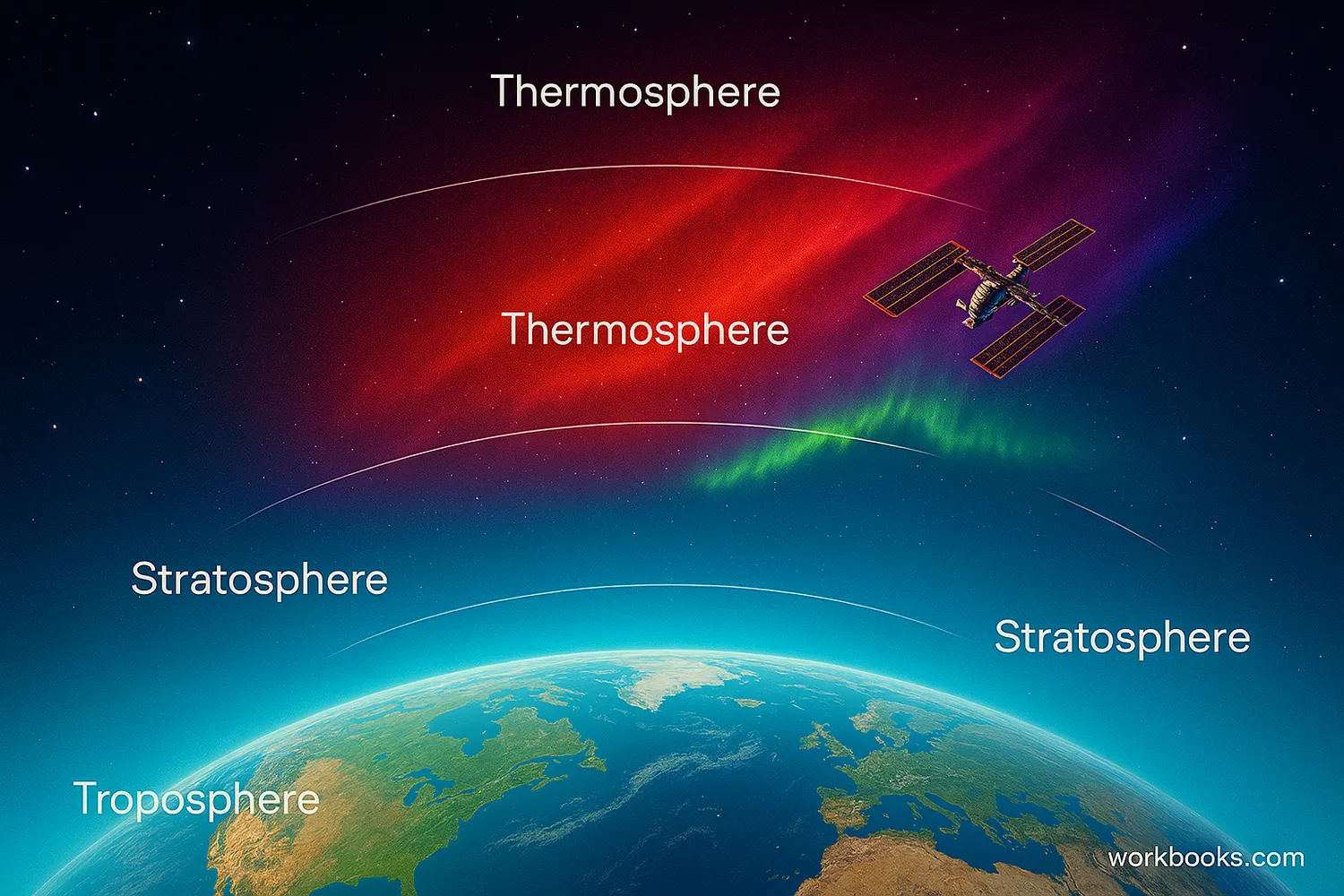
The thermosphere, Earth's hottest atmospheric layer, and the location of the International Space Station's orbit.
The Earth's atmosphere is a protective blanket of gases, divided into several distinct layers. While you might think the layers closest to the ground are the warmest, the highest layer, the thermosphere, is actually the hottest. This is because the thermosphere absorbs high-energy solar radiation, such as X-rays and ultraviolet (UV) light, which causes the temperature to soar. Although the temperature can reach thousands of degrees Celsius, a thermometer would feel extremely cold here. The reason is the air density. There are so few gas molecules, spaced so far apart, that they do not transfer much heat to an object, such as a thermometer.
The thermosphere is located above the mesosphere and extends from about 90 km to between 500 and 1,000 km above Earth's surface. Within this layer is the ionosphere, a region of the atmosphere that is full of charged particles, or ions. The ions are created when the Sun’s high-energy radiation strips electrons from gas molecules. The ionosphere is crucial for our lives on Earth. It is the region where radio waves are reflected, allowing for long-distance radio communication. Without the ionosphere, radio signals would simply travel out into space.
A well-known phenomenon that occurs in the thermosphere is the aurora. These spectacular light shows, also known as the Northern and Southern Lights, are created when charged particles from the Sun collide with atoms and molecules in the thermosphere. These collisions excite the atmospheric gases, causing them to emit light. This process is similar to how a neon sign works. The specific color of the aurora depends on the type of gas molecule being hit and the altitude. For example, collisions with oxygen often produce a greenish glow, while nitrogen can create a red or purple hue.
The thermosphere is also where the International Space Station (ISS) orbits Earth. The extremely low density of the air at this altitude means there is very little drag, allowing the ISS to maintain its speed and orbit for extended periods. The low air density is also why we don't feel the extreme heat of the thermosphere on Earth.
Fun Fact: The thermosphere is where meteors and space debris burn up. The friction with the sparse air molecules, even though they are few, is enough to cause the object to heat up and glow brightly as it enters this layer.
Which of the following is the primary reason the thermosphere is the hottest layer of the atmosphere?
It is the closest layer to the Sun.It absorbs high-energy solar radiation.It has the highest concentration of greenhouse gases.It contains the most dense air molecules.
The ionosphere is an important part of the thermosphere because it is responsible for what?
Protecting us from meteors.Generating the Earth's magnetic field.Reflecting radio waves for communication.Creating weather patterns.
Based on the passage, why would a thermometer register a very cold temperature in the thermosphere despite the high temperatures?
The thermometer is not designed for that altitude.The gas molecules are spaced too far apart.The Sun's energy is not strong enough to heat the thermometer.The Earth's core is too far away to provide heat.
Which phenomenon is directly caused by charged particles from the Sun colliding with atmospheric gases in the thermosphere?
Solar eclipsesThe auroraThunderstormsThe formation of clouds
A scientist is studying a new type of radio communication that requires signals to bounce off a specific atmospheric layer to travel long distances. Which layer would the scientist most likely be focusing on?
MesosphereTroposphereStratosphereThermosphere
What is the main idea of the passage?
The thermosphere is the most important layer of the atmosphere for living things.The thermosphere is the hottest layer of the atmosphere due to solar radiation and is home to unique phenomena like the aurora.The different layers of the atmosphere are defined by their temperature.The International Space Station orbits in the thermosphere to avoid the heat.
What is the primary role of the thermosphere in absorbing radiation?
It absorbs harmful X-rays and UV light from the sun.It traps greenhouse gases, warming the planet.It absorbs cosmic rays from deep space.It reflects visible light, causing the sky to appear blue.
What makes the aurora so colorful?
The different types of gas molecules that are hit by solar particles.The varying speeds of the solar particles.The reflection of sunlight off of water vapor.The way the Earth's magnetic field bends the light.
Perfect For:
👩🏫 Teachers
• Reading comprehension practice
• Auto-graded assessments
• Literacy skill development
👨👩👧👦 Parents
• Reading practice at home
• Comprehension improvement
• Educational reading time
🏠 Homeschoolers
• Reading curriculum support
• Independent reading practice
• Progress monitoring
Reading Features:
📖
Reading Passage
Engaging fiction or nonfiction text
❓
Comprehension Quiz
Auto-graded questions
📊
Instant Feedback
Immediate results and scoring
📄
Printable Version
Download for offline reading
🔊
Read Aloud
Voice-over with word highlighting
Reviews & Ratings
No reviews yet. Be the first to share your experience!
Related Content
Earth: Our Home in Space
This engaging Grade 4-5 science passage, aligned to NGSS, introduces students to Earth's special place in the solar syst...
Tools and Technology in Earth Science
This middle school science reading passage explores the wide range of tools and technologies used in Earth science, from...
MS-ESS2-2MS-ESS3-2MS-ETS1-1MS-PS4-3
Earth's Place in the Universe
This reading passage explains Earth's place in the universe, supporting NGSS 1-ESS1-1. It describes how Earth is one of ...
1-ESS1-1
Scientific Inquiry in Earth Science
This passage explores scientific inquiry in Earth science for grades 6-8, aligned with NGSS standards MS-ESS1-4, MS-ESS2...
MS-ESS1-4MS-ESS2-1MS-ESS3-5SEP
What Is Space Weather and How Does It Affect the Earth?
This NGSS-aligned science passage for middle school explains what space weather is and how it affects Earth. Students le...
MS-ESS2-2
Escape Velocity and Space Travel
This middle school science passage introduces students to the concept of escape velocity—the minimum speed required to b...
MS-ESS1-2MS-PS2-4
Space Stations
This informational science reading passage for grades 6-8 explores the complex systems and technology behind space stati...
MS-ESS1-3MS-ETS1-1
What Is Earth Science?
This engaging middle school science passage introduces students to the field of Earth science, aligning with NGSS standa...
MS-ESS1MS-ESS2MS-ESS3SEP
The Space Garden
This innovative passage combines plant science with space exploration, aligning with NGSS standards for life sciences an...
RL.3.1RL.2.1RL.4.9
Measuring Distances in Space
This middle school science passage explores how astronomers measure the vast distances in space, aligning with NGSS stan...
MS-ESS1-3
Earth: Our Home Planet
This comprehensive science passage for grades 6-8 explores Earth’s unique characteristics and the interconnected systems...
MS-ESS1-2
Meteorite Impacts on Earth
This engaging science reading passage for Grades 4-5 explores meteorite impacts on Earth, aligning with NGSS standards. ...
Exploring Space: Rockets and Spacecraft
Space exploration has been one of humanity's greatest achievements, made possible by rockets and spacecraft. Rockets act...
RI.4.4RI.4.2
Earth's Rotation
This middle school science passage, aligned with NGSS standard MS-ESS1-1, focuses on Earth's rotation—how Earth spins on...
MS-ESS1-1
Facts About Earth
This engaging science reading passage introduces Grade 4 and 5 students to Earth, our home planet. Aligned with NGSS sta...
Earth's Moon Facts
This engaging science passage, 'The Moon: Earth's Companion,' is designed for Grade 4-5 students and aligns with NGSS ge...
Earth's Seasons
This comprehensive reading passage for grades 6-8 explains why Earth has seasons, revealing the scientific mechanisms be...
MS-ESS1-1
International Space Station
Discover the wonders of the International Space Station with this informative coloring page showcasing the orbiting outpost where astronauts live and work in space. As children color the complex modul...
Venus: Earth's Twin?
This comprehensive science passage for grades 6-8 examines Venus—often called Earth's twin—by exploring its similarities...
MS-ESS1-2MS-ESS1-3
What Makes Earth Perfect for Life?
This Grade 4-5 science passage, aligned with NGSS standards, explores the essential features that make Earth the perfect...