What is the Most Abundant Gas in the Atmosphere — Reading Comprehension
Rate this
Premium Resource
Present
Present in classroom. No work saved
Assign
Classroom with student accounts, Track progress
Quick Play
No student accounts, assign with a link
Grades
3
4
5
6
7
8
PRINT+DIGITAL RESOURCE
This learning resource is available in interactive and printable formats. The interactive worksheet can be played online and assigned to students. The Printable PDF version can be downloaded and printed for completion by hand.
This NGSS-aligned reading passage for middle school students explores nitrogen, the most abundant gas in Earth's atmosphere. It details nitrogen's role in sustaining life and explains the critical process of nitrogen fixation and the nitrogen cycle. The passage is designed to build a deep understanding of atmospheric composition and its connection to biological systems, aligning with core concepts in physical and life sciences. The content highlights how nitrogen, despite its abundance, must be converted into usable forms and the significant roles played by bacteria and lightning in this process. The reading is suitable for grades 6-8 and supports inquiry-based learning about Earth's systems.
CONTENT PREVIEW
Expand content preview
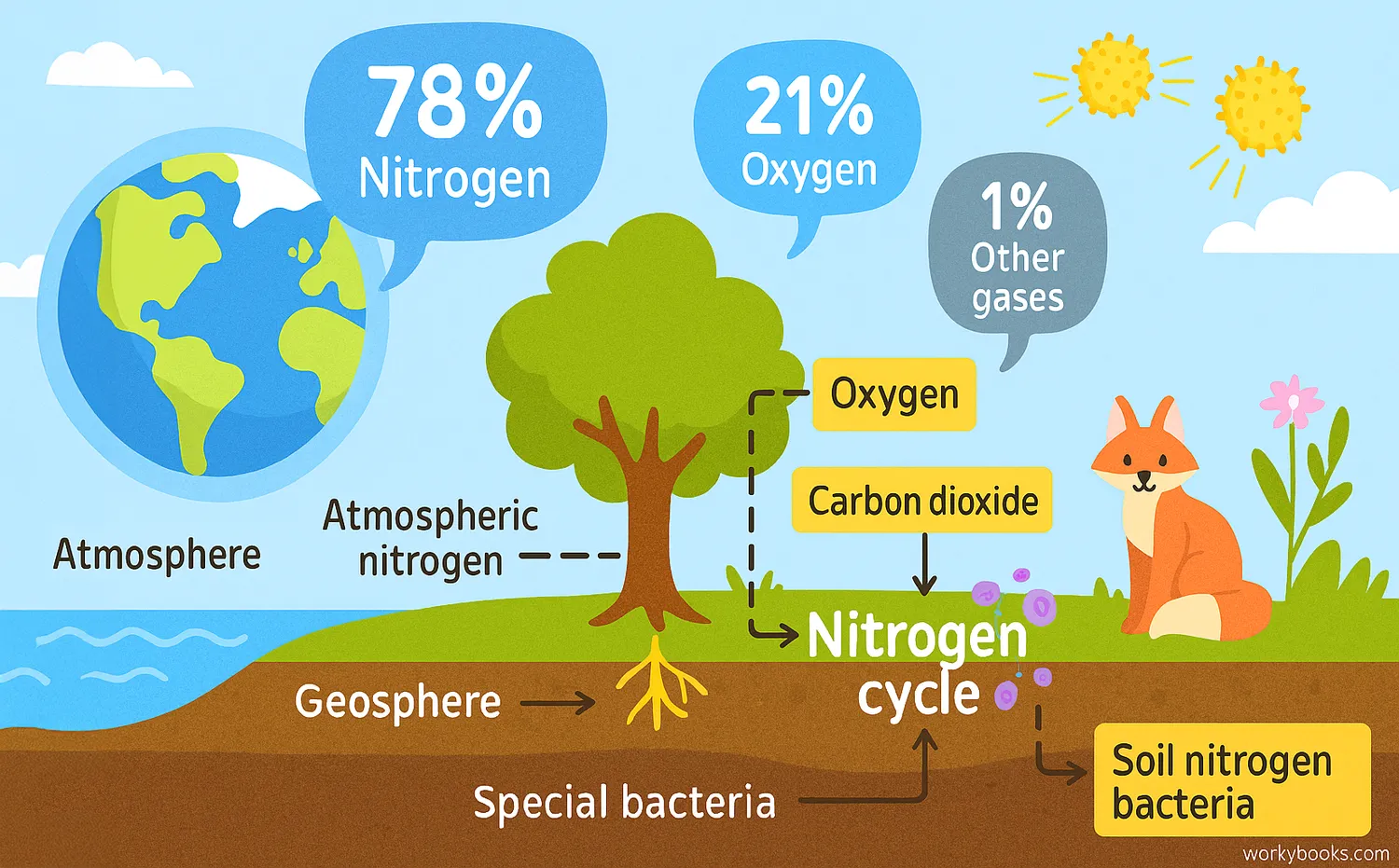
The composition of Earth's atmosphere, highlighting nitrogen as the most abundant gas, and depicts the nitrogen cycle where atmospheric nitrogen is converted into a usable form for life.
The Earth's atmosphere is a crucial, protective blanket of gases surrounding our planet. It provides the air we breathe and shields us from harmful solar radiation. While we often think of oxygen as the most important gas, it is actually nitrogen that is the most abundant, making up about 78% of the atmosphere. Oxygen is the second most common, comprising approximately 21%, with the remaining 1% consisting of other gases like argon, carbon dioxide, and neon.
Nitrogen's abundance is vital for life, but its atmospheric form, N2, is not directly usable by most organisms. The strong triple bond holding the two nitrogen atoms together makes the gas largely unreactive. To become useful, nitrogen must undergo a process called nitrogen fixation, which converts it into compounds like ammonia (NH3) that plants can absorb. This process is primarily carried out by specialized bacteria found in the soil and on the roots of certain plants, such as legumes. Lightning strikes can also provide enough energy to fix a small amount of nitrogen.
Once nitrogen is fixed, it becomes a key building block for life. It is an essential component of amino acids, which form proteins, and nucleic acids, which make up our DNA and RNA. Animals get the nitrogen they need by consuming plants or other animals that have incorporated fixed nitrogen into their tissues. The cycling of nitrogen through the atmosphere, soil, and living organisms is known as the nitrogen cycle, a fundamental process that sustains ecosystems. Without this cycle, the abundant nitrogen in the atmosphere would remain unavailable, and life as we know it would not exist.
Fun Fact: Nitrogen is also a key ingredient in many industrial products. Liquid nitrogen, with its extremely low temperature of -196°C (-321°F), is used in cryogenics for preserving biological samples and even in some forms of cooking to create instant freezing effects.
What is the most abundant gas in Earth's atmosphere?
OxygenNitrogenCarbon dioxideArgon
Approximately what percentage of the atmosphere is made up of nitrogen?
21%50%78%99%
What process converts atmospheric nitrogen into a usable form for plants?
Which of the following is an example of an organism that performs nitrogen fixation?
AnimalsSpecialized bacteriaHumansFungi
What is the primary reason atmospheric nitrogen is not directly usable by most living things?
It is a noble gas.It is a liquid at room temperature.The nitrogen atoms are bonded very strongly.It is too heavy for organisms to absorb.
According to the passage, what would be the result if the nitrogen cycle did not exist?
The amount of oxygen would increase.Animals would get nitrogen directly from the atmosphere.Life as we know it would not be sustained.Plants would use atmospheric nitrogen directly.
What is the main idea of this reading passage?
The importance of oxygen in the atmosphere.How nitrogen is the most abundant and essential gas.The process of lightning strikes in the atmosphere.The composition of all gases in the atmosphere.
A scientist discovers a new type of plant that can directly absorb and use atmospheric nitrogen. This new plant would most likely:
need a lot more sunlight to grow.not rely on nitrogen-fixing bacteria.be unable to produce proteins or DNA.release oxygen into the atmosphere.
Perfect For:
👩🏫 Teachers
• Reading comprehension practice
• Auto-graded assessments
• Literacy skill development
👨👩👧👦 Parents
• Reading practice at home
• Comprehension improvement
• Educational reading time
🏠 Homeschoolers
• Reading curriculum support
• Independent reading practice
• Progress monitoring
Reading Features:
📖
Reading Passage
Engaging fiction or nonfiction text
❓
Comprehension Quiz
Auto-graded questions
📊
Instant Feedback
Immediate results and scoring
📄
Printable Version
Download for offline reading
🔊
Read Aloud
Voice-over with word highlighting
Reviews & Ratings
No reviews yet. Be the first to share your experience!
Related Content
Earth: Our Home in Space
This engaging Grade 4-5 science passage, aligned to NGSS, introduces students to Earth's special place in the solar syst...
Tools and Technology in Earth Science
This middle school science reading passage explores the wide range of tools and technologies used in Earth science, from...
MS-ESS2-2MS-ESS3-2MS-ETS1-1MS-PS4-3
Earth's Place in the Universe
This reading passage explains Earth's place in the universe, supporting NGSS 1-ESS1-1. It describes how Earth is one of ...
1-ESS1-1
Scientific Inquiry in Earth Science
This passage explores scientific inquiry in Earth science for grades 6-8, aligned with NGSS standards MS-ESS1-4, MS-ESS2...
MS-ESS1-4MS-ESS2-1MS-ESS3-5SEP
What Is Space Weather and How Does It Affect the Earth?
This NGSS-aligned science passage for middle school explains what space weather is and how it affects Earth. Students le...
MS-ESS2-2
Escape Velocity and Space Travel
This middle school science passage introduces students to the concept of escape velocity—the minimum speed required to b...
MS-ESS1-2MS-PS2-4
Space Stations
This informational science reading passage for grades 6-8 explores the complex systems and technology behind space stati...
MS-ESS1-3MS-ETS1-1
What Is Earth Science?
This engaging middle school science passage introduces students to the field of Earth science, aligning with NGSS standa...
MS-ESS1MS-ESS2MS-ESS3SEP
The Space Garden
This innovative passage combines plant science with space exploration, aligning with NGSS standards for life sciences an...
RL.3.1RL.2.1RL.4.9
Measuring Distances in Space
This middle school science passage explores how astronomers measure the vast distances in space, aligning with NGSS stan...
MS-ESS1-3
Earth: Our Home Planet
This comprehensive science passage for grades 6-8 explores Earth’s unique characteristics and the interconnected systems...
MS-ESS1-2
Meteorite Impacts on Earth
This engaging science reading passage for Grades 4-5 explores meteorite impacts on Earth, aligning with NGSS standards. ...
Exploring Space: Rockets and Spacecraft
Space exploration has been one of humanity's greatest achievements, made possible by rockets and spacecraft. Rockets act...
RI.4.4RI.4.2
Earth's Rotation
This middle school science passage, aligned with NGSS standard MS-ESS1-1, focuses on Earth's rotation—how Earth spins on...
MS-ESS1-1
Facts About Earth
This engaging science reading passage introduces Grade 4 and 5 students to Earth, our home planet. Aligned with NGSS sta...
Earth's Moon Facts
This engaging science passage, 'The Moon: Earth's Companion,' is designed for Grade 4-5 students and aligns with NGSS ge...
Earth's Seasons
This comprehensive reading passage for grades 6-8 explains why Earth has seasons, revealing the scientific mechanisms be...
MS-ESS1-1
International Space Station
Discover the wonders of the International Space Station with this informative coloring page showcasing the orbiting outpost where astronauts live and work in space. As children color the complex modul...
Venus: Earth's Twin?
This comprehensive science passage for grades 6-8 examines Venus—often called Earth's twin—by exploring its similarities...
MS-ESS1-2MS-ESS1-3
What Makes Earth Perfect for Life?
This Grade 4-5 science passage, aligned with NGSS standards, explores the essential features that make Earth the perfect...