Reading PassagePremium

What Is the Night Sky

Interactive passage with audio narration, comprehension questions, and printable PDF.

No ratings yet
Grades 5–8ScienceElaEnglish · SpanishInteractive · Printable
Aligned toMS-ESS1-1
Just this resource
$1.50
One-time purchase
Best value
Unlock everything
$49.99$29.99/yr
40% off until Aug 1 — 10,000+ resources
Renews at $49.99/year.
Unlock above to use these actions

What's included

Reading passage
Audio narration
Comprehension quiz
Writing activity
Glossary & flashcards
Differentiated version
Spanish translation

What Is the Night Sky preview and details

About this printable What Is the Night Sky science reading passage, NGSS-aligned (Grades 5-8)

This engaging 400-500 word reading passage introduces middle school students (grades 6-8) to the night sky and celestial observation. Aligned with NGSS MS-ESS1-1 and MS-ESS1.A standards, the passage explores what students can see when looking up after sunset, including stars, planets, the Moon, meteors, and satellites. Students learn how light pollution affects visibility and why rural areas offer better views of space. The passage includes real-world connections to astronomical observation and explains why understanding the night sky matters for science and culture. Audio-integrated content supports diverse learners, while differentiated versions accommodate English Language Learners and struggling readers. Comprehensive activities include multiple-choice questions, writing prompts, and graphic organizers that develop scientific thinking skills. Glossary terms build essential vocabulary for earth and space science concepts.
Written by Workybooks TeamPublished by Workybooks
Preview

Sample passage and quiz from What Is the Night Sky

Reading passage and comprehension quiz preview

What Is the Night Sky
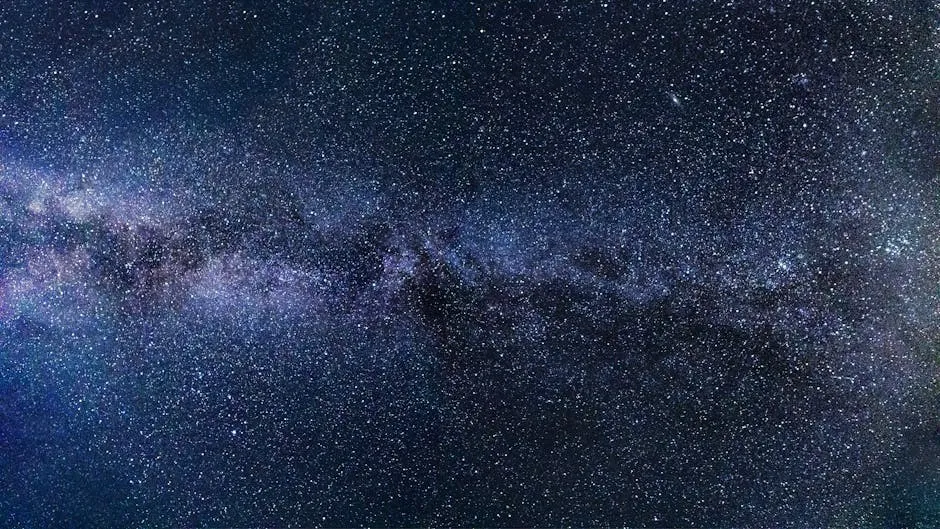
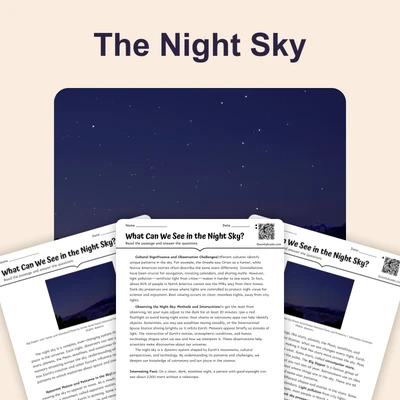
A breathtaking view of the starry night sky showcasing the Milky Way galaxy. Perfect for celestial themes.

The night sky is the view of space we see from Earth after the Sun sets. When darkness falls, we can observe many celestial objects beyond our planet. These objects include stars, planets, the Moon, and sometimes meteors and satellites. . Image by Felix Mittermeier / Pexels.

The night sky is the view of space we see from Earth after the Sun sets. When darkness falls, we can observe many celestial objects beyond our planet. These objects include stars, planets, the Moon, and sometimes meteors and satellites. Scientists study the night sky to learn about our universe and Earth's place in it.

Stars are massive balls of hot gas that produce their own light. The light we see from stars has traveled across space for many years. Planets in our solar system also appear in the night sky. Unlike stars, planets do not produce their own light. Instead, they reflect sunlight, which makes them visible from Earth. The Moon is Earth's natural satellite and appears as the brightest object in the night sky. Evidence shows that meteors, or shooting stars, are pieces of rock that burn up in Earth's atmosphere. Human-made satellites also orbit Earth and can be seen moving steadily across the sky.

Light pollution from cities significantly affects what we can observe in the night sky. Electric lights from buildings, streets, and vehicles create a glow that blocks the view of fainter stars. In urban areas, people may see only a few dozen bright stars. However, dark rural areas far from cities reveal thousands of stars. Scientists explain that reducing light pollution helps both astronomical observation and wildlife that depends on natural darkness.

The Atacama Desert in Chile provides one of the clearest views of the night sky on Earth. This region has very little light pollution and dry air conditions. Scientists have built several major observatories there to study distant galaxies and stars. Astronomers use telescopes to observe objects too faint for the human eye to detect.

Understanding the night sky matters for many reasons. Observations of celestial objects help scientists learn about the formation of our solar system. The night sky also connects us to human history. Every culture throughout time has looked up and created stories to explain what they saw. Today, studying the night sky helps us understand Earth's motion in space and our connection to the broader universe.

Interesting Fact: On a perfectly clear, dark night far from city lights, the human eye can see about 2,500 stars. However, our galaxy contains more than 100 billion stars that remain invisible without telescopes.

Comprehension quiz (10 questions)

1. What is the night sky?

The view of space from Earth after the Sun sets
Only the stars visible during winter
The atmosphere surrounding Earth
The dark side of the Moon

2. How do planets differ from stars in the night sky?

Planets are larger than stars
Planets produce their own light while stars reflect sunlight
Planets reflect sunlight while stars produce their own light
Planets are always brighter than stars

3. What does the term 'light pollution' mean in the passage?

Pollution that makes light dirty
Excessive artificial light that reduces visibility of stars
Natural light from the Moon
Light that travels through space

4. According to the passage, what are meteors?

Large planets in our solar system
Human-made satellites orbiting Earth
Pieces of rock that burn up in Earth's atmosphere
Stars that produce their own light

5. Why is the Atacama Desert in Chile ideal for observing the night sky?

It has the most stars in the world
It has very little light pollution and dry air conditions
It is the darkest place on Earth
It is closest to the Moon

6. Based on the passage, what can you infer about urban areas and star visibility?

Urban areas have more stars than rural areas
Electric lights in cities make it harder to see faint stars
Cities have clearer skies than rural areas
Urban areas have no stars at all

7. How does reducing light pollution benefit both science and nature?

It makes cities brighter and safer
It helps astronomical observation and wildlife that depends on natural darkness
It increases the number of stars in the sky
It prevents meteors from entering Earth's atmosphere

8. If you wanted to see the most stars possible, where should you go?

A brightly lit city center
A dark rural area far from cities
Any location during a full moon
Near a large observatory

9. True or False: The Moon produces its own light like stars do.

True
False

10. True or False: Every culture throughout history has observed the night sky and created stories about it.

True
False
Who it's for

Perfect for the way you teach

Teachers
  • Build comprehension skills
  • Auto-graded quiz
  • Differentiated reading
Parents
  • Read together at home
  • Improve fluency
  • Quiet reading time
Homeschoolers
  • Reading curriculum support
  • Independent practice
  • Track Lexile growth
Topics

Reviews & Ratings

No reviews yet. Be the first to share your experience!

More reading you might love

20 more
Passage
What is Solar Radiation - reading educational content
Grades 3–7

What is Solar Radiation

science · MS-ESS1-1

Free
Passage
How Incoming Solar Radiation Changes with Latitude - reading educational content
Grades 3–7

How Incoming Solar Radiation Changes with Latitude

science · MS-ESS1-1

$1.50
Passage
Tides and Tidal Forces - reading educational content
Grades 5–8

Tides and Tidal Forces

science · MS-ESS1-1

$1.50
Passage
The Night Sky - reading educational content
Grades 5–8

The Night Sky

earth science · MS-ESS1-1

$1.50
Passage
Ancient Astronomy - reading educational content
Grades 5–8

Ancient Astronomy

earth science · MS-ESS1-1

$1.50
Passage
Tools of Modern Astronomy - reading educational content
Grades 5–8

Tools of Modern Astronomy

earth science · MS-ESS1-1

$1.50
Passage
How Astronomy Became a Science - reading educational content
Grades 5–8

How Astronomy Became a Science

earth science · MS-ESS1-1

$1.50
Passage
Earth's Rotation - reading educational content
Grades 5–8

Earth's Rotation

science · MS-ESS1-1

$1.50
Passage
Earth's Revolution - reading educational content
Grades 5–8

Earth's Revolution

science · MS-ESS1-1

$1.50
Passage
Why We Have Seasons - reading educational content
Grades 5–8

Why We Have Seasons

science · MS-ESS1-1

$1.50
Passage
Earth's Seasons - reading educational content
Grades 5–8

Earth's Seasons

science · MS-ESS1-1

$1.50
Passage
The Moon's Characteristics - reading educational content
Grades 5–8

The Moon's Characteristics

science · MS-ESS1-1

$1.50
Passage
The Sun's Characteristics - reading educational content
Grades 5–8

The Sun's Characteristics

science · MS-ESS1-1

$1.50
Passage
What Is a Galaxy? - reading educational content
Grades 5–8

What Is a Galaxy?

earth science · MS-ESS1-1

$1.50
Passage
The Milky Way: Our Home Galaxy - reading educational content
Grades 5–8

The Milky Way: Our Home Galaxy

earth science · MS-ESS1-1

$1.50
Passage
Types of Galaxies - reading educational content
Grades 5–8

Types of Galaxies

earth science · MS-ESS1-1

$1.50
Passage
The Expanding Universe - reading educational content
Grades 5–8

The Expanding Universe

earth science · MS-ESS1-1

$1.50
Passage
The Big Bang - reading educational content
Grades 5–8

The Big Bang

earth science · MS-ESS1-1

$1.50
Passage
Dark Matter and Dark Energy - reading educational content
Grades 5–8

Dark Matter and Dark Energy

earth science · MS-ESS1-1

$1.50
Passage
How Do Stars Die - reading educational content
Grades 5–8

How Do Stars Die

science · MS-ESS1-1

$1.50
Copyright © 2026 Workybooks. Made with ♥ in California.