What is the Relationship between the Oxygen Cycle and the Carbon Cycle? — Reading Comprehension
Rate this
Premium Resource
Present
Present in classroom. No work saved
Assign
Classroom with student accounts, Track progress
Quick Play
No student accounts, assign with a link
Grades
3
4
5
6
7
8
PRINT+DIGITAL RESOURCE
This learning resource is available in interactive and printable formats. The interactive worksheet can be played online and assigned to students. The Printable PDF version can be downloaded and printed for completion by hand.
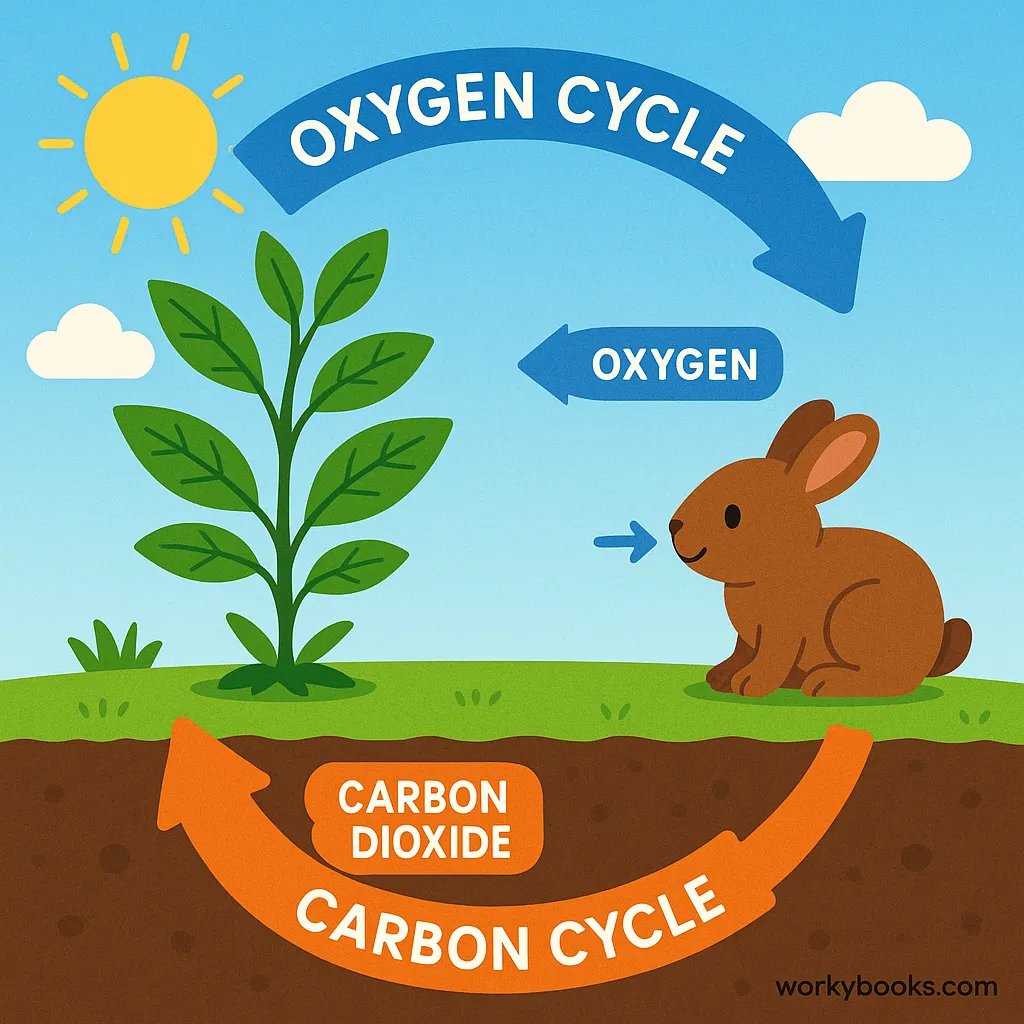
"This reading passage, designed for a middle school audience, explains the fundamental relationship between the oxygen cycle and the carbon cycle. It focuses on how these two vital biogeochemical cycles are interconnected through the processes of photosynthesis and cellular respiration. The passage describes how plants and other photosynthetic organisms produce oxygen and consume carbon dioxide, while animals and decomposers do the opposite. It also highlights the impact of human activities, such as the burning of fossil fuels, on the balance of these cycles. This content is aligned with NGSS standards related to matter cycling in ecosystems, providing a comprehensive overview for students to understand these essential natural processes. Key terms like photosynthesis, cellular respiration, and fossil fuels are clearly defined to enhance comprehension and vocabulary acquisition. The module includes multiple-choice questions to assess student understanding of the key concepts presented in the text."
CONTENT PREVIEW
Expand content preview
The oxygen cycle and the carbon cycle are two fundamental processes that work together to sustain life on Earth. These cycles describe how oxygen and carbon, two of the most important elements for living things, move through the atmosphere, oceans, land, and all living organisms. They are interconnected and depend on each other to maintain a stable environment. Understanding their relationship is key to understanding how ecosystems function.
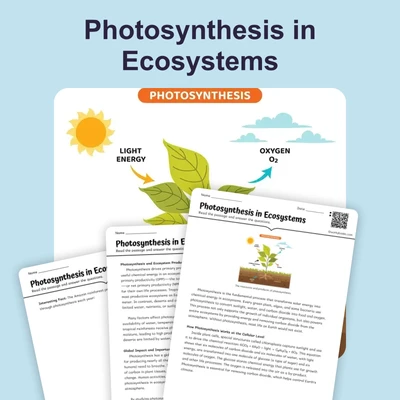
The primary connection between the two cycles is the process of photosynthesis. During photosynthesis, plants and other photosynthetic organisms, like algae, absorb carbon dioxide (CO2) from the atmosphere. They use sunlight as energy to convert the CO2 and water (H2O) into glucose (a type of sugar for food) and release oxygen (O2) as a waste product. This process is the main source of oxygen in our atmosphere. Without photosynthesis, the amount of atmospheric oxygen would drop dramatically, and the concentration of carbon dioxide would rise.
The second half of this relationship is cellular respiration, which is the reverse of photosynthesis. All living organisms—including plants, animals, and decomposers—take in oxygen to break down glucose and release the energy stored within it. A key waste product of this process is carbon dioxide, which is then released back into the atmosphere. This cycle of respiration provides the carbon dioxide that plants need for photosynthesis, effectively closing the loop.
Human activities can disrupt the balance of these cycles. The burning of fossil fuels releases large amounts of carbon dioxide into the atmosphere, much faster than plants and oceans can absorb it. This excess carbon dioxide contributes to the greenhouse effect and climate change. Protecting forests and oceans is crucial because they are massive reservoirs for carbon and help regulate the cycles.
Fun Fact: The oxygen we breathe today is a product of billions of years of photosynthesis, primarily from ancient cyanobacteria in the oceans that transformed Earth's early atmosphere.
What is the primary connection between the oxygen cycle and the carbon cycle?
Cellular respirationDecompositionPhotosynthesisThe water cycle
Which of the following is released as a waste product during photosynthesis?
GlucoseWaterCarbon dioxideOxygen
How do animals contribute to the carbon cycle?
By releasing oxygen during respiration.By absorbing carbon dioxide for energy.By releasing carbon dioxide during respiration.By producing glucose from sunlight.
What is the role of photosynthesis in the oxygen cycle?
It consumes oxygen.It produces oxygen.It consumes carbon dioxide.It releases glucose.
Based on the passage, what would happen if there were no plants on Earth?
The amount of atmospheric oxygen would increase.The amount of carbon dioxide would decrease.The amount of atmospheric oxygen would decrease.The atmosphere would become cooler.
The passage suggests that the burning of fossil fuels primarily affects which part of the cycles?
It decreases atmospheric oxygen.It decreases atmospheric carbon dioxide.It increases the amount of glucose.It increases atmospheric carbon dioxide.
What is the main idea of this reading passage?
How photosynthesis and respiration work.The importance of fossil fuels.The interconnectedness of the oxygen and carbon cycles.The role of decomposers in ecosystems.
A student observes a sealed jar containing a small plant and a snail. The plant uses sunlight to perform photosynthesis, and the snail breathes. What is the most likely exchange of gases occurring in the jar?
The plant provides carbon dioxide for the snail, and the snail provides water for the plant.The plant provides oxygen for the snail, and the snail provides carbon dioxide for the plant.The plant and the snail are both competing for oxygen.The snail provides sunlight for the plant, and the plant provides food for the snail.
Perfect For:
👩🏫 Teachers
• Reading comprehension practice
• Auto-graded assessments
• Literacy skill development
👨👩👧👦 Parents
• Reading practice at home
• Comprehension improvement
• Educational reading time
🏠 Homeschoolers
• Reading curriculum support
• Independent reading practice
• Progress monitoring
Reading Features:
📖
Reading Passage
Engaging fiction or nonfiction text
❓
Comprehension Quiz
Auto-graded questions
📊
Instant Feedback
Immediate results and scoring
📄
Printable Version
Download for offline reading
🔊
Read Aloud
Voice-over with word highlighting
Reviews & Ratings
No reviews yet. Be the first to share your experience!
Related Content
Earth: Our Home in Space
This engaging Grade 4-5 science passage, aligned to NGSS, introduces students to Earth's special place in the solar syst...
Tools and Technology in Earth Science
This middle school science reading passage explores the wide range of tools and technologies used in Earth science, from...
MS-ESS2-2MS-ESS3-2MS-ETS1-1MS-PS4-3
Earth's Place in the Universe
This reading passage explains Earth's place in the universe, supporting NGSS 1-ESS1-1. It describes how Earth is one of ...
1-ESS1-1
Scientific Inquiry in Earth Science
This passage explores scientific inquiry in Earth science for grades 6-8, aligned with NGSS standards MS-ESS1-4, MS-ESS2...
MS-ESS1-4MS-ESS2-1MS-ESS3-5SEP
What Is Space Weather and How Does It Affect the Earth?
This NGSS-aligned science passage for middle school explains what space weather is and how it affects Earth. Students le...
MS-ESS2-2
Escape Velocity and Space Travel
This middle school science passage introduces students to the concept of escape velocity—the minimum speed required to b...
MS-ESS1-2MS-PS2-4
Space Stations
This informational science reading passage for grades 6-8 explores the complex systems and technology behind space stati...
MS-ESS1-3MS-ETS1-1
What Is Earth Science?
This engaging middle school science passage introduces students to the field of Earth science, aligning with NGSS standa...
MS-ESS1MS-ESS2MS-ESS3SEP
The Space Garden
This innovative passage combines plant science with space exploration, aligning with NGSS standards for life sciences an...
RL.3.1RL.2.1RL.4.9
Measuring Distances in Space
This middle school science passage explores how astronomers measure the vast distances in space, aligning with NGSS stan...
MS-ESS1-3
Earth: Our Home Planet
This comprehensive science passage for grades 6-8 explores Earth’s unique characteristics and the interconnected systems...
MS-ESS1-2
Meteorite Impacts on Earth
This engaging science reading passage for Grades 4-5 explores meteorite impacts on Earth, aligning with NGSS standards. ...
Exploring Space: Rockets and Spacecraft
Space exploration has been one of humanity's greatest achievements, made possible by rockets and spacecraft. Rockets act...
RI.4.4RI.4.2
Earth's Rotation
This middle school science passage, aligned with NGSS standard MS-ESS1-1, focuses on Earth's rotation—how Earth spins on...
MS-ESS1-1
Facts About Earth
This engaging science reading passage introduces Grade 4 and 5 students to Earth, our home planet. Aligned with NGSS sta...
Earth's Moon Facts
This engaging science passage, 'The Moon: Earth's Companion,' is designed for Grade 4-5 students and aligns with NGSS ge...
International Space Station
Discover the wonders of the International Space Station with this informative coloring page showcasing the orbiting outpost where astronauts live and work in space. As children color the complex modul...
Earth's Seasons
This comprehensive reading passage for grades 6-8 explains why Earth has seasons, revealing the scientific mechanisms be...
MS-ESS1-1
Venus: Earth's Twin?
This comprehensive science passage for grades 6-8 examines Venus—often called Earth's twin—by exploring its similarities...
MS-ESS1-2MS-ESS1-3
The Space Needle
Students read a passage about the history and features of Seattle's Space Needle, then answer comprehension questions to...