Reading PassagePremium

What Makes Earth a Giant Magnet

Interactive passage with audio narration, comprehension questions, and printable PDF.

No ratings yet|
1
Grades 5–8ScienceElaEnglish · SpanishInteractive · Printable
Aligned toMS-ESS2-1
Just this resource
$1.50
One-time purchase
Best value
Unlock everything
$49.99$29.99/yr
40% off until Aug 1 — 10,000+ resources
Renews at $49.99/year.
Unlock above to use these actions

What's included

Reading passage
Audio narration
Comprehension quiz
Writing activity
Glossary & flashcards
Differentiated version
Spanish translation

What Makes Earth a Giant Magnet preview and details

About this printable What Makes Earth a Giant Magnet science reading passage, NGSS-aligned (Grades 5-8)

This comprehensive 400-500 word reading passage explores how Earth functions as a giant magnet through the geodynamo process. Students in grades 6-8 will learn how the outer core's liquid iron generates Earth's magnetic field through convection currents and rotation. The passage is aligned with NGSS standard MS-ESS2-1 and disciplinary core idea MS-ESS2.A, connecting Earth's internal processes to its magnetic properties. Audio-integrated content includes a grade-level passage, simplified version for struggling readers, Spanish translations, glossary of key terms, multiple-choice comprehension questions, writing activities, and graphic organizers. Students will understand how moving molten metal creates electricity and flowing electricity generates magnetism on a planetary scale. The lesson emphasizes evidence-based scientific explanations and includes real-world examples of Earth's magnetic field in action.
Written by Workybooks TeamPublished by Workybooks
Preview

Sample passage and quiz from What Makes Earth a Giant Magnet

Reading passage and comprehension quiz preview

What Makes Earth a Giant Magnet
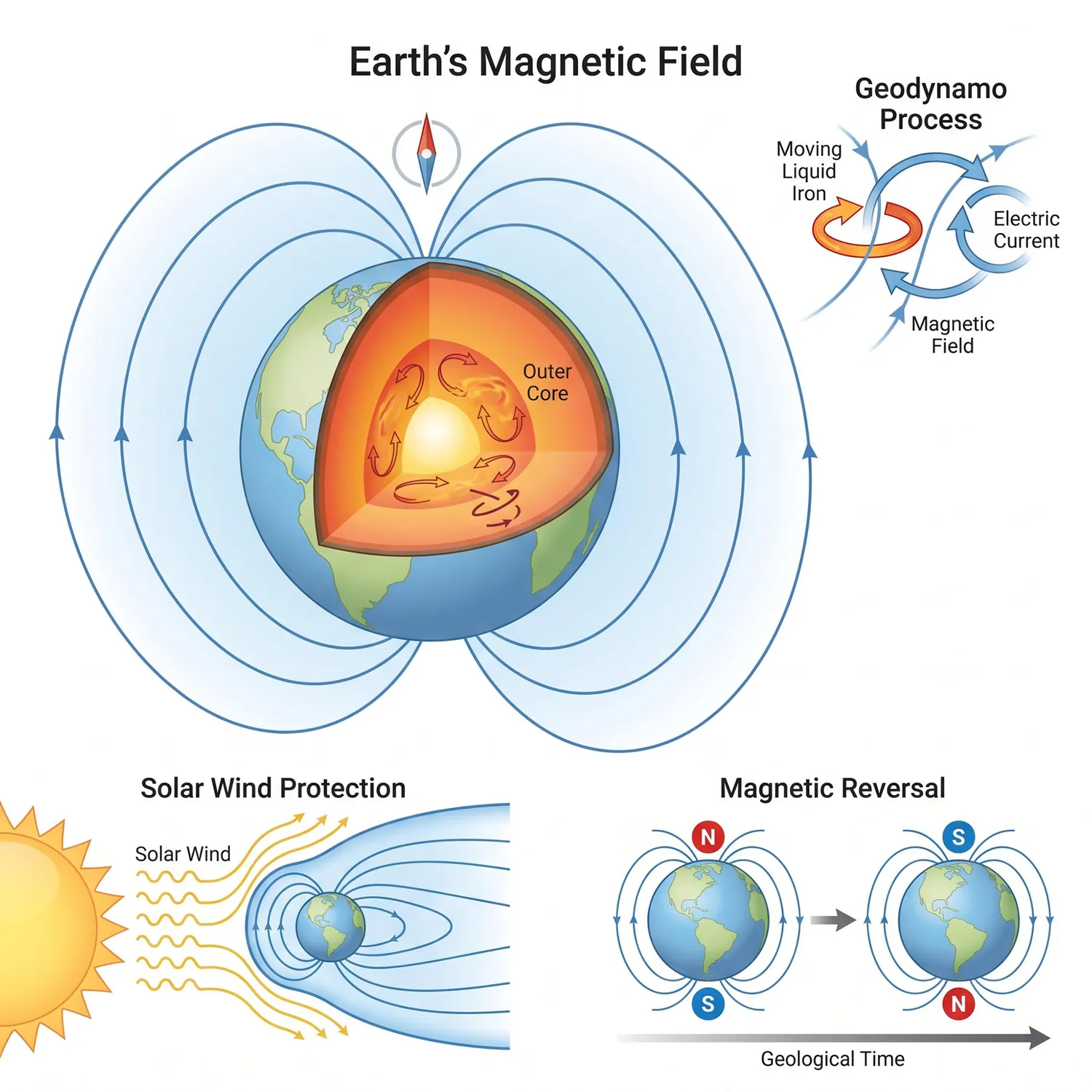
Earth's magnetic field generated by the geodynamo inside the liquid outer core
Earth's geodynamo creates the magnetic field protecting our planet from solar wind.

Earth behaves like an enormous magnet surrounded by an invisible magnetic field. This field stretches far into space and affects everything from compass needles to migrating birds. Scientists explain that Earth's magnetic properties do not come from a giant iron bar buried inside our planet. Instead, the field forms through a process called the geodynamo, which operates deep within Earth's outer core.

The outer core is a vast ocean of liquid iron located about 2,900 kilometers below Earth's surface. This layer remains molten because of extreme heat from the planet's interior. The liquid iron does not sit still. Instead, it churns in powerful convection currents driven by temperature differences. Hot iron rises toward the mantle while cooler iron sinks back down. Earth's rotation adds another force, stirring and twisting these currents in complex patterns.

Moving metal creates a remarkable effect. When liquid iron flows through Earth's existing magnetic field, it generates electric currents. These electric currents then produce their own magnetic fields. The process feeds itself in a continuous cycle. Flowing electricity creates magnetism, and that magnetism influences the moving iron to generate more electricity. Scientists call this self-sustaining system the geodynamo. The process operates constantly and on a planetary scale.

Evidence shows that Earth's magnetic field protects our planet in important ways. The field deflects harmful charged particles from the sun, called solar wind. Without this protection, these particles could strip away Earth's atmosphere over time. In 1989, a powerful surge of solar wind disrupted Earth's magnetic field and caused electrical blackouts across Quebec, Canada. The event affected six million people and demonstrated how Earth's magnetic field shields our technology and infrastructure.

Understanding Earth's magnetic field helps scientists study our planet's interior. The magnetic field connects directly to the hot, convecting layers that students learn about in Earth science. A spinning, molten core makes a magnetic planet. The strength and direction of the field can change over time as convection patterns shift. Evidence from ancient rocks shows that Earth's magnetic poles have even reversed many times throughout geological history.

Interesting Fact: Earth's magnetic north pole moves about 55 kilometers per year and has been drifting from Canada toward Siberia. Scientists track this movement using satellites and ground-based measurements to update navigation systems worldwide.

Comprehension quiz (10 questions)

1. What is the geodynamo?

A giant iron bar buried inside Earth
A process in Earth's outer core that generates the magnetic field
A type of compass used by scientists
The rotation of Earth around the sun

2. Where is Earth's outer core located?

At the surface of Earth
In the atmosphere above Earth
About 2,900 kilometers below Earth's surface
At the North and South Poles

3. What does the term 'convection currents' mean in the passage?

Electric currents flowing through wires
Ocean currents on Earth's surface
Circular movement of fluid where hot material rises and cool material sinks
Wind patterns in the atmosphere

4. According to the passage, what is 'solar wind'?

Wind that blows during sunny days
A stream of charged particles from the sun
Air currents in Earth's atmosphere
Magnetic field lines from Earth

5. How does moving liquid iron in the outer core create Earth's magnetic field?

The iron absorbs magnetism from space
The iron cools down and becomes solid
Moving iron generates electric currents, which produce magnetic fields
The iron reflects sunlight back into space

6. What real-world event in 1989 demonstrated the importance of Earth's magnetic field?

A volcanic eruption in Iceland
An earthquake in California
Electrical blackouts in Quebec caused by solar wind
A tsunami in the Pacific Ocean

7. Why does the passage say Earth's outer core remains liquid?

Because of extreme heat from the planet's interior
Because it is exposed to cold temperatures
Because it contains water from the oceans
Because it is close to Earth's surface

8. What can happen to Earth's magnetic poles over geological time?

They stay in exactly the same position forever
They can reverse or switch places
They disappear completely
They move to the equator

9. True or False: Earth's magnetic field is created by a giant iron bar buried inside the planet.

True
False

10. True or False: Earth's magnetic north pole moves about 55 kilometers per year.

True
False
Who it's for

Perfect for the way you teach

Teachers
  • Build comprehension skills
  • Auto-graded quiz
  • Differentiated reading
Parents
  • Read together at home
  • Improve fluency
  • Quiet reading time
Homeschoolers
  • Reading curriculum support
  • Independent practice
  • Track Lexile growth
Topics

Reviews & Ratings

No reviews yet. Be the first to share your experience!

More reading you might love

20 more
Passage
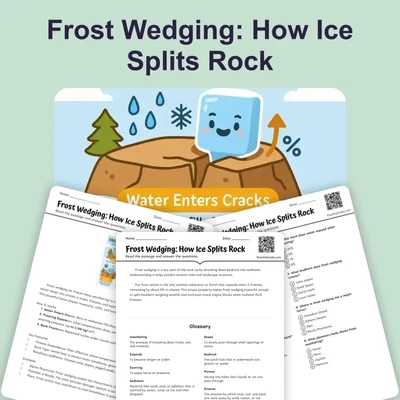
Frost Wedging: How Ice Splits Rock - reading educational content
Grades 5–8

Frost Wedging: How Ice Splits Rock

earth and space science · MS-ESS2-1

$1.50
Passage
Limestone Caves: Nature’s Underground Wonders - reading educational content
Grades 5–8

Limestone Caves: Nature’s Underground Wonders

science · MS-ESS2-1

Free
Passage
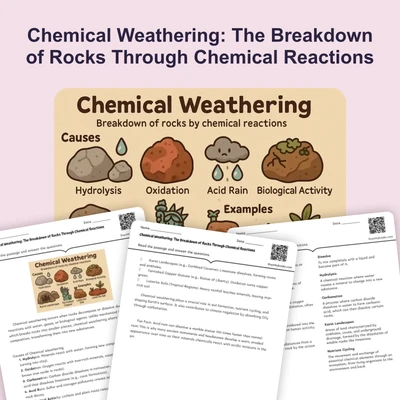
Chemical Weathering: The Breakdown of Rocks Through Chemical Reactions - reading educational content
Grades 5–8

Chemical Weathering: The Breakdown of Rocks Through Chemical Reactions

earth and space science · MS-ESS2-1

Free
Passage
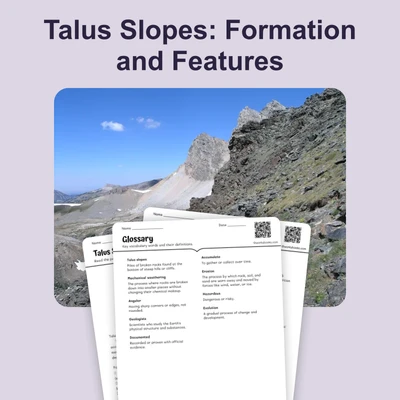
Talus Slopes: Formation and Features - reading educational content
Grades 5–8

Talus Slopes: Formation and Features

science · MS-ESS2-1

Free
Passage
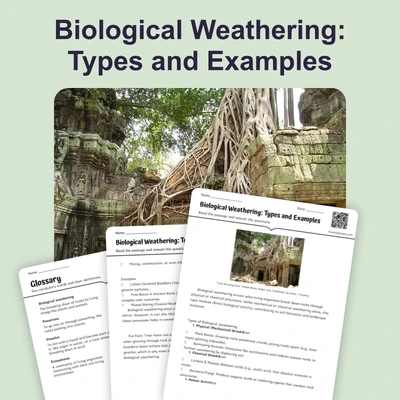
Biological Weathering: Types and Examples - reading educational content
Grades 5–8

Biological Weathering: Types and Examples

science · MS-ESS2-1

Free
Passage
The Coldest City in the World: Yakutsk - reading educational content
Grades 5–8

The Coldest City in the World: Yakutsk

weather and climate · MS-ESS2-1

$1.50
Passage
Igneous Rocks - reading educational content
Grades 5–8

Igneous Rocks

earth and space science · MS-ESS2-1

$1.50
Passage
Sedimentary Rocks - reading educational content
Grades 5–8

Sedimentary Rocks

earth and space science · MS-ESS2-1

$1.50
Passage
Metamorphic Rocks - reading educational content
Grades 5–8

Metamorphic Rocks

earth and space science · MS-ESS2-1

Free
Passage
Scientific Inquiry in Earth Science - reading educational content
Grades 5–8

Scientific Inquiry in Earth Science

earth and space science · MS-ESS1-4

$1.50
Passage
Contour Lines and Elevation - reading educational content
Grades 5–8

Contour Lines and Elevation

earth and space science · MS-ESS2-2

$1.50
Passage
Weathering - reading educational content
Grades 5–8

Weathering

earth and space science · MS-ESS2-1

$1.50
Passage
Erosion - reading educational content
Grades 5–8

Erosion

earth and space science · MS-ESS2-1

$1.50
Passage
Stream Erosion and Deposition - reading educational content
Grades 5–8

Stream Erosion and Deposition

earth and space science · MS-ESS2-1

$1.50
Passage
Wind Erosion and Deposition - reading educational content
Grades 5–8

Wind Erosion and Deposition

earth and space science · MS-ESS2-1

$1.50
Passage
Glacial Erosion and Deposition - reading educational content
Grades 5–8

Glacial Erosion and Deposition

earth and space science · MS-ESS2-1

$1.50
Passage
Mass Movements - reading educational content
Grades 5–8

Mass Movements

science · MS-ESS2-1

$1.50
Passage
Soil Formation and Composition - reading educational content
Grades 5–8

Soil Formation and Composition

earth and space science · MS-ESS2-1

$1.50
Passage
Constructive and Destructive Forces - reading educational content
Grades 5–8

Constructive and Destructive Forces

earth and space science · MS-ESS2-1

Free
Passage
Mountains and Mountain Building - reading educational content
Grades 5–8

Mountains and Mountain Building

earth and space science · MS-ESS2-1

$1.50
Copyright © 2026 Workybooks. Made with ♥ in California.