Reading PassagePremium

What Produces Heat Inside Earth

Interactive passage with audio narration, comprehension questions, and printable PDF.

No ratings yet|
1
Grades 5–8ScienceElaEnglish · SpanishInteractive · Printable
Aligned toMS-ESS2-1
Just this resource
$1.50
One-time purchase
Best value
Unlock everything
$49.99$29.99/yr
40% off until Aug 1 — 10,000+ resources
Renews at $49.99/year.
Unlock above to use these actions

What's included

Reading passage
Audio narration
Comprehension quiz
Writing activity
Glossary & flashcards
Differentiated version
Spanish translation

What Produces Heat Inside Earth preview and details

About this printable What Produces Heat Inside Earth science reading passage, NGSS-aligned (Grades 5-8)

science,ela
Written by Workybooks TeamPublished by Workybooks
Preview

Sample passage and quiz from What Produces Heat Inside Earth

Reading passage and comprehension quiz preview

What Produces Heat Inside Earth
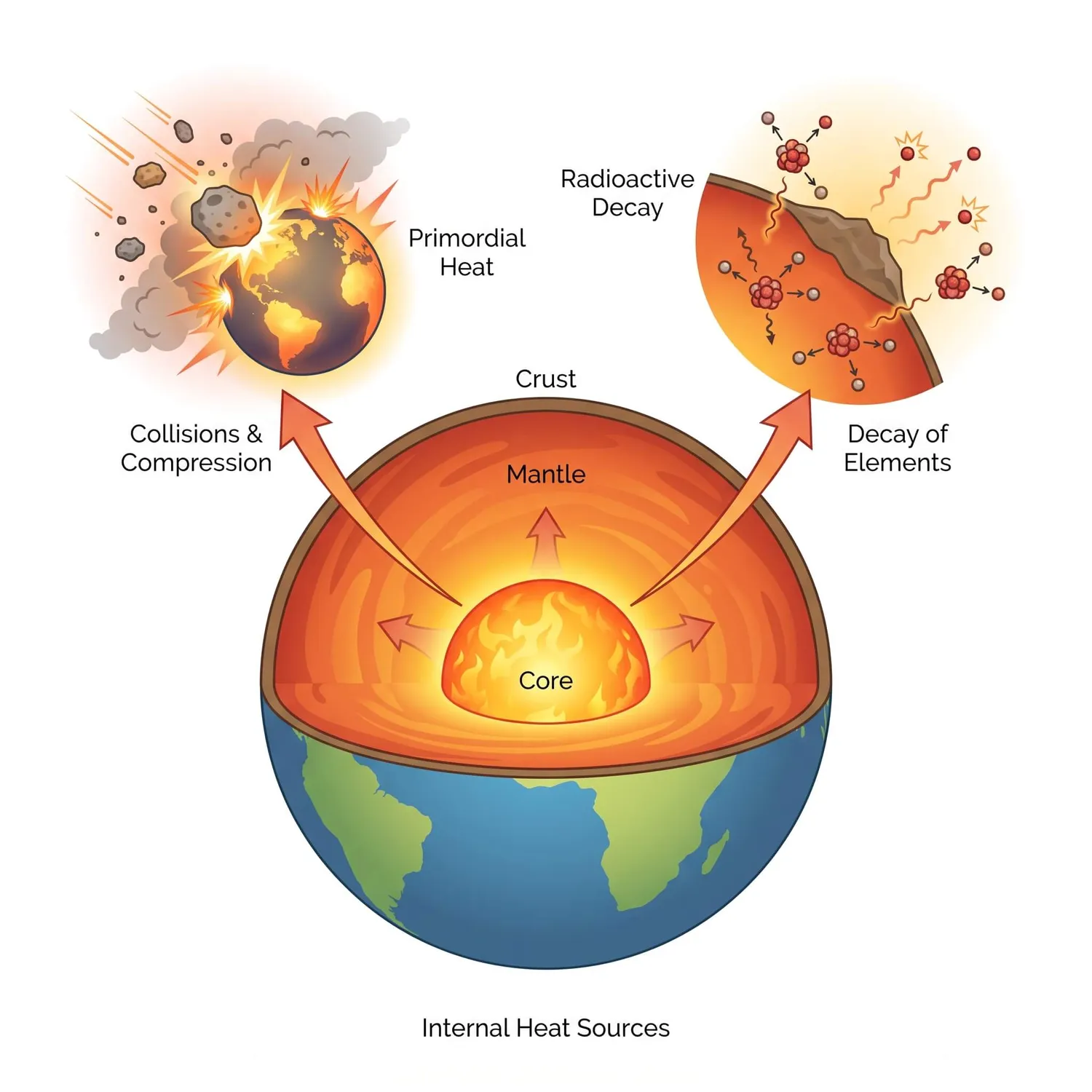
Earth's internal heat from primordial energy and radioactive decay explained diagram
Primordial heat and radioactive decay power Earth's hot interior and plate tectonics.

Where does all the heat deep inside Earth come from? Scientists explain that two main sources keep our planet's interior scorching hot. The first source is primordial heat, which is leftover energy from Earth's birth. The second source is radioactive decay, an ongoing process that continues to generate heat today.

About 4.5 billion years ago, Earth formed from countless rocks, dust, and debris crashing together in space. These collisions released enormous amounts of energy as heat. Gravity pulled all this material inward, squeezing it tightly together. This compression also generated tremendous heat, similar to how a bicycle pump gets warm when you compress air inside it. Much of this primordial heat became trapped deep within Earth's interior. Because rock is an excellent insulator, this heat escapes very slowly. Evidence shows that roughly half of Earth's internal heat still comes from this ancient energy source.

The second heat source involves radioactive elements scattered throughout Earth's rocks. Elements like uranium, thorium, and potassium are naturally unstable. Their atoms break down over time in a process called radioactive decay. When these atoms decay, they release energy as heat. This process happens continuously, acting like a built-in furnace that has been running for billions of years. Scientists estimate that radioactive decay produces the other half of Earth's internal heat. The mantle, Earth's thick middle layer, contains most of these radioactive elements.

These heat sources work together to keep Earth's interior extremely hot. The inner core may reach temperatures around 5,000 degrees Celsius. This internal heat is not just interesting—it is the fundamental energy source that powers many of Earth's processes. Heat causes material in the mantle to flow slowly, which drives plate tectonics. Plate tectonics shapes our planet's surface through earthquakes, volcanic eruptions, and mountain building. In Iceland, geothermal power plants tap into Earth's internal heat to generate electricity for homes and businesses.

Understanding Earth's heat sources helps scientists explain why our planet remains geologically active after billions of years. Unlike smaller bodies like the Moon, which cooled quickly, Earth retains enough internal heat to maintain dynamic processes. This heat drives the movement of continents, creates new ocean floor, and recycles Earth's crust. Without these two heat sources, Earth would be a cold, geologically dead world with no volcanic activity or shifting plates.

Interesting Fact: Earth loses heat through its surface at a rate of about 47 terawatts, which equals the power of 47 trillion light bulbs running continuously!

Comprehension quiz (10 questions)

1. What are the two main sources of heat inside Earth?

Primordial heat and radioactive decay
Sunlight and volcanic activity
Ocean currents and wind energy
Fossil fuels and geothermal springs

2. How did primordial heat originate in Earth?

From solar radiation heating the surface
From collisions of rocks and gravitational compression during Earth's formation
From chemical reactions in the atmosphere
From friction between tectonic plates

3. What does radioactive decay mean?

The cooling of hot rocks over time
The movement of plates on Earth's surface
The breaking down of unstable atoms that releases heat energy
The melting of ice in polar regions

4. Which layer of Earth contains most of the radioactive elements?

The crust
The mantle
The outer core
The inner core

5. According to the passage, what percentage of Earth's internal heat comes from primordial heat?

About one quarter
About half
About three quarters
Almost all of it

6. How does Earth's internal heat drive plate tectonics?

It causes water to evaporate from oceans
It makes material in the mantle flow slowly
It creates wind patterns in the atmosphere
It pulls the Moon closer to Earth

7. What real-world example does the passage give for using Earth's internal heat?

Coal mining in Australia
Solar panels in California
Geothermal power plants in Iceland
Wind turbines in Denmark

8. Why does Earth remain geologically active while the Moon does not?

Earth is larger and retains more internal heat
The Moon has more volcanoes
Earth is closer to the Sun
The Moon rotates faster

9. True or False: Rock is a poor insulator, so Earth's primordial heat escaped quickly.

True
False

10. True or False: Radioactive decay is an ongoing process that continues to generate heat today.

True
False
Who it's for

Perfect for the way you teach

Teachers
  • Build comprehension skills
  • Auto-graded quiz
  • Differentiated reading
Parents
  • Read together at home
  • Improve fluency
  • Quiet reading time
Homeschoolers
  • Reading curriculum support
  • Independent practice
  • Track Lexile growth
Topics

Reviews & Ratings

No reviews yet. Be the first to share your experience!

More reading you might love

20 more
Passage
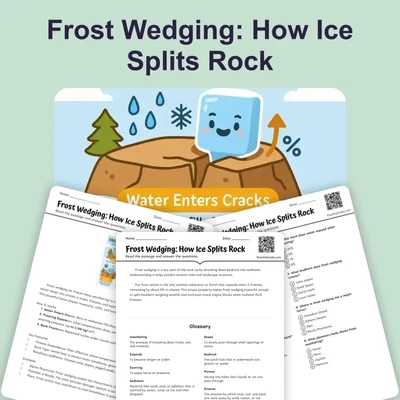
Frost Wedging: How Ice Splits Rock - reading educational content
Grades 5–8

Frost Wedging: How Ice Splits Rock

earth and space science · MS-ESS2-1

$1.50
Passage
Limestone Caves: Nature’s Underground Wonders - reading educational content
Grades 5–8

Limestone Caves: Nature’s Underground Wonders

science · MS-ESS2-1

Free
Passage
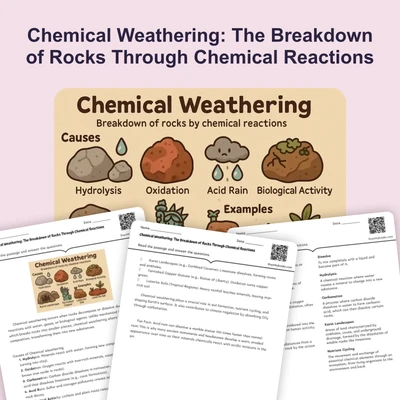
Chemical Weathering: The Breakdown of Rocks Through Chemical Reactions - reading educational content
Grades 5–8

Chemical Weathering: The Breakdown of Rocks Through Chemical Reactions

earth and space science · MS-ESS2-1

Free
Passage
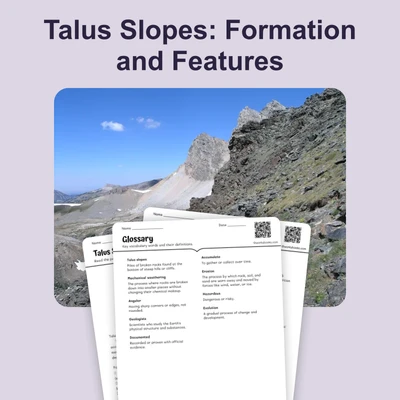
Talus Slopes: Formation and Features - reading educational content
Grades 5–8

Talus Slopes: Formation and Features

science · MS-ESS2-1

Free
Passage
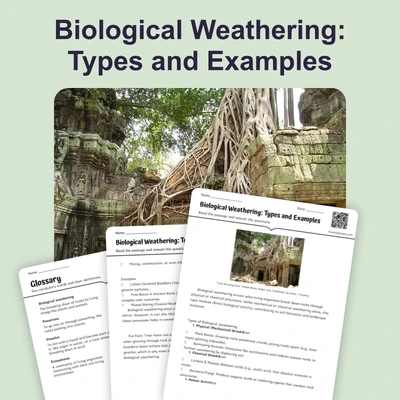
Biological Weathering: Types and Examples - reading educational content
Grades 5–8

Biological Weathering: Types and Examples

science · MS-ESS2-1

Free
Passage
The Coldest City in the World: Yakutsk - reading educational content
Grades 5–8

The Coldest City in the World: Yakutsk

weather and climate · MS-ESS2-1

$1.50
Passage
Igneous Rocks - reading educational content
Grades 5–8

Igneous Rocks

earth and space science · MS-ESS2-1

$1.50
Passage
Sedimentary Rocks - reading educational content
Grades 5–8

Sedimentary Rocks

earth and space science · MS-ESS2-1

$1.50
Passage
Metamorphic Rocks - reading educational content
Grades 5–8

Metamorphic Rocks

earth and space science · MS-ESS2-1

Free
Passage
Scientific Inquiry in Earth Science - reading educational content
Grades 5–8

Scientific Inquiry in Earth Science

earth and space science · MS-ESS1-4

$1.50
Passage
Contour Lines and Elevation - reading educational content
Grades 5–8

Contour Lines and Elevation

earth and space science · MS-ESS2-2

$1.50
Passage
Weathering - reading educational content
Grades 5–8

Weathering

earth and space science · MS-ESS2-1

$1.50
Passage
Erosion - reading educational content
Grades 5–8

Erosion

earth and space science · MS-ESS2-1

$1.50
Passage
Stream Erosion and Deposition - reading educational content
Grades 5–8

Stream Erosion and Deposition

earth and space science · MS-ESS2-1

$1.50
Passage
Wind Erosion and Deposition - reading educational content
Grades 5–8

Wind Erosion and Deposition

earth and space science · MS-ESS2-1

$1.50
Passage
Glacial Erosion and Deposition - reading educational content
Grades 5–8

Glacial Erosion and Deposition

earth and space science · MS-ESS2-1

$1.50
Passage
Mass Movements - reading educational content
Grades 5–8

Mass Movements

science · MS-ESS2-1

$1.50
Passage
Soil Formation and Composition - reading educational content
Grades 5–8

Soil Formation and Composition

earth and space science · MS-ESS2-1

$1.50
Passage
Constructive and Destructive Forces - reading educational content
Grades 5–8

Constructive and Destructive Forces

earth and space science · MS-ESS2-1

Free
Passage
Mountains and Mountain Building - reading educational content
Grades 5–8

Mountains and Mountain Building

earth and space science · MS-ESS2-1

$1.50
Copyright © 2026 Workybooks. Made with ♥ in California.