When Did Dinosaurs Live on Earth — Reading Comprehension
Rate this
Premium Resource
Present
Present in classroom. No work saved
Assign
Classroom with student accounts, Track progress
Quick Play
No student accounts, assign with a link
Grades
3
4
5
6
PRINT+DIGITAL RESOURCE
This learning resource is available in interactive and printable formats. The interactive worksheet can be played online and assigned to students. The Printable PDF version can be downloaded and printed for completion by hand.
This engaging Grade 4-5 science passage explores the fascinating world of dinosaurs, creatures that lived millions of years ago during the Mesozoic Era. Students will learn about key scientific concepts such as fossils, extinction, the differences between herbivores and carnivores, and the work of paleontologists. Important vocabulary words are highlighted and defined to build science literacy. The passage includes a real-world look at how fossils are discovered and studied, and ends with an interesting science fact. The resource aligns with NGSS standards and helps students practice reading comprehension, vocabulary, and critical thinking skills. Included are a Spanish translation, glossary, multiple-choice quiz, and writing activities that encourage students to explain scientific concepts, make connections to their own lives, and analyze cause and effect in nature. Audio integration is available to support different learning needs. Perfect for classroom or independent study.
CONTENT PREVIEW
Expand content preview
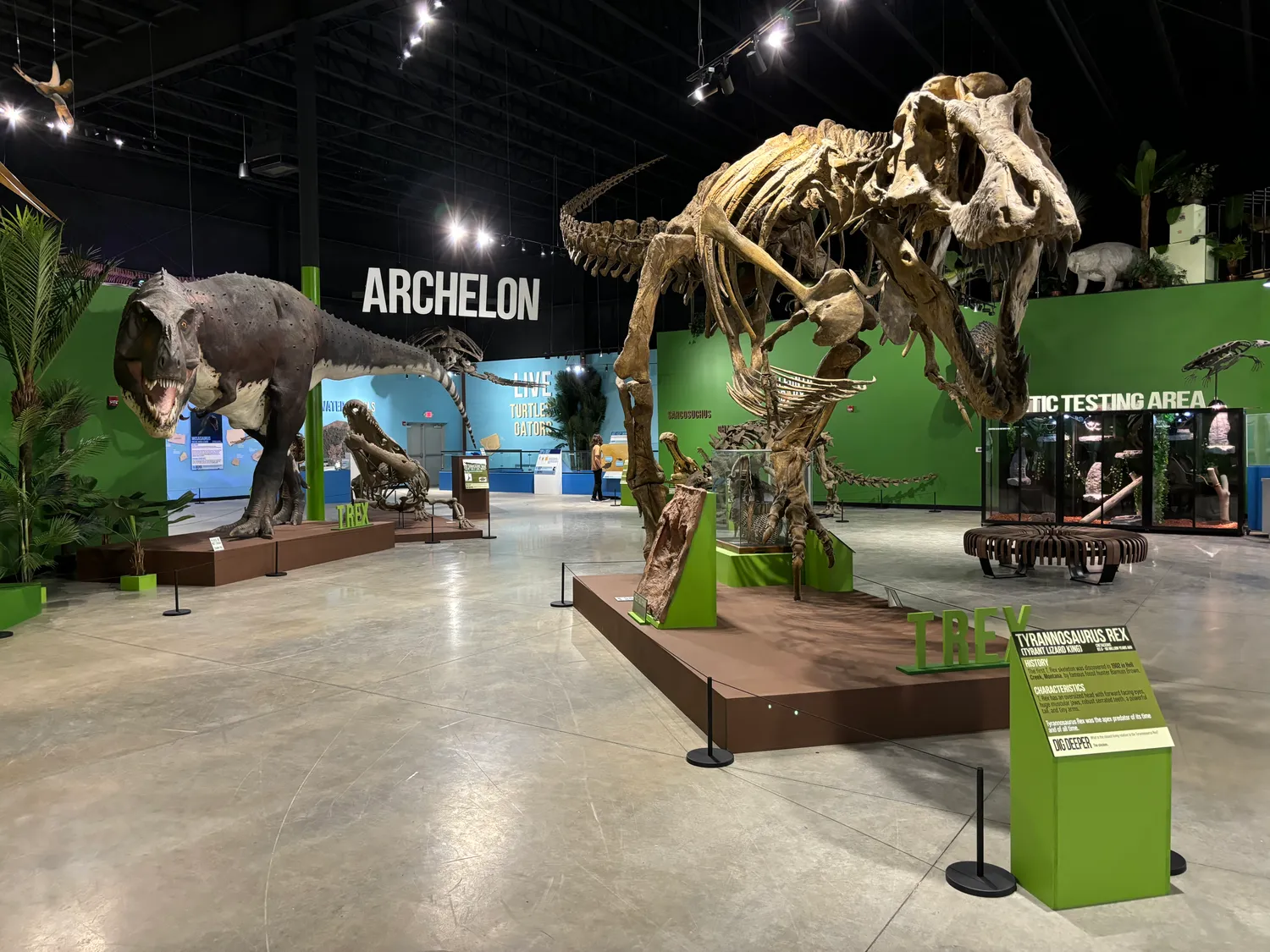
Dinosaur exhibits in the Indiana Dinosaur Museum, South Bend, Indiana. Image by CusterDome Wikimedia Commons
Dinosaurs were a group of reptiles that lived on Earth millions of years ago. They first appeared during the Mesozoic Era, which lasted from about 250 to 65 million years ago. Dinosaurs came in many shapes and sizes. Some were as small as chickens, while others, like the Brachiosaurus, were taller than a house!
Dinosaurs are divided into two main groups based on their diets. Herbivores were plant-eaters. They had flat teeth for chewing leaves and stems. Examples include Triceratops and Stegosaurus. Carnivores were meat-eaters. They had sharp teeth and claws to hunt other animals. Tyrannosaurus rex is a famous carnivore.
We know about dinosaurs because of fossils. Fossils are the remains or imprints of ancient living things. These can be bones, teeth, or even footprints, which have turned into rock over millions of years. Scientists called paleontologists study fossils to learn how dinosaurs lived, what they ate, and how they moved. Fossils are usually found in layers of rock. Finding and studying fossils helps us learn about Earth’s past.
Dinosaurs became extinct about 65 million years ago. Extinction means that all members of a group have died out. Scientists think a giant asteroid hit Earth, causing huge changes to the climate. Plants and animals could not survive, and the dinosaurs disappeared. Today, birds are considered by scientists to be the closest living relatives of dinosaurs.
Interesting Fact: Some dinosaur fossils have been found with evidence of feathers, showing that not all dinosaurs had scales!
What is a fossil?
Remains of ancient living thingsA type of plantA kind of dinosaurA scientist's tool
Which era did dinosaurs live in?
Mesozoic EraIce AgeStone AgeModern Era
What did carnivores eat?
MeatLeavesRocksWater
Why did dinosaurs become extinct?
Asteroid changed climateThey all got sickThey turned into birdsPlants disappeared
How do paleontologists learn about dinosaurs?
By studying fossilsBy reading storiesBy watching TVBy growing them
What does extinction mean?
All members die outA new animal is bornAn animal grows largerAnimals move to new places
Dinosaurs lived 1,000 years ago. True or False?
TrueFalse
What is a herbivore?
Plant-eaterMeat-eaterBirdFossil
Perfect For:
👩🏫 Teachers
• Reading comprehension practice
• Auto-graded assessments
• Literacy skill development
👨👩👧👦 Parents
• Reading practice at home
• Comprehension improvement
• Educational reading time
🏠 Homeschoolers
• Reading curriculum support
• Independent reading practice
• Progress monitoring
Reading Features:
📖
Reading Passage
Engaging fiction or nonfiction text
❓
Comprehension Quiz
Auto-graded questions
📊
Instant Feedback
Immediate results and scoring
📄
Printable Version
Download for offline reading
🔊
Read Aloud
Voice-over with word highlighting
Reviews & Ratings
No reviews yet. Be the first to share your experience!
Related Content
Tools and Technology in Earth Science
This middle school science reading passage explores the wide range of tools and technologies used in Earth science, from...
MS-ESS2-2MS-ESS3-2MS-ETS1-1MS-PS4-3
Scientific Inquiry in Earth Science
This passage explores scientific inquiry in Earth science for grades 6-8, aligned with NGSS standards MS-ESS1-4, MS-ESS2...
MS-ESS1-4MS-ESS2-1MS-ESS3-5SEP
What Is Earth Science?
This engaging middle school science passage introduces students to the field of Earth science, aligning with NGSS standa...
MS-ESS1MS-ESS2MS-ESS3SEP
Earth: Our Home in Space
This engaging Grade 4-5 science passage, aligned to NGSS, introduces students to Earth's special place in the solar syst...
Earth's Spheres
This middle school science passage introduces students to Earth's four major spheres: the geosphere, hydrosphere, atmosp...
MS-ESS2-4MS-ESS2-6
What Is Space Weather and How Does It Affect the Earth?
This NGSS-aligned science passage for middle school explains what space weather is and how it affects Earth. Students le...
MS-ESS2-2
Earth's Energy Balance
This engaging, NGSS-aligned science passage for grades 6–8 explores Earth's energy balance, a key process that keeps our...
MS-ESS2-6
Earth's Rotation
This middle school science passage, aligned with NGSS standard MS-ESS1-1, focuses on Earth's rotation—how Earth spins on...
MS-ESS1-1
Earth's Land and Water
This 250-word reading passage introduces fourth-grade students to the fundamental concept of how land and water are dist...
NGSS 4-ESS2-2ESS2.B
Earth's Interior
This comprehensive passage for grades 6-8 explores Earth's layered interior, including the crust, mantle, outer core, an...
MS-ESS2-1MS-ESS2-2
Facts About Earth
This engaging science reading passage introduces Grade 4 and 5 students to Earth, our home planet. Aligned with NGSS sta...
Meteorite Impacts on Earth
This engaging science reading passage for Grades 4-5 explores meteorite impacts on Earth, aligning with NGSS standards. ...
Venus: Earth's Twin?
This comprehensive science passage for grades 6-8 examines Venus—often called Earth's twin—by exploring its similarities...
MS-ESS1-2MS-ESS1-3
Earth Changes Over Millions of Years
This engaging, audio-integrated science passage for Grade 4-5 students explores how Earth has changed over millions of y...
Volcano Patterns on Earth
This Grade 4 science reading passage introduces students to volcano patterns on Earth, aligned with NGSS standard 4-ESS2...
NGSS 4-ESS2-2
Earth's Moon Facts
This engaging science passage, 'The Moon: Earth's Companion,' is designed for Grade 4-5 students and aligns with NGSS ge...
Earth's Quick and Slow Changes
In 'Earth's Quick and Slow Changes,' students categorize 12 Earth events by their speed of occurrence, enhancing underst...
Earth: Our Home Planet
This comprehensive science passage for grades 6-8 explores Earth’s unique characteristics and the interconnected systems...
MS-ESS1-2
Earth's Revolution
This middle school science passage explores the science behind Earth's revolution around the Sun, closely aligned with N...
MS-ESS1-1
Earthquake Patterns on Earth
This engaging 250-word reading passage introduces fourth-grade students to earthquake patterns on Earth, aligned with NG...