Where Could Life Exist Beyond Earth
Interactive passage with audio narration, comprehension questions, and printable PDF.
By completing this purchase you agree to our Terms of Use and Privacy Policy. Your subscription renews automatically until you cancel. You can cancel anytime from your account settings. All sales are final and non-refundable. Digital content is available for download in your account immediately upon purchase.
What's included
Where Could Life Exist Beyond Earth preview and details
About this printable Where Could Life Exist Beyond Earth science reading passage, NGSS-aligned (Grades 5-8)
Sample passage and quiz from Where Could Life Exist Beyond Earth
Reading passage and comprehension quiz preview
Where Could Life Exist Beyond Earth
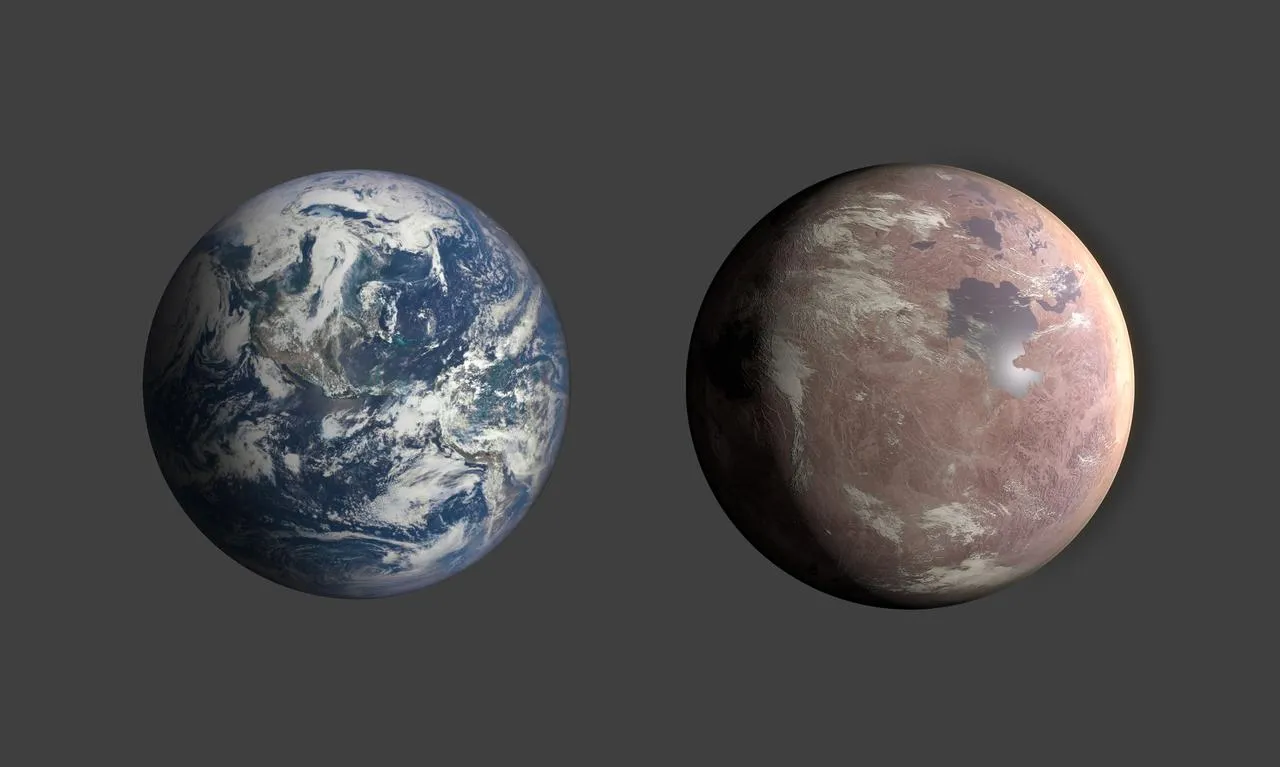
Scientists search for life beyond Earth by looking for places with conditions that could support living organisms. Life as we know it requires liquid water, energy sources, and certain chemical elements. Evidence shows that several locations in our solar system and beyond may have these essential ingredients.
Mars offers one of the most promising possibilities for life in our solar system. Scientists have found strong evidence that liquid water once flowed across the Martian surface billions of years ago. Today, Mars appears dry and cold, but researchers believe liquid water may still exist deep underground. Microbes, tiny organisms that can survive in extreme conditions, might live beneath the planet's surface. NASA's rovers have discovered organic molecules and seasonal methane releases that suggest possible biological activity.
Two icy moons in our solar system hide vast oceans beneath their frozen surfaces. Europa, a moon of Jupiter, has a global ocean of liquid water beneath an ice shell that may be several miles thick. Enceladus, a moon of Saturn, also contains a subsurface ocean. Scientists observe water vapor and ice particles shooting from cracks in Enceladus's surface. These geysers provide evidence of liquid water below. Both moons may have heat from tidal forces, which could provide energy for life.
Saturn's largest moon, Titan, presents a different environment for potential life. Titan has lakes and seas of liquid methane and ethane on its surface. While these liquids are very different from water, some scientists think life forms might use them instead. Titan also has organic molecules in its atmosphere, which are the building blocks of life.
Beyond our solar system, astronomers have discovered thousands of exoplanets, or planets orbiting other stars. Many of these worlds sit within the habitable zone, the region around a star where temperatures allow liquid water to exist on a planet's surface. The habitable zone is sometimes called the "Goldilocks zone" because conditions are not too hot or too cold. Scientists use telescopes to study exoplanet atmospheres for signs of oxygen, methane, or other gases that might indicate life.
The search for life beyond Earth matters because it helps us understand our place in the universe. Finding even simple microbes on another world would show that life can emerge in different environments. This discovery would suggest that life may be common throughout the cosmos rather than unique to Earth.
Interesting Fact: Europa's ocean may contain twice as much water as all of Earth's oceans combined, making it one of the most water-rich places in our solar system.
Comprehension quiz (10 questions)
1. What three essential ingredients does life as we know it require?
2. What evidence suggests that Mars might have life underground?
3. What does the term 'habitable zone' mean?
4. What makes Europa and Enceladus similar to each other?
5. How is Titan different from Europa and Enceladus?
6. What do geysers on Enceladus provide evidence of?
7. If scientists discovered simple microbes on Mars, what would this suggest about life in the universe?
8. Why do scientists study the atmospheres of exoplanets?
9. True or False: Liquid water once flowed on the surface of Mars billions of years ago.
10. True or False: The habitable zone is also called the 'Goldilocks zone' because conditions are not too hot or too cold.
Perfect for the way you teach
- Build comprehension skills
- Auto-graded quiz
- Differentiated reading
- Read together at home
- Improve fluency
- Quiet reading time
- Reading curriculum support
- Independent practice
- Track Lexile growth